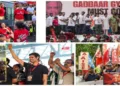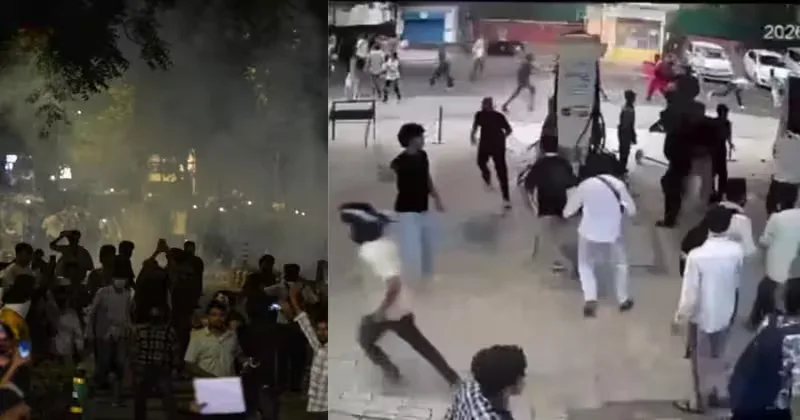
The July 20, protests staged by the Cockroach Janta Party (CJP), which turned violent, have been given a revolutionary colour, threatening the state to fix credibility and accountability crises in exam system leakages, especially concerning the NEET Exam paper leak which happened in May this year. However, were these revolutionary projections and aggressive street protests, which led to injuries on both sides, justified or even required? Or was such a level of coercion against the state necessary? This warrants a complete examination of the protest at the Jantar Mantar.
The necessity test
To test the protest and street-level hard power against the social issue, three primary conditions must be met under Just Revolution Theory.
First is just cause: A revolutionary protest should target a clear, severe violation or deep systemic injustice.
Second is last resort: Normal, peaceful, and institutional channels, such as legal petitions, dialogue, or other means, must have failed or proven entirely unresponsive. This also means that state machinery is completely ignorant of the burning issue.
Third is reasonability: The application of street power must have a credible chance of creating positive change without causing disproportionate chaos or harm to society.
Putting the Jantar Mantar 20th July protest to this three-test framework will clearly show that it barely passes any of these tests. Taking each test case by case. First, there was no sustaining or just cause. Paper leaks reforms were already announced two years back.
A comprehensive report by the Radhakrishnan Committee presented more than a hundred recommendations, which the government accepted for phased implementation. The CBT recommendations required logistical planning and were therefore implemented gradually, not immediately.
Following that report, the subsequent cycle of the NEET exam was conducted successfully. The 2026 leak was not due to a policy failure but to a lapse in human integrity, which the government acknowledged, demonstrating quick accountability by conducting the NEET re-exam within a month, without putting aspirants’ futures at stake or in limbo, and even declaring results weeks later. Where was systemic injustice done to aspirants, or have there been severe violations by the state’s system itself that it refuses to accept? Nowhere.
Second: The channels of grievance were open following the leak in May; the government immediately handed the probe to the CBI, leading to multi-state arrests and a crackdown on the syndicate, while allowing aspirants to register their dissent peacefully.
The state was not ignorant or running away from accountability, but was in the process of fixing it by launching swift investigations along with systemic relief to aspirants, easing logistical issues of swift centre allocations and providing financial relief to poor students by refunding fees; in fact, the refund was done for all 2.2 million candidates, ensuring no additional financial burden for the upcoming re-test.
However, these immediate fixes should not let the state go away with a clean chit; the state must also be tested on its intent to face broader accountability questions, i.e., fixing the systemic leakage issue and not performative actions for which protestors took to the streets, raising accountability crises, but even here they fail.
Within one month of the leak, the government also announced a binding policy directive to permanently abandon the traditional pen-and-paper Optical Mark Recognition(OMR) system and shift to Computer-Based Testing. Even during the initial Supreme Court filings in May 2026, after the paper leak, the government formally assured the court that regulatory and supervisory authorities would build a resilient “institutional memory” to permanently close data gaps and prevent future paper leaks.
Ideally, storming the streets aggressively would have been the last resort, but it became the first option against the government without carefully considering the government’s action after the exam leak. CJP went ahead and created false propaganda to stage their protest. The third and most important test this protest fails is the reasonableness test.
The protest did not promise any positive change or propose a constructive alternative; it merely spun its demands, which began with accountability and escalated to complete political demands seeking the resignation of the Union Education Minister. Moreover, the street power, meant to act as pressure, became a blackmailing game, and to up the ante, violence broke out in the heart of the capital.
The short burst campaign
The so-called revolution that sought accountability was not actual accountability; it was a mere plank for destabilisation and an opposition political revival scheme, not the ordinary framing of political demands under the garb of short-lived social movements. If the Jantar Mantar 20th July protest was meant to inspire genuine confidence of students and NEET aspirants, what was actually played out? The answer is a short campaign of limited psychological warfare to trick the youth’s consciousness and emotionally pursue them against a cause the state is already working on.
The ultimate aim perhaps was to extract political dividends, weaken the government and push it towards legitimacy and confidence crises. The pattern appears to be a classic one. Subversion, propaganda, and environmental control. All three key instruments of limited psychological warfare were set. The crowd was subverted by criminals to pump up the protest and dangerously escalate the situation.
White propaganda was launched, where truth was twisted to such an extent that it paved the way for the manufacturing of a controlled and one-sided narrative, which often uses real facts but presents them in a way that favours only one side. The narrative was that the government was deaf to the paper leak issue; no concrete steps were taken, labelling a total governance collapse in the examination system. However, neither of them is correct, as discussed above. Here, no one took the time to examine the government’s response and study the accountability that the government has promised.
The environmental control part is the most crucial and dangerous stage of the protest, and this is the stage where psychological colouring by vested groups was done, weaponising social media spaces, especially Instagram, global media propaganda and most importantly, the police’s kinetic action against protesters.
A deliberate environmental control strategy was staged by fully controlling digital spaces, especially by inviting iconic youth faces, activists and celebrities to lend credence and visibility to a narrative being peddled across the spectrum. Within the span of hours, an echo chamber was formed where a single narrative looked justified and that was Gen Z revolution, youth frustration, the government’s failure of accountability; the final nail on the head was the counterreaction of security forces that strengthened this one-sided narrative and helped protesters and their leaders to gain more grip on their narrative and environment.
Supporting the protest without knowing the actual situation and issues became a mob-mentality phenomenon where everyone followed the mob.
Government actions
The government actions must be evaluated from both ends: first, tactical response and strategic response. The tactical response has to be revisited, as brute force was used and that must be examined, investigated, and accountability must be fixed accordingly, as the government had more ways to contain the protesters; direct severe kinetic actions could have been avoided, as this direct strong kinetic action has become the engine that is pumping the one-sided narrative.
The strategic response was calibrated and much-needed to defuse the situation by choosing to retreat and accede to CJP’s demands, which primarily included the resignation of Union Education Minister Dharmendra Pradhan. Once the government began fulfilling the demand, the narrative that was supposed to linger weakened. The government’s surprising move to submit to CJP’s demands derailed CJP’s prospects of continued resistance and pressure tactics. But even now, to ensure its relevance, CJP is sticking to police actions.
While it may be argued that the retreat option was a well-thought-out plan to immediately extinguish the fire, it may also set a dangerous precedent and strengthen illegitimate means and inauthentic pressure groups to pressure and blackmail the government.
There were ways youth could have approached the government, as the government itself was conscious of the issue and was effectively working to ease the pressure and burden emanating from paper leaks and even tried to address systemic causes. But coercive action against the state, organised unreasonably to weaken and destabilise the government without strong cause and grounds, becomes questionable and political.
The movement echoed the spirit of Ambedkar but failed to understand that even Ambedkar laid down limits on anarchy or coercive action against the government, calling it the grammar of anarchy. If every group uses unconstitutional pressure tactics whenever they disagree with a government policy, it destroys the rule of law, leading to anarchy where the loudest or most disruptive group wins, rather than the democratic majority; here, many of them were successful NEET candidates.
A famous German philosopher, Habermas, argued that in a functioning constitutional democracy, coercive or disruptive protests (like civil disobedience) are strictly a tool of last resort, justified only when the state is structurally “ignorant” or blind to a systemic injustice. If the government is actively using democratic institutions to ensure its own accountability, bypassing those legal processes with coercion is illegitimate.