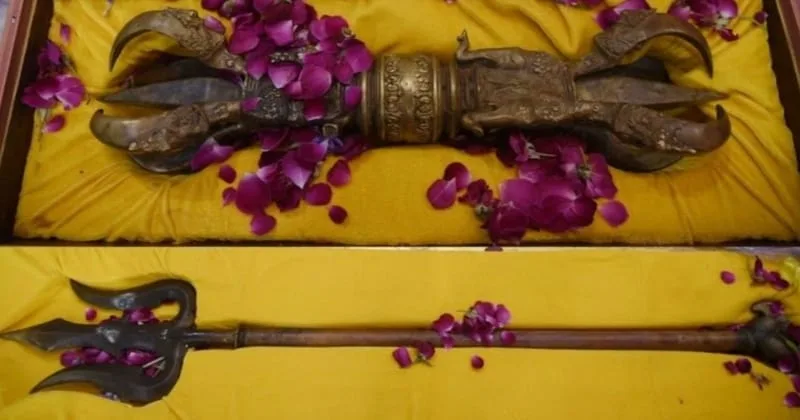
A fascinating claim has recently emerged that ancient artefacts, described as the Trishul (trident) of Bhagwan Shiva and the Vajra (thunderbolt) of Bhagwan Indra, have been discovered in the Philippines. The announcement was made at a public event in Mumbai, where the artefacts and supporting documents were presented to an audience of scholars and enthusiasts.
https://twitter.com/SquintNeon/status/2032185502091395313
According to the presentation, these items were first found in 2015 at a mining site in the Philippines. Workers reportedly encountered unusual objects buried underground, which were later studied extensively. The findings have been described as connecting ancient Indian spiritual symbols with distant regions, highlighting possible cultural links across Asia.
The trident is claimed to be around 10,000 years old, symbolically linked to Bhagwan Shiva, while the Vajra is said to be approximately 3,000 years old, associated with Bhagwan Indra, the storm god of Hindu tradition. Photographs, documents, and detailed descriptions were showcased during the presentation to support these claims.
Despite the excitement surrounding these announcements, experts urge caution. There is currently no independent archaeological verification or scientific dating confirming the age, origin, or religious association of the artefacts. Verified prehistoric artefacts typically undergo rigorous scientific analysis, including radiocarbon dating, controlled excavation, and peer-reviewed publication — steps that have not yet been documented in this case.
The Philippines does have notable archaeological discoveries, such as the Laguna Copperplate Inscription from the 10th century AD and ancient human remains in the Tabon Caves dating back over 16,000 years, which show early cultural connections in Southeast Asia. However, these do not independently support claims about divine tridents or Vajras linked to Indian deities.
Scholars emphasize the importance of scientific validation and peer-reviewed research before accepting extraordinary claims. While the artefacts are intriguing and may inspire further exploration of historical cultural links, they remain unverified under mainstream archaeological standards.