Decoding Earth’s Deep Past: Ladakh Magmatic Arc
July 12, 2026
  • Read Ecopy
  • Circulation
  • Advertise
  • Careers
  • About Us
  • Contact Us
Android AppiPhone AppArattai
Organiser
  • ‌
  • Bharat
    • Assam
    • Bihar
    • Chhattisgarh
    • Jharkhand
    • Maharashtra
    • View All States
  • World
    • Asia
    • Europe
    • North America
    • South America
    • Africa
    • Australia
  • Editorial
  • International
  • Opinion
  • RSS @ 100
  • More
    • Op Sindoor
    • Analysis
    • Sports
    • Defence
    • Politics
    • Business
    • Economy
    • Culture
    • Special Report
    • Sci & Tech
    • Entertainment
    • G20
    • Azadi Ka Amrit Mahotsav
    • Vocal4Local
    • Web Stories
    • Education
    • Employment
    • Books
    • Interviews
    • Travel
    • Law
    • Health
    • Obituary
  • Subscribe
    • Subscribe Print Edition
    • Subscribe Ecopy
    • Read Ecopy
  • ‌
  • Bharat
    • Assam
    • Bihar
    • Chhattisgarh
    • Jharkhand
    • Maharashtra
    • View All States
  • World
    • Asia
    • Europe
    • North America
    • South America
    • Africa
    • Australia
  • Editorial
  • International
  • Opinion
  • RSS @ 100
  • More
    • Op Sindoor
    • Analysis
    • Sports
    • Defence
    • Politics
    • Business
    • Economy
    • Culture
    • Special Report
    • Sci & Tech
    • Entertainment
    • G20
    • Azadi Ka Amrit Mahotsav
    • Vocal4Local
    • Web Stories
    • Education
    • Employment
    • Books
    • Interviews
    • Travel
    • Law
    • Health
    • Obituary
  • Subscribe
    • Subscribe Print Edition
    • Subscribe Ecopy
    • Read Ecopy
Organiser
  • Home
  • Bharat
  • World
  • Operation Sindoor
  • Editorial
  • Analysis
  • Opinion
  • Culture
  • Defence
  • International Edition
  • RSS @ 100
  • Magazine
  • Read Ecopy
Home Bharat

Scientists decode 130-million-year evolution of Ladakh magmatic arc in Himalayan breakthrough

In a major breakthrough in understanding the geological evolution of the Himalaya, scientists have decoded the 130-million-year history of the Ladakh Magmatic Arc—a vast belt of ancient igneous rocks that preserves a detailed record of tectonic activity beneath the Earth’s surface. The study reveals how the gradual subduction of the Neo-Tethys Ocean beneath the Eurasian plate, followed by the eventual collision with the Indian plate, shaped the region long before the rise of the modern Himalaya

WEBDESKWEBDESK
Mar 18, 2026, 01:30 pm IST
in Bharat, Sci & Tech, Ladakh
Follow on Google News
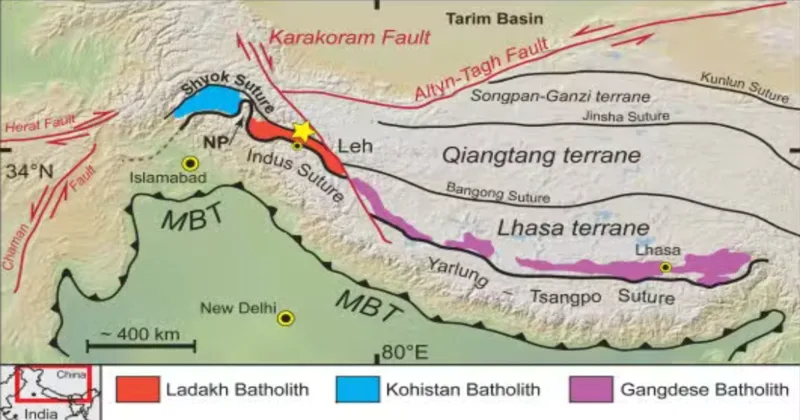
Decoding the Ancient Depths of the Ladakh Magmatic Arc (Image credit: ScienceDirect.Com)

Decoding the Ancient Depths of the Ladakh Magmatic Arc (Image credit: ScienceDirect.Com)

FacebookTwitterWhatsAppTelegramEmail

Scientists have decoded the evolution of the Ladakh Magmatic Arc in the NW Himalaya, which acts as a around 130-million-year, record of plate tectonics that documents the subduction, maturation, and collision between the Indian and Eurasian plates.

Millions of years before the Himalayas became the tallest mountains on Earth, the region now called Ladakh lay above the Neo-Tethys Ocean. Below that ancient sea, giant slabs of Earth’s crust slowly plunged into the mantle in a process known as subduction, leading to the formation of the Ladakh Magmatic Arc (LMA). LMA is a belt of igneous rocks in the Trans-Himalaya formed in the period Jurassic to Eocene, 201.3 million years ago to 33.9 million years (Ma).

Scientists from the Wadia Institute of Himalayan Geology, an autonomous institute of Department of Science and Technology (DST) have now traced this slow but powerful motion of subduction that formed the LMA by probing into the chemistry of rocks. They found that it was formed by the northward subduction of the Neo-Tethyan oceanic plate beneath the Eurasian margin.

They compared geochemical and isotopic results from the pre-collisional Dras-Nidar Island Arc Complex (DNIAC), pre-to syn-collisional Ladakh Batholith (LB) that formed part of the well-known Kohistan-Ladakh Batholith, and post-collisional mafic dykes.

The researchers observed that the long-term magmatic evolution was controlled by the geodynamics of the Neo-Tethyan Ocean. The pre-, syn-, and post-collisional history of the Ladakh magmatic arc shows three main magmatic episodes (160– 110 Million Years (Ma), 103–45 Ma, and < 45 Ma) of distinct geochemical signatures that are closely linked to the subducting slab dynamics involving the slab, the sub-arc mantle wedge, and the crustal components.

The LMA is a long-extinct volcanic system that once produced enormous volumes of molten rock, evolving through three major phases of geological activity over tens of millions of years.

In the earliest phase, the region resembled a chain of volcanic islands rising from the Neo-Tethys Ocean. Rocks from the Dras–Nidar Island Arc Complex preserve evidence of this stage. Their chemical fingerprints suggest that the magma mainly emerged from the mantle with only a small contribution from sediments dragged down by the subducting oceanic plate.
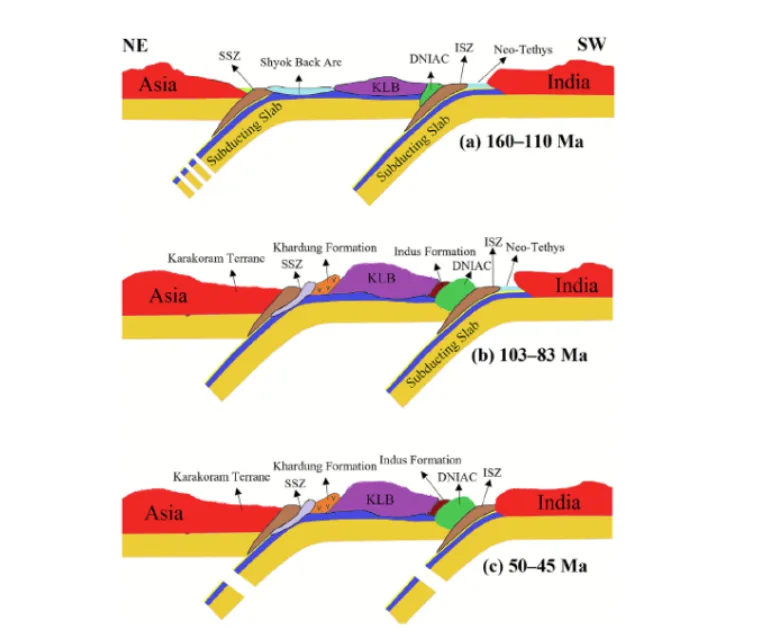
Fig: A 2-D geodynamic model for the evolution of the DNIAC-KLB compiled and modified after Ahmad et al. (2008). Abbreviations: KLB, Kohistan Ladakh Batholith; DNIAC, Dras Nidar Island Arc Complex; SSZ, Shyok Suture Zone; ISZ, Indus Suture Zone.

The arc evolved as tectonic plates continued to converge. Large bodies of granite, known as the Ladakh Batholith, formed deep underground. These rocks show stronger chemical signals from continental materials, implying that sediments and crustal fragments were being recycled into the magma.

This is because the approaching collision between the Indian Plate and Eurasia began to reshape the entire system. The plate that subducted carried more sediments into the mantle, enriching the magma and changing its chemistry.

The two plates eventually collided, and the Neo-Tethys Ocean closed, and the dramatic collision uplifted the Himalaya. Even after the main collision, molten rock still forced its way upward through cracks, forming mafic dykes—narrow sheets of dark volcanic rock cutting through older formations.

These later magmas came from a mantle source that was already enriched by earlier tectonic processes.

They reconstructed the tectomagmatic events by measuring rare elements and isotopes such as strontium and neodymium, which record whether magma formed from deep-mantle material, recycled sediments, or continental crust, and hence act as a geological time machine.

The researchers concluded that the contribution from sediment subduction is more pronounced in the KLB Kohistan Ladakh Batholith than in the DNIAC.


Topics: Ladakh Magmatic ArcLadakh BatholithNeo-Tethys OceanDNIAC
ShareTweetSendShareSend
✮ Subscribe Organiser YouTube Channel. ✮
✮ Join Organiser's WhatsApp channel for Nationalist views beyond the news. ✮
Previous News

Varanasi Iftar Row: At a boat party on river Ganga, 14 Islamists throw left-overs of non-veg biryani

Next News

India climbs global aviation ladder propelled by UDAN: DGCA to further facilitate inclusivity in domestic flying

Related News

No Content Available
Load More

Latest News

Red Corner Notice issued against Hizbul terrorist for 2013 Kashmir attack

Jammu & Kashmir: 13 years after Sopore ambush, SIA secures Interpol red notice against Hizbul Terrorist Imtiyaz Kandoo

Uttar Pradesh CM Yogi Adityanath

‘Mandir donations were used to build Mosque walls’: UP CM Yogi Adityanath targets Samajwadi Party amid Ram Mandir row

Bhagwan Krishna reference in TCS accused Nida Khan bail order draws sharp reactions

Nashik TCS Case: Nida Khan, Hindus are ‘Kafirs’; then why is there a mention of Bhagwan Krishna’s mother in verdict

Crime Branch probe ordered into SCERT textbook errors

Odisha CM Mohan Majhi orders crime branch probe into SCERT textbook errors

Islamist Nawaz stabs Hindu girl Nandini for rejecting his marriage proposal and marrying someone else

Bengaluru Horror: Former boyfriend Bande Nawaz stabbed Nandita for marrying Hindu man

CBI dismantles the Rs 6,000-Crore Mahadev betting empire

Mahadev Betting App Scam: CBI’s major crackdown on a parallel financial empire exceeding Rs 6,000 Crore

Representative Image

Maharashtra: Malegaon voter toll verification reveals large-scale anomalies; BJP alleges 1.26 lakh suspicious entries

ABVP Keralam flags 'Love Jihad' angle in killing of Sawariya Basanth in Uzbekistan by accused Sadarul Anam

ABVP Keralam flags ‘Love Jihad’ angle in killing of Sawariya Basanth in Uzbekistan by accused Sadarul Anam

Tamil Nadu: Ramaswamy Naicker statue on ancient Shiva temple land without HR&CE approval; Hindu activist seeks removal

From 2016 to 2026, attacks on Sikhs and Gurdwaras have raised concerns over the safety of Sikh communities worldwide

Islamist Extremism and the Targeting of Sikhs: Major incidents of violence from 2016–2026

Load More
  • Privacy
  • Terms
  • Cookie Policy
  • Refund and Cancellation
  • Delivery and Shipping

© Bharat Prakashan (Delhi) Limited.
Tech-enabled by Ananthapuri Technologies

  • Home
  • Search Organiser
  • Bharat
    • Assam
    • Bihar
    • Chhattisgarh
    • Jharkhand
    • Maharashtra
    • View All States
  • World
    • Asia
    • Africa
    • North America
    • South America
    • Europe
    • Australia
  • Editorial
  • Operation Sindoor
  • Opinion
  • Analysis
  • Defence
  • Culture
  • Sports
  • Business
  • RSS @ 100
  • Entertainment
  • More ..
    • Sci & Tech
    • Vocal4Local
    • Special Report
    • Education
    • Employment
    • Books
    • Interviews
    • Travel
    • Health
    • Politics
    • Law
    • Economy
    • Obituary
  • Subscribe Magazine
  • Read Ecopy
  • Advertise
  • Circulation
  • Careers
  • About Us
  • Contact Us
  • Policies & Terms
    • Privacy Policy
    • Cookie Policy
    • Refund and Cancellation
    • Terms of Use

© Bharat Prakashan (Delhi) Limited.
Tech-enabled by Ananthapuri Technologies