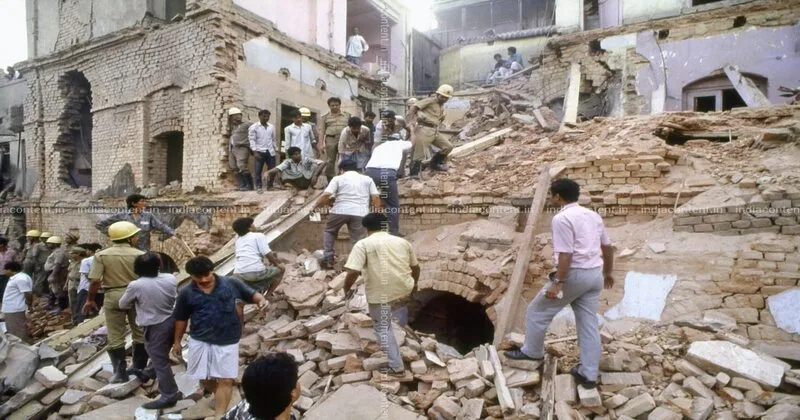
In March 1993, India witnessed one of the most terrifying phases in its recent history. Even as the nation struggled to come to terms with the devastating serial bomb blasts in Mumbai, another deadly explosion struck Kolkata just days later. While the Mumbai attacks remain etched in public memory, the blast in Kolkata’s Bowbazar area has largely faded from wider discussion. The explosion occurred in the early hours of March 16, 1993, when a powerful blast brought down two residential buildings in the densely populated Bowbazar locality, causing significant damage and panic.
Just days earlier, on March 12, 1993, a series of coordinated explosions had rocked Mumbai (then Bombay). The blasts targeted key commercial hubs and crowded public spaces across the city, killing over 250 people and injuring more than 1,300, plunging the country into shock.
Investigations later revealed that the attacks were meticulously planned and executed with the involvement of a large network of operatives. Authorities estimated that around 50 individuals may have been involved, with explosives planted across multiple high-density locations, including markets and office complexes.
Investigators later traced possible links between the attacks to members of the Mumbai underworld. Among those named was gangster Dawood Ibrahim, who was believed to be operating from Dubai at the time. During follow-up search operations, police also recovered unexploded devices. Two motor scooters packed with plastic explosives were discovered in a crowded diamond merchants’ market and were successfully defused, averting further loss of life. The scale, precision, and coordination of the attacks triggered widespread panic across the country, with intelligence agencies warning of the possibility of further strikes.
A deadly explosion in Kolkata
Just days after the Mumbai attacks, another explosion struck India, this time in Kolkata. On March 16, 1993, a powerful blast ripped through the Bowbazar area in the heart of the city. The explosion was so intense that it brought down two buildings and sparked fires in several nearby structures.
The attack occurred in the early hours, when most residents were asleep. Within moments, buildings collapsed, trapping people under the debris, while flames quickly spread through the affected structures, adding to the chaos and devastation.
Police reported that at least 45 people were killed in the immediate aftermath of the explosion. As rescue operations continued and more bodies were pulled from the debris, the death toll rose to 69. The impact of the blast was so powerful that it was heard nearly three miles away.
Fires and desperate rescue operations
Bowbazar is among the most densely populated parts of Kolkata, serving as both a residential and commercial hub, surrounded by prominent gold and furniture markets. Hundreds of families live in closely packed buildings in the area.
At the time of the explosion, around 125 people were believed to be inside the two apartment buildings that collapsed. Soon after the blast, both structures caught fire, severely hampering rescue efforts. At least ten fire engines were deployed, and firefighters battled the flames for over two hours to bring the situation under control.
The impact extended to nearby buildings as well, with several structures damaged and some catching fire. Many people were trapped inside. With ambulances delayed, local residents and volunteers stepped in to assist. Victims were transported to nearby hospitals using trucks and private vehicles. Community members also called for blood donations as medical facilities struggled to cope with the sudden influx of injured people.
Questions over the cause of the blast
In the immediate aftermath, police suspected that the explosion was caused by a bomb. However, investigators also explored another possibility. One officer indicated that a large stockpile of explosives may have been stored inside one of the buildings and could have detonated accidentally due to mishandling. Given this, authorities noted that the Kolkata blast might not have been carried out in the same coordinated manner as the attacks in Mumbai. At the time, it also remained unclear whether there was any direct link between the Kolkata explosion and the Mumbai bombings that had taken place just four days earlier.
The site of the explosion was located close to several key government establishments, including the state secretariat at Writers’ Building and the city’s police headquarters.
International warnings and ongoing investigations
In the aftermath of the Mumbai attacks, the already tense atmosphere was further compounded by international alerts.
The United States Department of State warned Indian authorities about the possibility of additional attacks. It conveyed to New Delhi that intelligence inputs pointed to a heightened threat of further terrorist activity, particularly in the national capital.
United States also advised its citizens to defer non-essential travel to India for the time being. Additionally, American bomb experts offered assistance to Indian agencies in analysing the explosives used in the Mumbai blasts, in the hope that such examination could reveal potential links to other incidents. Police continued to probe the network behind the 1993 Mumbai serial blasts. In one instance, two suspects believed to be linked to the attacks were cornered during a raid but managed to escape after a brief gunfight.
Criminal networks and economic motives
Investigators believed the Mumbai blasts involved elements of the city’s organised crime syndicates, often referred to as the Mumbai underworld.
For years, these networks had thrived on smuggling gold, electronics, and foreign currency into India from Gulf countries. However, economic liberalisation in the early 1990s reduced import duties, weakening the profitability of such illegal trade.
As traditional revenue streams declined, many criminal groups diversified into narcotics, extortion, and other illicit activities. Authorities suspected that these networks may have facilitated aspects of the bombings. Even so, questions persisted over why organised crime groups would take part in attacks of such magnitude against Indian cities.
The Bowbazar blast and the 2015 debate
The investigation into the Bowbazar explosion in Kolkata eventually led to multiple arrests. One of the key accused was Rashid Khan, a local satta operator. According to investigators, a cache of explosives had been stored in a building linked to him, which was believed to have triggered the devastating blast.
In 2001, Khan was convicted under the Terrorist and Disruptive Activities (Prevention) Act (TADA) and sentenced to life imprisonment. Years later, in 2015, the Government of West Bengal considered the possibility of granting him early release.
By then over 60 years old, Khan had spent a significant portion of his life in prison. Officials cited his good conduct and noted that he had taken up painting during incarceration. The State Sentence Review Board examined his case under remission provisions.
However, the proposal sparked debate, primarily because his conviction fell under TADA, a stringent central anti-terror law. Authorities also pointed out that the Calcutta High Court had upheld his life sentence, and the judicial department planned to seek the court’s opinion before taking any final decision.
2025 court ruling on another convict
More than three decades after the blast, the case resurfaced in 2025. A division bench of the Calcutta High Court set aside the early release of another life convict in the case, Md Khalid.
Khalid had earlier been granted remission by a single judge, but the State Review Board later raised concerns about his release. A bench comprising Justices Debangsu Basak and Md Shabbar Rashidi reviewed the matter and ruled that the earlier order could not be sustained.
The court observed that judicial review in such cases should focus on whether due process was followed, rather than substituting the decision of the review board if it is reasonable. It noted that the board had provided clear grounds for denying Khalid’s release and that its decision was not arbitrary.
Kolkata Police had also expressed concerns, warning that Khalid could return to criminal activities if released. According to submissions made in court, he had worked closely with Rashid Khan and carried out various operations under his direction to instil fear in the locality.
Khalid, now around 60 years old, has spent over 30 years in prison since his arrest in 1993. His counsel argued that he suffers from diabetes and requires ongoing medical care.
However, the court emphasised that remission is not a matter of right. While a convict may seek consideration for early release, the final decision must be based on legal provisions and the assessment of competent authorities. The bench ultimately directed the review board to reconsider Khalid’s case in accordance with the law.
While the 1993 Mumbai blasts remain widely remembered, the deadly explosion that struck Bowbazar in Kolkata just days later has largely faded from public attention. For many, the incident is a distant memory. For others, it remains a painful reminder of the lives lost and homes destroyed. Even after more than three decades, periodic court proceedings continue to bring the case back into focus, underscoring that the wave of violence in 1993 was not confined to Mumbai alone.