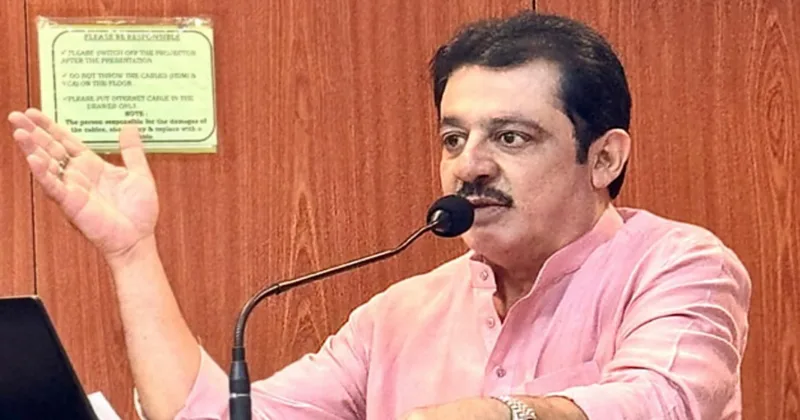
BENGALURU: A major political and social debate has been triggered in Karnataka after State Waqf and Minority Welfare Minister BZ Zameer Ahmed Khan revealed in the Assembly that a significant portion of Waqf land encroachments in the state has been carried out by members of the Muslim community.
Speaking during the Question Hour, the minister responded to a query raised by Afzalpur MLA M. Y. Patil and presented detailed data on Waqf properties across Karnataka. According to him, the state has a total of 1,12,860 acres of Waqf land. However, only about 20,054 acres are currently under the direct control of the Waqf Board.
He stated that nearly 17,969 acres of Waqf land have been encroached upon. In addition to this, around 47,263 acres have been affected under the Inam Abolition Act, while 23,627 acres have come under the Land Reforms Act, significantly reducing the effective control of Waqf authorities over these properties.
Highlighting the nature of encroachments, the minister made a striking claim that most of the illegal occupations are not by other communities but by Muslims themselves. “Encroachments on Waqf land are largely by Muslims and not by temples or members of other communities,” he said, adding that this reality must be acknowledged to address the issue effectively.
He further explained that after the Congress government assumed power, efforts were initiated to identify and remove encroachments through Waqf Adalats conducted across the state. These special drives were aimed at resolving disputes and reclaiming land meant for community welfare.
Zameer Ahmed Khan also clarified that Waqf properties are not government-owned lands but have been donated by private individuals and institutions for religious and charitable purposes. He stressed that protecting such properties is essential for the welfare of the community they are intended to serve.
However, the issue took a political turn when Leader of Opposition R. Ashoka intervened and raised concerns over alleged misclassification of lands. He stated that the BJP’s objection is not against the removal of encroachments by Muslims, but against instances where farmers’ lands, educational institutions, and even temple properties are allegedly being marked as Waqf land.
Ashoka cited cases where lands linked to institutions associated with M Visvesvaraya were reportedly brought under Waqf claims, leading to confusion and unrest among landowners. He argued that such actions have created fear among farmers and other stakeholders.
Responding to these allegations, the minister firmly denied any wrongdoing by the government. He clarified that no temple or educational institution is being arbitrarily declared as Waqf property. According to him, the focus remains strictly on identifying genuine encroachments and resolving them through legal mechanisms.
“Waqf Adalats were conducted to identify encroachments, most of which are by private individuals, largely from within the Muslim community,” he reiterated.
The revelation has sparked intense debate both inside and outside the Assembly. While some have welcomed the minister’s candid admission as a step towards transparency, others have raised concerns about the broader implications and the need for a fair and comprehensive survey of all disputed lands.
The issue of Waqf land has long been a contentious one in Karnataka, involving legal, religious, and political dimensions. With fresh data now placed on record, the focus is likely to shift towards how effectively the government can reclaim encroached land while ensuring that no wrongful claims are made.
As the debate intensifies, all eyes are on the state government’s next steps to address encroachments and safeguard Waqf properties intended for public and community welfare.