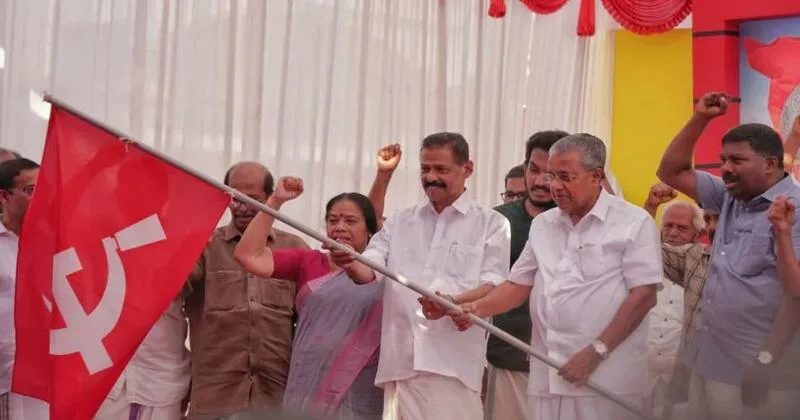
Thiruvananthapuram: The Communist Party of India (Marxist) [CPI(M)’s decision to announce its candidates early for the upcoming Keralam Assembly elections has triggered an unexpected political storm within the party. Instead of consolidating the organisation ahead of the polls, the move has exposed deep dissatisfaction among party cadres and leaders. In several constituencies, rebel candidates have begun to emerge against the official nominees of both the CPI(M) and its ally, the CPI. Many within the party view the candidate list as a clear reflection of Chief Minister Pinarayi Vijayan’s unchallenged authority. Critics argue that the list has been shaped to strengthen his dominance within the organisation rather than to accommodate diverse leadership within the party.
Consolidation of power around CM Pinarayi Vijayan
Observers within the party say the candidate list demonstrates the extent to which Pinarayi Vijayan has consolidated power within the CPI(M). By fielding the wives of two Politburo members from Kerala, Vijayan has effectively secured the loyalty of senior leaders who might otherwise have questioned the Chief Minister’s decisions. Party insiders claim that this move has helped Vijayan ensure that the top leadership remains firmly aligned with him. However, critics say this strategy has also alienated several experienced leaders and grassroots cadres who feel sidelined in the decision-making process.
There is also growing criticism that senior leaders capable of questioning the Chief Minister’s leadership style have been systematically eliminated from the electoral arena. At the same time, some young leaders who were emerging as influential voices within the party have reportedly been kept under control.
Among them are Kerala Assembly Speaker A. N. Shamseer and senior CPI(M) leader M. Swaraj. Many party members believe that their political rise could eventually challenge the influence of P. A. Muhammad Riyaz, the Public Works Department Minister and Vijayan’s son-in-law. Critics argue that keeping such leaders out of the candidate list is part of a calculated strategy to prevent potential future rivals from gaining political strength.
Growing discontent and rebel voices
The internal dissatisfaction within the CPI(M) appears to be spreading rapidly. Several leaders and cadres have begun expressing open dissent, and more rebel voices are expected to emerge in the coming days. Senior leader and former minister G. Sudhakaran has already indicated strong criticism of the current leadership style. His stance has encouraged other disgruntled leaders to consider openly opposing the party’s official candidates.
According to party insiders, dissatisfaction within the CPI(M) is now more visible than at any time in recent decades. Some leaders have also raised concerns about the increasing influence of business interests within the party.
The decision to field wealthy businessmen as independent candidates in certain constituencies, including Palakkad, has triggered criticism from within the party. Critics argue that such moves contradict the ideological foundations of the CPI(M) and represent a shift towards crony capitalism. Many within the organisation believe that these developments benefit only a small group of leaders while undermining the party’s traditional support base among workers and the poor. Another source of political fatigue for the party has been the controversies surrounding former Left Democratic Front MLA P. V. Anwar. His confrontational politics and public disputes with party leaders have created additional tensions within the organisation.
Absence of internal opposition
For decades, senior leader V. S. Achuthanandan served as a powerful internal critic who could openly challenge decisions taken by the party leadership. Many observers say that such an internal balancing force is now absent within the CPI(M).
Over the past two and a half decades, what critics describe as “Pinarayism” has come to dominate the party’s functioning. Without a leader like Achuthanandan to question the leadership, dissenting voices within the party appear increasingly marginalised.
Even leaders who were once considered close allies of Pinarayi Vijayan have begun to express unease. G. Sudhakaran, long regarded as one of Vijayan’s most loyal supporters, recently raised sharp criticism against the party leadership.
During the 2021 Assembly elections, the CPI(M) leadership introduced several criteria to manage internal competition and prevent dissent. However, critics say that these rules have been selectively relaxed in the current election cycle.
The two-term limit that was previously enforced to ensure generational change has reportedly been modified in several cases. As a result, several leaders have been allowed to contest for three or even four consecutive terms. This has led to accusations that the rules are applied differently depending on the leader’s proximity to the Chief Minister.
Nepotism allegations and local rebellions
Another controversy that created discussion within the party was the speculation that former CM VS Achuthanandan’s son, V. A. Arunkumar, might be fielded from Malampuzha, the constituency long represented by V. S. Achuthanandan. Some party members believed that such a move could convert the emotional support for Achuthanandan into an electoral advantage for the party. However, internal disagreements reportedly prevented Arunkumar from being nominated.
Meanwhile, assembly speaker A. N. Shamseer was reportedly excluded from the candidate list, citing the two-term rule, even though the same rule was relaxed for several other leaders. Critics within the party say this inconsistency reflects a deliberate effort to prevent young leaders from gaining influence.
Some party members believe this is part of a long-term strategy to eliminate potential challengers to CM’s son- in-law Muhammad Riyaz’s political future. As a result, many observers believe that the CPI(M) has entered a phase where decision-making is concentrated within a small group of leaders close to Pinarayi Vijayan and his family. More rebel voices are expected to emerge in the coming days, particularly in Kannur district, which has traditionally been the organisational stronghold of the CPI(M).
Rebel candidates and political fallout
One of the most significant developments occurred in Thaliparamba, where CPI(M) state secretary M. V. Govindan’s wife, P. K. Shyamala was announced as the party’s candidate.
Following this decision, district secretariat member T. K. Govindan resigned from the CPI(M) and announced that he would contest as an independent candidate against Shyamala. In a sharp criticism of the party leadership, he said the CPI(M) was ending a six-decade tradition of organisational discipline. According to him, the current leadership has adopted a policy of accepting anyone who supports them while sidelining long-time party workers. He alleged that serious injustice was taking place within the party.
Another political shock came when former CPI leader and Nattika MLA C. C. Mukundan joined the Bharatiya Janata Party (BJP). Mukundan, who had been associated with the CPI for nearly four decades, formally joined the BJP at the party’s Thrissur City District Committee office, Saya Namo Bhavan. He was welcomed by BJP Thrissur City District President Justin Jacob, while NDA State Vice Chairman A. N. Radhakrishnan presented him with a ceremonial shawl. He stated that the BJP is a party committed to the upliftment of the poor.
Meanwhile, in Payyannur, former CPI(M) Kannur district committee member V. Kunjikrishnan, who was expelled from the party for exposing alleged embezzlement in the CPI(M) Martyrs Fund, has announced that he will contest as an independent candidate. His decision comes after the CPI(M) nominated T. I. Madhusudhanan, an MLA facing allegations, as the party’s candidate in the constituency.
Kunjikrishnan declared that he would contest independently and would not align with any political front. He said his primary objective was to prevent what he described as the “mafia takeover” of the CPI(M) in Payyannur.
He also emphasised that his candidacy was part of the struggle he had already begun against corruption within the party. Although Madhusudhanan won the constituency in 2021 with a margin of 49,780 votes, the emergence of a strong rebel candidate has caused concern within the CPI(M) leadership.
The party leadership was already alarmed after a CPI(M) branch secretary, Vysakh, contested as a rebel candidate and won in the Payyannur Municipality local body elections. The presence of several rebels within the Kara branch of the party has further intensified the leadership’s worries. With rebellion spreading across constituencies and internal dissent becoming increasingly visible, the CPI(M) now faces one of its most challenging moments in history ahead of the Kerala Assembly elections.