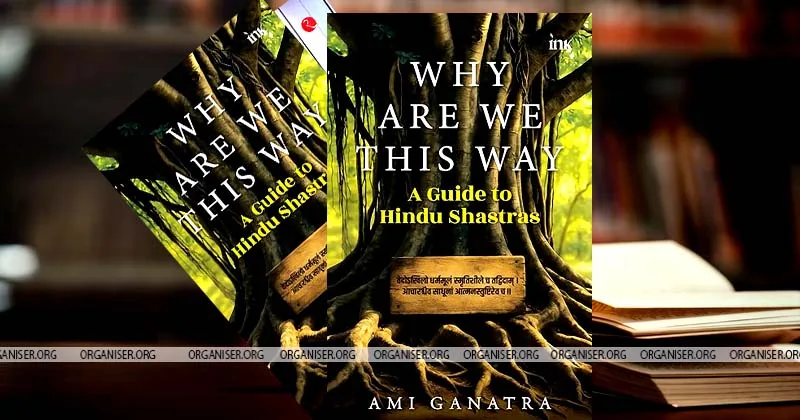
Title: Why Are We This Way: A Guide to Hindu Shastras; Author: Ami Ganatra; Publication: Bluone Ink Pvt Ltd; Pages: 304;
Price: Rs 499.00
Price: Rs 499.00
How does one review a book on a topic on which one has limited knowledge? In the vast ocean of Bharatiya knowledge, people like me are just splashing around in the shallow side of the deep pool. Some people feel that the bane of Hindu Dharma is that it is too complex and beyond the understanding of the average Hindu.
One is a Hindu by birth and knows some Hindu rituals one sees at home. Earlier, we used to get educated through our parents and many of us, baby boomers, passed on some of it to our children. But today’s children have no religious education at home, no introduction to their own traditions and cultures in the schools as their parents have forgotten to practice simple religious practices with the excuse of being too busy, hiding the fact that they know little. In schools we used to read poetry of Kabir, Tulsidas, Guru Nanak etc and had received some sprinkles of mysticism and basic Bharatiya philosophy. As Marxists got more grip over education, even those few sprinkles of timeless philosophy have evaporated.
Those who wake up to the Bharatiya culture have the option of studying via the internet and social media. Internet has saved our GenZ generation from total deracination. Unfortunately, there are charlatans too out there, and give misleading and downright wrong information. The real problem of opening up the vast knowledge treasure of Hindu or Sanatan Dharma for today’s generation remains. Especially, for the youth born and brought up in English, who is easily deracinated due to the content of the education he/she receives, and total disconnect of the language from Bharatiya roots. Fortunately for us, there are many Acharyas, scholars and writers who have taken up this challenge of presenting timeless knowledge in a simple form. While some have chosen the path of fiction, others have chosen to stick to the original sources and still present the ideas in a simple to understand form. This is less populist but the most important way according to me. It avoids confusion. It is in this context that I appreciate the works of Ami Ganatra. She has chosen to stick to the original scriptures and sources, not on secondary or tertiary sources. She has broken many myths about Bharatiya history, civilisational values and philosophy through her work. She is uncompromising on the truth of our scriptures.
This time, she has taken up the most challenging task of trying to help the reader untangle the huge web of knowledge stored in Hindu scriptures or Shastras. It is not easy. I felt like a person coming out of the deep end of the pool – breathless by the time I finished her present book though I have had the fortune of being exposed to many scriptures due to the atmosphere at home during my younger days. So, you can imagine what a person feels when he hears unending lectures about Shrutis, Smritis, Vedas, Puranas, Vedanta, Upanishads, reads about about Shad-darshana (six schools of darshana) and so on. She then hears about the literature that are products of these basic scriptures. This is why this work is very important. As an engineer and a professional, the writer has presented bare minimum information in a well-structured form. Rather than ‘Guide to Hindu Shastras’, I would call it an introduction to Hindu Shastras. A guide would demand more pages.
Ms Ganatra has avoided reader’s exposure to deeper philosophy, nor has she given importance to any one branch of knowledge. She has not shown partiality to one or the other school of thought. She has simply provided structural introduction to the vast intellectual upvan (garden) of Hindu philosophy where every plant that has flowered out of Vedic roots to stand resplendent in its own glory. She tries to dispel the phobia that trying to study Hindu scriptures is like entering into a dense forest which you fear to venture into for the fear of getting lost as there seems to be no path or trails that apparently cross each other. This guide maps out the beautiful, thought complex, topography of Hindu thought. You may decide to rest under a tree and bask in its cool shadows, or you may move like a butterfly sipping honey from different flowers before you settle down. The book gives a peep into, both, the philosophy and the rituals. It explains the evolution of various schools of thought, evolution of shastras from Shrutis into Smritis and so on.
Though this subject can be dry, the writer inserts some interesting stories picked up from books of Itihaasa and Upanishads that make it easier for the reader to get a basic understanding. Graphics to explain the structure of our Shastras help you navigate the huge field better.
In concluding chapters, the writer explains to the seeker how to move ahead into deeper woods by lighting up some important markers on the way, so you do not get lost. As you read, you are surprised at the continuity of Bharatiya darshan from thousands of years to the present. There is no disconnect, but there are changes based on the geography, time and situation. Marxists slice the Hindu philosophy and try to create an illusion of breaks in different periods, the writer challenges this notion.
Ami’s books Ramayana Unravelled and Mahabharata unravelled volume 1 and 2 are already household titles for the English speaking youth and have been translated in many Indian languages. Writing this latest book must have been a much bigger challenge for her as it is not about re-telling the stories already known in today’s context.
This writer took up the challenge of introducing this vast treasure house to common Hindu in a structured form. Why Hindu alone; any person tired of simplistic explanations about his/her existence and the creation of this universe in other faith systems will find this guide a wonderful starting point and search for one’s own path. It is a peep into a different philosophical world that confesses honestly that there are many paths to the Supreme Truth, called differently by sages – Ekam Sat Vipra Bahudha Vadanti. It explains how an individual is connected to the universe. Not as a cog in the wheel, but as a cell in the body of humungous living Supreme Being – Virat Purusha. The philosophy encapsulated and introduced to the reader here tells us how an integral and scientific world view can resolve many conflicts in the mind and in this world.