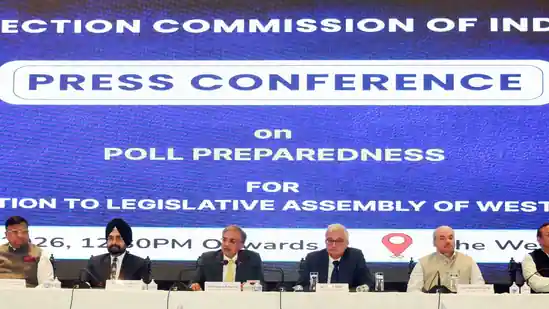
The Election Commission of India on Sunday (March 15) announced the detailed schedule for the 2026 Assembly elections in five states and one Union Territory. Polling will take place in Assam, Kerala, Tamil Nadu, West Bengal and Puducherry, with voting beginning on April 9 and the counting of votes scheduled for May 4.
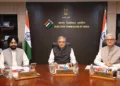
The announcement was made during a press conference held at Vigyan Bhawan in New Delhi, where Chief Election Commissioner Gyanesh Kumar outlined the scale and preparations for the upcoming polls.
The legislative assemblies in these regions are set to complete their terms in May and June, making the elections crucial for determining the next governments in these states and the Union Territory.
Massive electoral exercise covering 824 constituencies
According to the Election Commission, the elections will be conducted across 824 Assembly constituencies spread across the five states and the Union Territory.
Addressing the press conference, Chief Election Commissioner Gyanesh Kumar described the upcoming polls as a major democratic exercise.
“The festival of elections, our pride, is going to be held in the state of Assam, Kerala, Tamil Nadu, West Bengal and the Union Territory of Puducherry,” Kumar said, highlighting the importance of the democratic process.
The polls will involve approximately 17.4 crore eligible voters, making it one of the largest electoral exercises in the country.
Voting dates for each state
The Election Commission announced the polling schedule for each state and the Union Territory:
Assam – April 9
Kerala – April 9
Puducherry – April 9
Tamil Nadu – April 23
West Bengal – April 23 and April 29
The counting of votes for all regions will take place on May 4, after which results for all constituencies will be declared.
Over 17.4 crore voters eligible
The Election Commission said that around 17.4 crore electors will participate in the upcoming elections. The figure reflects the vast scale of the democratic exercise across multiple regions with diverse geography and population.
Chief Election Commissioner Gyanesh Kumar emphasised that the electorate includes people across all age groups, including a significant number of elderly voters.
“To give you a feel of the category of our electors, we have centenarians above 100 years of age in states like Assam, Kerala, Puducherry, Tamil Nadu and West Bengal. There are also a large number of electors aged 85 and above,” he said.
Over 2.19 lakh polling stations to be set up
To facilitate smooth voting, the Election Commission will set up more than 2.19 lakh polling stations across the poll-bound states and the Union Territory.
Most of these polling booths will be located in rural areas, ensuring accessibility for voters in remote locations.
The poll body also noted that the average number of voters per polling station will remain between 750 and 850, ensuring manageable queues and efficient voting procedures.
Special polling stations and accessibility measures
The Election Commission announced several initiatives aimed at making the elections more inclusive and accessible.
These include:
Women-managed polling stations
Divyang (differently-abled) managed polling stations
Model polling stations with enhanced facilities
Special arrangements for elderly voters
Chief Election Commissioner Gyanesh Kumar said such initiatives are designed to strengthen participation and improve the voting experience for all citizens.
100% webcasting for transparency
In a major transparency measure, the Election Commission announced that 100 percent webcasting will be implemented at all polling stations during the elections.
This will allow authorities to monitor voting activities in real time and ensure that the electoral process remains free and fair.
The move is part of the Commission’s broader strategy to strengthen accountability and prevent electoral malpractices.
Conducting elections on such a massive scale requires extensive manpower.
The Election Commission said nearly 25 lakh election officials will be deployed for the upcoming polls. These will include polling staff, administrative officers and security personnel responsible for managing the voting process.
Their duties will include setting up polling stations, ensuring security, managing voter queues and overseeing vote counting.
International observers to witness elections
Chief Election Commissioner Gyanesh Kumar also revealed that representatives from electoral commissions of more than 20 countries will be invited to observe the elections.
The observers will witness what Kumar described as India’s “festive, transparent and efficient” electoral process.
The initiative is aimed at showcasing India’s electoral system as one of the largest and most robust democratic exercises in the world.
Ahead of the announcement of the poll schedule, the Election Commission had already published the final electoral rolls for all the states and the Union Territory.
These were prepared after a Special Intensive Revision (SIR) of voter lists to ensure accuracy and inclusion of eligible voters.
The revision process included adding new voters, removing duplicate entries and updating voter details.
Political stakes high
The upcoming Assembly elections are expected to carry significant political importance as several major national and regional parties prepare for intense contests across the states.
Each of the poll-bound regions has a distinct political landscape and local issues, making the elections crucial for shaping the political dynamics of southern and eastern India.
With the schedule now announced, political parties are likely to intensify campaigning in the coming weeks as the country prepares for yet another major democratic exercise.
As Chief Election Commissioner Gyanesh Kumar described it, the upcoming polls will once again reflect India’s vibrant democratic spirit, a true “festival of elections.”