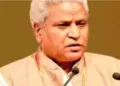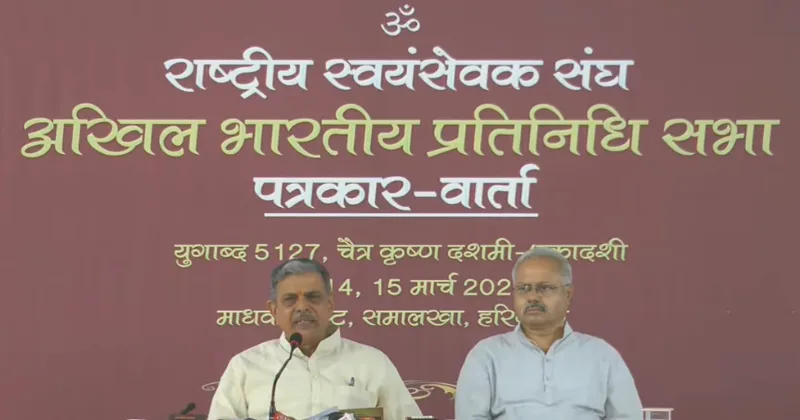
Samalkha (Haryana), March 15: Addressing a press conference during the Rashtriya Swayamsevak Sangh Akhil Bharatiya Pratinidhi Sabha 2026, Sarkaryavah Dattatreya Hosabale ji detailed the organisational expansion of the Rashtriya Swayamsevak Sangh, the themes guiding its centenary year programmes, and the broad social outreach initiatives undertaken across the country. The press conference was held at Samalkha, where the three-day meeting of the Akhil Bharatiya Pratinidhi Sabha (ABPS), the Sangh’s highest decision-making body, is underway.
Hosabale ji began by greeting the media representatives and noted that many among them had spent the last three days at the venue receiving information about the various proceedings of the Akhil Bharatiya Pratinidhi Sabha. He said it was a matter of satisfaction that the same campus in Samalkha was hosting the ABPS meeting for the second time. Four years earlier as well, functionaries from across Bharat had assembled at the same venue.
Explaining the organisational structure of the ABPS, Hosabale ji said the representatives of the Sangh’s highest decision-making body are elected and nominated for a three-year term. Some positions are filled through elections, while others are filled through nomination. For the present session, 1,487 representatives were expected, with delegates arriving from all 46 prants (provinces) of the Sangh across the country.
He said that over the past three days, the delegates and media representatives had received information on different aspects of Sangh work from members of the Prachar Vibhag and other senior functionaries.
The meeting also reviewed the expansion of Sangh work and discussed the special initiatives undertaken as part of the centenary year of the Rashtriya Swayamsevak Sangh.
Hosabale ji said the Sangh had considered two aspects from the organisational perspective and three aspects from the societal perspective while planning the centenary year activities.
One major organisational focus has been the expansion of Sangh work across the geographical expanse of Bharat, ensuring that more areas host daily shakhas or weekly milans.
Sharing the latest figures, Hosabale ji said that the Sangh currently runs 88,949 shakhas across 55,683 sthans (locations). He explained the Sangh’s internal terminology regarding locations. In rural areas, a sthan generally corresponds to a village or a cluster similar to the Nyaya Panchayat system found in Uttar Pradesh, though different states have different administrative terminology.
In urban areas, the Sangh generally treats a settlement of around 10,000 to 12,000 people as a basti, which forms a functional unit within a town. A city may have a population ranging from 30,000 to several lakh, and municipal corporations with around five lakh population are generally categorised as mahanagar (metropolitan units). From the Sangh’s organisational perspective, a city is considered a mahanagar when at least 50 shakhas are functioning there, though population size is also a factor. In such metropolitan regions, several towns, often five to eight, may together be treated as one organisational unit depending on the Sangh’s structure.
Hosabale ji said the expansion of shakhas had taken place across diverse geographical regions. He highlighted that Sangh shakhas are active in distant border areas such as Arunachal Pradesh and Leh, and also in the Andaman and Nicobar Islands. While administrative restrictions limit entry into the Nicobar region, shakhas are active in parts of the Andaman area. Sangh work has also expanded into remote and difficult regions, including several janajati (tribal) areas, and the organisation intends to continue this expansion.
He emphasised that the purpose of expanding shakhas was not merely to increase numbers. Wherever a shakha operates, swayamsevaks develop a national outlook, he said. A swayamsevak does not confine his thinking to a single linguistic or regional identity, whether in Tamil Nadu, Andhra Pradesh, or any other region, but instead views the entire country as one integrated whole.
Hosabale ji added that swayamsevaks are encouraged to think beyond caste and community identities and to develop a broader concern for the entire society. “The country gives us everything; we must also learn to give something back,” he said, noting that this spirit of service is cultivated through the shakha system.
At the same time, he stressed that expansion alone was not sufficient and that the quality of karyakartas must also improve. Swayamsevaks should develop a deeper societal perspective, build connections with more people, and actively participate in constructive social initiatives.
From the societal perspective, Hosabale ji said the Sangh has been promoting the concept of Panch Parivartan (five transformations). These include Samajik Samarasata (social harmony), Kutumb Prabodhan (family awakening), Paryavaran (environmental responsibility), Swadeshi Jeevan Shaili (swadeshi lifestyle), and Nagrik Kartavya or civic awareness and duty. These themes have guided many of the outreach programmes undertaken across the country during the centenary year.
Another key focus has been ensuring a “right and proper narrative” about Bharat’s history, culture, knowledge traditions, and social life. Hosabale ji said such discussions should take place in universities, textbooks, intellectual forums and literature so that society can overcome the legacy of colonial thinking.
He referred to the long influence of colonial rule on Indian intellectual life, noting that it created what he described as a “colonised mind”. Overcoming this mentality requires a process of decolonisation of the mind, he said, adding that concepts such as Bharatiyata and Hindutva should be understood not merely as philosophical ideas but as a civilisational way of life. Hosabale ji recalled that thinkers such as Swami Vivekananda and Dayanand Saraswati had already initiated such intellectual awakening in earlier times.
He also cited India’s message at the G20 Summit “One Earth, One Family, One Future” as an example of a narrative emerging from the civilisational ethos of Bharat that can contribute positively to the global discourse.
Hosabale ji clarified that the Sangh does not claim that only its karyakartas are devoted to the nation. Across the country there are many organisations and individuals who dedicate their time, resources, intellect, and talent to national and social causes. If these “sajjan shakti” (good forces) cooperate with each other, he said, it can strengthen constructive social transformation. He described this idea as the “Power of the Good”, adding that unless positive forces come together, the “power of the bad” tends to dominate social discourse.
He then detailed several outreach initiatives organised during the centenary year. These included Prabuddha Nagarik Goshtis (intellectual gatherings), Hindu Sammelans, Dharma Sammelans, Swadharma Sammelans, and Griha Sampark Abhiyan (household contact programmes). These programmes were conducted across rural and urban areas and brought together ordinary citizens, intellectuals, community leaders, and social activists. Many sants from different spiritual traditions also offered guidance during these gatherings.
Hosabale ji noted that Sarsanghchalak Dr Mohan Bhagwat attended several such programmes in metros, while other Akhil Bharatiya office-bearers addressed similar gatherings across the country. Women’s participation referred to as Matru Shakti also played an important role in many of these events. We have also planned several programmes specifically for youth, and they are underway.
For youth special programmes can still be organised. Discussions on Panch Parivartan should happen among young people. People should participate in such programmes.
He also cited that in Andaman and Nicobar, small tribal communities from nine islands participated in the programmes. Across many locations, nearly 13,000 people participated, including in Port Blair. Taking these programmes to such areas was also accomplished.
Around 37,000 sammelans, and many more are yet to be held. In Arunachal Pradesh, thousands participated in the sammelans. Due to the terrain, access is difficult, and many more are scheduled to take place in the coming days. The population of Arunachal Pradesh is around 15 lakh, and the programmes have received support from society.
We have conducted a review, though some programmes are yet to be completed. We still have time, and due to various reasons—such as weather and election-related circumstances—some programmes could not be held earlier, but they are now scheduled.
Among the major commemorative initiatives organised during the centenary year were programmes marking the 350th martyrdom anniversary 9th Sikh Guru of Guru Tegh Bahadur and the 150th anniversary of the song “Vande Mataram.” Hosabale ji said 2,134 programmes related to Guru Tegh Bahadur were organised across 18 prants, with nearly seven lakh participants. Many members of the Sikh community and Sikh sants were contacted and invited to participate. He noted that Guru Tegh Bahadur’s legacy belongs to the entire nation and the world.
He also mentioned initiatives connected with the 650th birth anniversary of Sant Ravidas, emphasising that remembering sants is not merely about reverence but about bringing their teachings to society. Such personalities, he said, are not meant to remain only in portraits or history books but should inspire people’s lives even today.
Hosabale ji further said the Sangh had planned 75 Sangh Shiksha Vargs (training camps) across the country in the coming months. These include 63 regional camps, 11 kshetra-level camps, and one Akhil Bharatiya training camp in Nagpur. The camps, typically lasting 15 to 21 days, are held between April and June and focus on training volunteers in organisational responsibilities and social initiatives.
He also referred to initiatives relating to Gau Seva (cow care) and Gram Vikas (village development). Since urban residents often ask how they can contribute to cow protection without owning cattle, Hosabale ji suggested alternatives such as terrace vegetable gardens using cow dung and cow urine as fertiliser. He said hundreds of families across the country have adopted such practices.
Similarly, he spoke about the concept of Harit Ghar (Green Home), which encourages households to reduce the use of polythene, conserve water, provide food and water for birds, and adopt environmentally responsible habits in daily life at homes, workplaces, and educational institutions.
Hosabale ji said the Sangh had prepared its organisational calendar up to Vijayadashami, when the centenary year concludes, and further programmes and tours will be planned thereafter.
Questions and Answers:
Question – Is a structural change going to happen in RSS?
Answer: If there is some change in responsibilities, then an announcement about it will be made after the afternoon. Some things will be made public.
Question – What is the Sangh’s view on India’s stand towards Iran?
Answer: In what is happening, the Sangh has no role. There is a belief that the Government of India must be doing the right thing in the interest of the country. The Sangh wants peace in the world.
Question – What is the stand on membership of Muslims and women in the Sangh?
Answer: A person of any religion can come here and can salute the Bhagwa flag. Muslim workers have also been in the Sangh earlier in large numbers. On the role of women in the Sangh, it was said that women do not participate only in the working of the shakha, but the Sangh also has other systems of work in which a large number of women are involved.
Question – What is the Sangh doing regarding stray cattle?
Answer: The government and municipal corporations are continuously making efforts. But people must understand that the cow is not only for milk; its urine and dung are also very useful. Therefore, they should not be left abandoned on the roads.
Question – What is the relationship between BJP and RSS?
Answer: There are many ideologies for the country. Only the BJP adopted these ideologies. Other parties kept their doors closed for the RSS. Therefore, many people of the Sangh entered politics and are advancing ideas in the national interest.
Question – What did he say about the UGC controversy?
Answer: This matter is currently under consideration in the Supreme Court. Therefore, the Sangh will not express its views on this subject. Only after the court’s decision can the Sangh say something.
Question – What did he say about building a headquarters in Panipat, Haryana?
Answer: Work related to village development keeps going on here continuously. Here we are holding the meeting after three years. Sangh workers have created many places to present their ideas. Here we do mushroom cultivation. Many courses are conducted here.