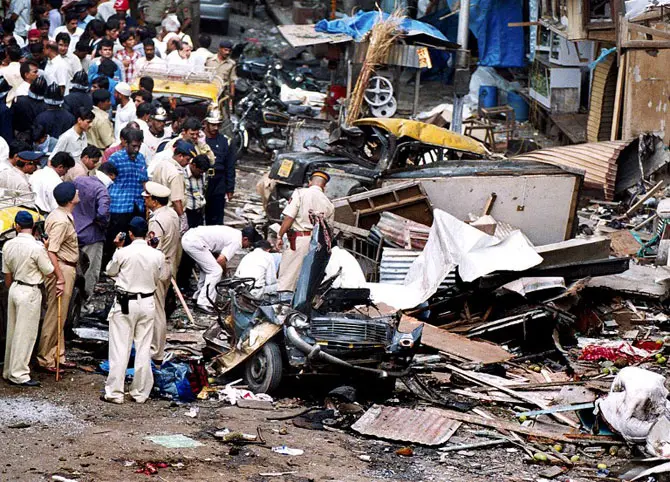
The afternoon of March 12, 1993, remains etched in the collective memory of Bharat as the day when coordinated terrorism struck the country’s financial capital with unprecedented brutality. Mumbai, then known as Bombay, was brought to a standstill as 13 powerful bombs exploded across the city between 1:30 PM and 3:40 PM, triggering panic, destruction, and unimaginable loss.
Within just two hours and ten minutes, the explosions ripped through some of the busiest commercial and public spaces in the city. By the end of the day, 257 people had lost their lives and more than 1,400 were injured, marking the first time India witnessed a large-scale, synchronised terror strike in a major metropolitan city.
The first explosion occurred outside the Bombay Stock Exchange, one of India’s most prominent financial institutions. The blast sent shockwaves across the city’s business district, shattering windows and causing chaos in the bustling area.
Within minutes, more explosions followed at key landmarks including the Air India Building, the Plaza Cinema, Century Bazar, and the Sea Rock Hotel. The blasts targeted commercial centres, hotels, and crowded public spaces, locations chosen to maximise casualties and psychological impact.
For the people of Mumbai, it was a moment of disbelief. The city had witnessed gang wars and underworld violence before, but never such a coordinated terrorist operation aimed at paralysing the metropolis.
Carefully planned sequence of blasts
Investigators later pieced together the sequence of the explosions that unfolded across Mumbai that afternoon.
The first blast occurred at 1:30 PM outside the Bombay Stock Exchange, damaging nearby buildings and vehicles. Just thirty minutes later, another powerful explosion struck the Air India Building, a prominent high-rise in South Mumbai.
By 2:15 PM, bombs detonated at Plaza Cinema and Century Bazar, two crowded public locations where the explosions caused heavy casualties. Shortly afterward, at 2:45 PM, another blast ripped through the Sea Rock Hotel near Bandra’s Land’s End.
Additional explosions continued between 3:10 PM and 3:40 PM, targeting several locations including Zaveri Bazaar, Hotel Juhu Centaur, Sena Bhavan, and areas near Sahar International Airport.
The sheer coordination of the attacks demonstrated a level of planning rarely seen in India at the time. The use of powerful explosives planted in vehicles and public areas revealed that the perpetrators had studied the city’s infrastructure carefully.
Underworld and cross-border conspiracy
As investigators began probing the attacks, attention soon turned toward the Mumbai underworld.
The conspiracy behind the blasts was orchestrated by fugitive gangster Dawood Ibrahim, along with his associate Tiger Memon. Authorities believed the attacks were planned with assistance from networks operating outside India.
The two men, who had once been among the most powerful figures in Mumbai’s criminal underworld, were accused of masterminding the operation and subsequently fleeing the country.
Investigators later revealed that large quantities of explosives, including RDX, were smuggled into India through the western coastline months before the blasts. The explosives were transported and assembled with the help of local operatives before being planted at key locations across the city.
The attacks were widely believed to be retaliation for communal riots that erupted in Mumbai following the demolition of the Babri Masjid in December 1992.
Security failures and questions for the then-ruling government
At the time of the blasts, the Congress party was in power at the Centre under Prime Minister P. V. Narasimha Rao, while Maharashtra was also governed by a Congress administration.
The attacks exposed glaring gaps in India’s security infrastructure, raising serious questions about intelligence coordination, coastal security, and the preparedness of enforcement agencies.
Security experts later pointed out that the explosives used in the blasts had been smuggled through India’s western coastline in large quantities. The failure to detect these shipments or intercept the networks responsible for transporting them suggested major lapses in surveillance and intelligence gathering.
Reports argued that the response of the government at the time appeared largely reactive rather than preventive. While investigations eventually led to arrests and convictions in several cases, the masterminds behind the attacks remained beyond India’s reach.
For many, the events of March 1993 highlighted the urgent need for structural reforms in India’s security apparatus, reforms that would take years to fully materialise.
Mumbai faces repeated terror attacks
Unfortunately, the 1993 serial blasts did not remain an isolated incident. Over the following years, Mumbai continued to face several major terror attacks.
In 2003, twin explosions near the Gateway of India and Zaveri Bazaar once again shook the city.
Three years later, on July 11, 2006, a series of coordinated blasts targeted Mumbai’s suburban railway network during the evening rush hour. The attacks killed more than 180 commuters and injured hundreds, once again highlighting the vulnerability of public transport systems.
The most devastating attack after 1993 occurred during the 2008 Mumbai attacks. Over the course of nearly 60 hours, heavily armed terrorists carried out attacks across multiple locations in the city.
Among the targets were the Taj Mahal Palace Hotel, the Oberoi Trident, the Chhatrapati Shivaji Maharaj Terminus, and a Jewish cultural centre in Colaba.
The siege resulted in the deaths of 166 people, including civilians and security personnel, and drew global attention to the threat of cross-border terrorism targeting India.
Strengthening India’s counter-terror framework
The repeated attacks forced India to gradually strengthen its counter-terrorism infrastructure.
Several reforms were introduced over the years, including better coordination among intelligence agencies, improved security screening at transportation hubs, and expanded surveillance along India’s vast coastline.
One of the most significant steps was the creation of the National Investigation Agency, which was established after the 26/11 attacks to handle terrorism-related investigations at the national level.
These measures marked an important shift in India’s approach to combating terrorism, though experts argue that the evolution of the country’s security doctrine continued in subsequent years.
A more assertive anti-terror doctrine
Since 2014, the government led by Prime Minister Narendra Modi has emphasised a policy of zero tolerance toward terrorism.
The government has sought to strengthen counter-terror capabilities through multiple initiatives, including improved intelligence sharing, stricter financial monitoring to curb terror funding, and enhanced border surveillance.
India has also adopted a more assertive posture in responding to cross-border terrorism.
This shift was demonstrated during the 2016 Uri surgical strikes, when Indian forces targeted terrorist launch pads across the Line of Control following an attack on an army base in Uri.
Similarly, in 2019, India carried out the 2019 Balakot airstrike in response to the Pulwama terror attack, striking a terrorist training facility across the border.
Such actions reflect a clear shift from earlier strategies toward a more proactive and deterrence-based counter-terror doctrine.
The “Spirit of Mumbai”
Despite these tragedies, the people of Mumbai repeatedly demonstrated extraordinary resilience.
In the immediate aftermath of the 1993 blasts, ordinary citizens rushed injured victims to hospitals using taxis and private vehicles. Blood donation drives were organised spontaneously, and volunteers worked tirelessly to support rescue efforts.
By the very next morning, many businesses and offices had reopened, a testament to what later came to be known as the “Spirit of Mumbai.”
The same resilience was witnessed during the 2005 Mumbai floods, the 2006 train blasts, and the 26/11 attacks, when citizens came together to help victims and support emergency services.
For many residents, this collective spirit has become a defining characteristic of the city, a determination to continue moving forward despite repeated challenges.
Remembering the victims
As India marks another anniversary of the 1993 Mumbai serial blasts, the memories of that tragic afternoon remain deeply painful for survivors and the families of victims.
Many continue to demand justice, especially as the alleged masterminds behind the attacks remain fugitives decades later.
The events of March 12, 1993, however, also changed India’s approach to security. They exposed vulnerabilities, forced institutional reforms, and reshaped the country’s understanding of terrorism.
For Mumbai, the day remains a solemn reminder of loss but also of resilience.
More than three decades later, the city continues to stand as a symbol of endurance, while India’s evolving counter-terror strategy reflects the lessons learned from one of the darkest chapters in its modern history.