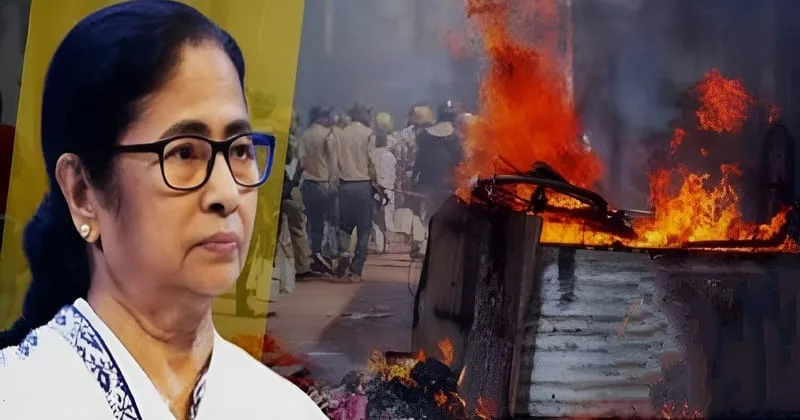
Kolkata: Since Mamata Banerjee and the All India Trinamool Congress (TMC) came to power in 2011, West Bengal has repeatedly witnessed communal tensions and violent clashes across several districts, raising serious concerns about governance and the state’s law-and-order situation.
Since Mamata Banerjee’s coming to power in 2011, West Bengal has repeatedly witnessed communal riots and large-scale clashes across several districts, with Bengali Hindus being at the receiving end.
From Kaliachak in Malda (2016), where a violent mob attacked a police station… pic.twitter.com/AD0OOuLQ73
— Amit Malviya (@amitmalviya) March 9, 2026
For decades, Bengal was widely regarded as a state known for its cultural pluralism, intellectual traditions and social coexistence. However, over the past decade, a series of riots, violent protests and clashes have repeatedly disrupted this image, with many districts witnessing unrest triggered by religious processions, political disputes or local provocations that quickly escalated into communal confrontations.
A Decade of Recurring Communal Flashpoints
One of the most significant early incidents took place in January 2016 in Kaliachak in Malda district. A large mob went on a violent rampage, attacking the local police station, torching vehicles and destroying government property. The scale of the violence shocked many observers, as law enforcement struggled to bring the situation under control.
Later that year, communal riots broke out in Dhulagarh in Howrah district. Several homes and shops were set on fire, forcing residents to flee their neighbourhoods. The violence lasted for days and required heavy deployment of police forces to restore order.
In 2017, the districts of Baduria and Basirhat in North 24 Parganas witnessed major communal clashes after tensions escalated over a social media post. The unrest quickly spiralled into large-scale violence, with mobs engaging in arson and vandalism, leading to the imposition of prohibitory orders and the deployment of central forces.
The following year, in 2018, fresh violence erupted in the industrial belt of Asansol and Raniganj during Ram Navami processions. Several people were killed and large-scale destruction of property was reported as clashes broke out between groups in different localities.
Anti-CAA Protests and Post-Poll Violence
West Bengal again witnessed widespread unrest during protests against the Citizenship Amendment Act in 2019 and early 2020. Protesters blocked railway tracks, vandalised stations and set fire to trains in multiple districts. Public infrastructure suffered significant damage as demonstrations turned violent in several locations.
Another major phase of violence was reported after the 2021 West Bengal Assembly elections. Following the electoral victory of the All India Trinamool Congress, incidents of post-poll violence were reported across several districts. Homes were attacked, properties damaged and people displaced as political clashes erupted in different parts of the state.
The violence drew national attention and led to intervention by courts and central agencies to investigate the incidents. Reports and testimonies from affected residents indicated widespread fear and displacement in some areas during the aftermath of the elections.
Ram Navami Clashes and Renewed Tensions
In recent years, tensions have again surfaced during religious processions. Violent clashes during Ram Navami celebrations in 2023 and 2024 in districts such as Howrah, Rishra and Murshidabad resulted in stone-pelting, crude bomb attacks and incidents of arson.
Several areas witnessed pitched battles between groups, forcing authorities to impose prohibitory orders and deploy large contingents of police and central forces to prevent further escalation. Video footage and reports from the affected areas showed damaged vehicles, burnt shops and deserted streets in the aftermath of the clashes.
These recurring episodes have repeatedly brought West Bengal’s law-and-order situation into national focus. Critics of the state government argue that the administration has failed to prevent the escalation of local disputes into communal violence and has struggled to maintain lasting peace in sensitive areas.
The increasingly charged political climate in the state has also contributed to heightened tensions. Statements by political leaders have often added to the polarised atmosphere surrounding communal incidents. Historical comparisons have also been drawn between the current political climate and the era of Huseyn Shaheed Suhrawardy, whose tenure as Premier of undivided Bengal is associated with the tragic communal violence of Direct Action Day in 1946. That episode remains one of the darkest chapters in Bengal’s history, leaving deep scars on the region’s social fabric.