The Four F’s Framework: Understanding and defining tribal India
July 7, 2026
  • Read Ecopy
  • Circulation
  • Advertise
  • Careers
  • About Us
  • Contact Us
Android AppiPhone AppArattai
Organiser
  • ‌
  • Bharat
    • Assam
    • Bihar
    • Chhattisgarh
    • Jharkhand
    • Maharashtra
    • View All States
  • World
    • Asia
    • Europe
    • North America
    • South America
    • Africa
    • Australia
  • Editorial
  • International
  • Opinion
  • RSS @ 100
  • More
    • Op Sindoor
    • Analysis
    • Sports
    • Defence
    • Politics
    • Business
    • Economy
    • Culture
    • Special Report
    • Sci & Tech
    • Entertainment
    • G20
    • Azadi Ka Amrit Mahotsav
    • Vocal4Local
    • Web Stories
    • Education
    • Employment
    • Books
    • Interviews
    • Travel
    • Law
    • Health
    • Obituary
  • Subscribe
    • Subscribe Print Edition
    • Subscribe Ecopy
    • Read Ecopy
  • ‌
  • Bharat
    • Assam
    • Bihar
    • Chhattisgarh
    • Jharkhand
    • Maharashtra
    • View All States
  • World
    • Asia
    • Europe
    • North America
    • South America
    • Africa
    • Australia
  • Editorial
  • International
  • Opinion
  • RSS @ 100
  • More
    • Op Sindoor
    • Analysis
    • Sports
    • Defence
    • Politics
    • Business
    • Economy
    • Culture
    • Special Report
    • Sci & Tech
    • Entertainment
    • G20
    • Azadi Ka Amrit Mahotsav
    • Vocal4Local
    • Web Stories
    • Education
    • Employment
    • Books
    • Interviews
    • Travel
    • Law
    • Health
    • Obituary
  • Subscribe
    • Subscribe Print Edition
    • Subscribe Ecopy
    • Read Ecopy
Organiser
  • Home
  • Bharat
  • World
  • Operation Sindoor
  • Editorial
  • Analysis
  • Opinion
  • Culture
  • Defence
  • International Edition
  • RSS @ 100
  • Magazine
  • Read Ecopy
Home Bharat

The Four F’s Framework: Understanding and defining tribal India

The four dimensions of Festival, Food, Folk and Fashion together form the very identity of India’s tribal communities. They are not just cultural expressions but defining markers that help us recognize, understand and preserve the uniqueness of each tribe

Dr. Shine P SasidharDr. Shine P Sasidhar
Mar 6, 2026, 07:10 pm IST
in Bharat, Analysis, Opinion, Culture
Follow on Google News
Representative Image

Representative Image

FacebookTwitterWhatsAppTelegramEmail

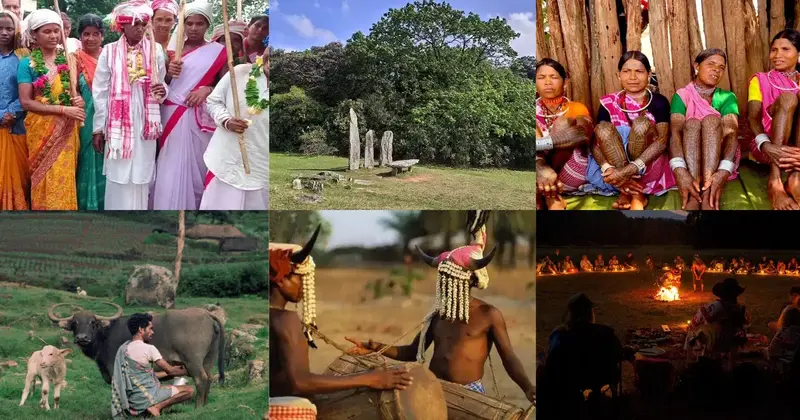
India is home to more than 700 tribal communities, each with its own distinct cultural identity. While there are similarities among them, every tribe has unique traditions that are deeply connected to their faith, land and way of life. Interestingly, when we look at indigenous groups across the world, we find the same balance of uniqueness and shared patterns. Tribal culture can be understood through four important aspects: Festival, Food, Folk and Fashion.

Festivals are one of the strongest markers of tribal identity. They are usually rooted in animistic beliefs, local deities such as forest spirits, hill gods or Bhagavathy and the forces of nature. Most tribal festivals are seasonal, tied to agriculture—sowing, harvest and monsoon cycles—unlike mainstream festivals that often follow mythological calendars. These celebrations reflect a deep bond with land, ancestors and ecological balance. Entire villages take part, with rituals that are simple yet profound: communal offerings, treks to sacred hills and folk dances. Tribal festivals remain local, spiritual and less commercialized, preserving indigenous traditions and strengthening community ties. In some regions, they coexist with temple-centered pan-Indian traditions, creating a dual cultural identity.

Food is another vital part of tribal culture. Tribal cuisines are closely tied to local ecosystems and seasonal produce. They rely on forest-gathered ingredients, fermentation, and traditional cooking methods that preserve both nutrition and heritage. South Indian tribal food, for example, uses rice, millets and coconut but remains distinct from mainstream cuisine. Tribal food traditions emphasize sustainability, medicinal value and community bonding. Ingredients are sourced from forests and shifting cultivation, herbs and flowers are used for healing and meals are simple yet nourishing. Food is central to festivals, rituals and social life.

Across India, tribal cuisines vary widely. In Central India, dishes like Dhuska, Chilka Roti, Bamboo Shoot Curry and Chapda Chutney are common. In the Northeast, tribes prepare Smoked Pork with Bamboo Shoot, Axone, Anishi, Jadoh, Tungrymbai and Eri Polu. In Odisha and Bengal, Mandia Pej, Banda Chutney, Pakhala Bhata and Tama Curry are traditional favorites. Drinks also form part of tribal food culture: Handia, Mahua liquor and Mahua ladoo are popular in Central India, while toddy or Kallu is used in Kerala and Tamil Nadu. Mahua flower liquor is common among tribal communities in Andhra Pradesh.

Also Read: Oil shock forces Pakistan into crisis mode: Govt mulls WFH, online classes as Hormuz closure threatens fuel supply

Folk traditions are the living heartbeat of tribal communities. They include oral narratives, songs, dances, rituals and customs that pass ecological wisdom and values across generations. Folk songs and dances preserve languages and strengthen community solidarity. Myths, legends and folktales explain origins, cosmology and moral codes. Music and dance are inseparable from worship, farming, healing, marriages, and seasonal cycles. Instruments like dhol, mandal, drums and bamboo flutes accompany these performances.

Tribal art in India is a powerful expression of identity, rooted in ecology, oral traditions and ritual practices. Unlike mainstream art, which often emphasizes aesthetics or commercial appeal, tribal art is inseparable from community life and spiritual belief. The government highlights tribal art as part of India’s “living civilisational heritage.” It serves as a visual language that encodes myths, cosmology and ecological wisdom. For example, Warli art from Maharashtra uses simple geometric patterns to depict farming, hunting, and social rituals, symbolizing the tribe’s bond with land and community. Similarly, Gond art from Madhya Pradesh employs vibrant colors and intricate motifs inspired by animals, trees and folklore, reflecting the tribe’s worldview and reverence for nature. These art forms are not merely decorative; they are cultural signatures that distinguish tribal communities from mainstream society, preserving their heritage and asserting their unique identity within India’s diverse civilisational fabric.

Fashion in tribal communities is more than clothing—it is identity, ecology and continuity. Garments, jewelry, tattoos and body art are woven into community life, rituals, and symbolism. Unlike mainstream fashion, tribal attire reflects cultural sovereignty and sustainable living. Handwoven fabrics made from cotton, jute, and bamboo carry motifs inspired by nature, animals and myths. Jewelry made of beads, shells, bones, brass, and silver is often large and symbolic of status or ritual. Tattoos and body painting are common among tribes in Nagaland, Odisha and Chhattisgarh. Clothing is designed not only for beauty but also for farming, hunting, and festivals, balancing utility with tradition. Tribal fashion is a living tradition, expressing heritage and ecological wisdom while serving as a marker of identity.

In conclusion, the four dimensions of Festival, Food, Folk and Fashion together form the very identity of India’s tribal communities. They are not just cultural expressions but defining markers that help us recognize, understand and preserve the uniqueness of each tribe. Festivals embody their spiritual connection with land and nature, food reflects ecological wisdom and sustainability, folk traditions carry ancestral memory and solidarity and fashion symbolizes continuity, sovereignty, and heritage. Taken together, these four aspects provide a holistic framework to identify and define tribal life in India, ensuring that their voices and traditions remain integral to the nation’s civilizational fabric.

Topics: Tribal FoodIndiatribal cultureTribal festivalsTribal ArtTribal Fashion
ShareTweetSendShareSend
✮ Subscribe Organiser YouTube Channel. ✮
✮ Join Organiser's WhatsApp channel for Nationalist views beyond the news. ✮
Previous News

Bangladesh General Election Results-— Decoding Jamaat: Bharat’s Bugbear 

Next News

From Macaulay to Mamata via Marxists: Who is responsible for Bengal’s economic decline?

Related News

117 pseudo-intellectuals write to PM Modi to extend diplomacy with Pakistan at the cost of national security

PM Modi and Australian PM Anthony Albanese

Powering India’s Nuclear Future: PM Modi’s Australia visit brings the landmark Uranium deal into focus

Prime Minister Narendra Modi was recieved at the airport by the Indonesian President Prabowo Subianto

Historic Welcome for PM Modi in Jakarta: Escort by Indonesia Fighter jets; Recieved by President Prabowo at the airport

Prime Minister Modi embarks on a three nation visit to Indonesia, Australia and New Zealand

PM Modi emplanes to Indonesia, Australia & New Zealand; An impetus to reinforce Act East policy & Indo-Pacific security

US Justice Department dismisses charges against Gautam Adani; Urges court to drop the case as it is legally flawed

The Hangor Story: What China’s submarine gift to Pakistan really means for India?

Load More

Latest News

Shri Ram Janmabhoomi Teerth Kshetra Trust accepts resignation on moral grounds; SIT submits interim report

Ayodhya Ram Mandir Donation Row: Trust accepts resignations, promises greater transparency; SIT submits interim report

Nida Khan one of the accused in Nashik TCS Corporate Jihad Case gets bail

Nashik TCS Corporate Jihad Case: Court grants bail to Nida Khan in conversion and sexual harassment case

Karnataka State BJP files complaint with Election Commission over irregularities in voter verification

Karnataka SIR Row: NDA submits documentary evidence to Election Commission, alleges irregularities in voter revision

Hindenburg report was a conspiracy to tarnish the image of India’s industrial sector using the Adani Group as a pretext

Battlefield to Top of the World: Indian Paralympian Hokato Hotozhe Sema becomes No.1 in shot put F57 category

Editor of Organiser Weekly Prafulla Ketkar and West Bengal Governor R N Ravi at the Narad Jayanti Udjapan & Narad Samman 2026

Whether my reporting is in the interest of nation or not is a litmus test for journalist: West Bengal Governor R N Ravi

POJK Protests: A reality check on atrocities committed by Pakistan

117 pseudo-intellectuals write to PM Modi to extend diplomacy with Pakistan at the cost of national security

80 years of Organiser: Enduring voice

PM Modi and Australian PM Anthony Albanese

Powering India’s Nuclear Future: PM Modi’s Australia visit brings the landmark Uranium deal into focus

Load More
  • Privacy
  • Terms
  • Cookie Policy
  • Refund and Cancellation
  • Delivery and Shipping

© Bharat Prakashan (Delhi) Limited.
Tech-enabled by Ananthapuri Technologies

  • Home
  • Search Organiser
  • Bharat
    • Assam
    • Bihar
    • Chhattisgarh
    • Jharkhand
    • Maharashtra
    • View All States
  • World
    • Asia
    • Africa
    • North America
    • South America
    • Europe
    • Australia
  • Editorial
  • Operation Sindoor
  • Opinion
  • Analysis
  • Defence
  • Culture
  • Sports
  • Business
  • RSS @ 100
  • Entertainment
  • More ..
    • Sci & Tech
    • Vocal4Local
    • Special Report
    • Education
    • Employment
    • Books
    • Interviews
    • Travel
    • Health
    • Politics
    • Law
    • Economy
    • Obituary
  • Subscribe Magazine
  • Read Ecopy
  • Advertise
  • Circulation
  • Careers
  • About Us
  • Contact Us
  • Policies & Terms
    • Privacy Policy
    • Cookie Policy
    • Refund and Cancellation
    • Terms of Use

© Bharat Prakashan (Delhi) Limited.
Tech-enabled by Ananthapuri Technologies