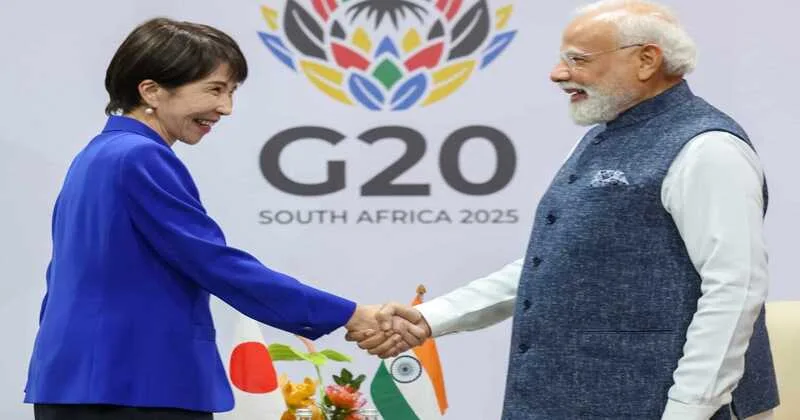
New Delhi: India and Japan are exploring a strategic partnership to jointly develop rare earth deposits in the desert state of Rajasthan, as Tokyo seeks to reduce its dependence on China for minerals crucial to advanced manufacturing and defence technologies.
According to the reports, the talks follow a preliminary agreement on critical minerals signed between the two countries last year. The proposed collaboration could see Japan providing advanced extraction technology and financial investment in exchange for a stable supply of rare earth materials.
Last month, India’s Mines Minister G. Kishan Reddy announced that three hard-rock rare earth deposits containing an estimated 1.29 million metric tonnes of rare earth oxides had been identified in Rajasthan and neighbouring Gujarat. These discoveries are considered significant for India’s ambitions to strengthen its domestic supply of strategic minerals.
Reports say that Japan has shown particular interest in the Rajasthan deposits. Tokyo is planning to send a team of technical experts to assess the site and examine the feasibility of joint exploration and extraction. However, the timeline for the visit has not yet been finalised.
Strategic minerals and technology cooperation
Rare earth elements are vital components in the production of permanent magnets used in electric vehicle motors, wind turbines, advanced electronics, fighter jets and drones. Their growing importance has made them central to both economic development and national security strategies.
China currently dominates the global rare earth supply chain, accounting for a significant share of mining and processing capacity. This dominance has pushed many countries, including India and Japan, to diversify their sources and develop independent processing capabilities.
According to the sources, Japan could offer specialised technology required to extract rare earth elements from hard-rock deposits, an area where India currently lacks sufficient expertise. In return, Japan would receive assured offtake agreements, ensuring a steady supply of these critical minerals.
India is also keen to build industrial-scale facilities capable of processing rare earth elements to high purity levels, an essential step for manufacturing advanced technologies domestically. Japanese technical expertise could play a crucial role in helping India establish such capabilities.
India’s Ministry of Mines and the Japanese embassy did not immediately respond to requests for comment on the discussions. Naoki Kobayashi, deputy director at Japan’s Ministry of Economy, Trade and Industry (METI), confirmed that Tokyo is examining mining projects worldwide to diversify its mineral supplies. However, he declined to comment on any specific partnership or technology transfer plans related to Rajasthan. The growing urgency for diversification follows recent tensions between Japan and China. Last week, Beijing restricted exports of certain dual-use materials, items that can serve both civilian and military purposes, to 20 Japanese entities that China claims are linked to Japan’s military supply chain.
The move effectively blocks Japanese companies from accessing several rare earth elements and related materials on China’s export control list.
Beyond rare earths, Japan is also exploring cooperation with Indian companies in overseas mining projects, including the search for lithium, copper and cobalt in Africa, further strengthening strategic resource partnerships between the two nations.