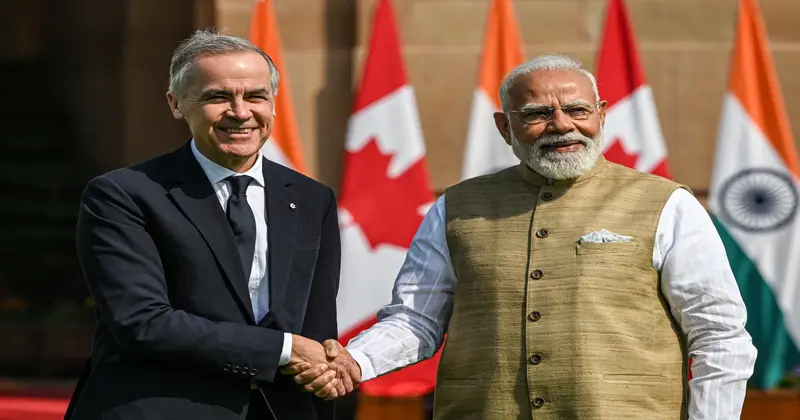
India-Canada relations have seen many ups and downs over the past few years, but the recent meeting between Prime Minister Narendra Modi and Canadian Prime Minister Mark Carney has given the bilateral relationship a new direction and energy. The talks with the Canadian Prime Minister, who is on a four-day visit to India, yielded concrete agreements on future technology, energy security, supply chains and trade expansion, further strengthening India’s role in 21st-century global geopolitics and economics.
This visit comes at a time when the world is experiencing a technological revolution, energy transition and supply chain crisis. Therefore, this cooperation between India and Canada could prove to be extremely important for both countries from strategic, economic and technological perspectives.
The beginning of new energy and trust
Prime Minister Modi’s statement at the joint press conference that “our first meeting itself has brought new energy, mutual trust and positivity to the relations between the two countries” clearly reflects a serious effort to thaw the frostiness that had settled over the past few years. It must be said that both India and Canada are countries that believe in democratic values, human rights and a pluralistic society. Their shared vision is “the well-being of humanity”. Efforts are now underway to transform this shared vision into a “Next Partnership”, a strategic partnership for the future. The goal of reaching $50 billion in bilateral trade by 2030 offers a concrete roadmap in this direction.
Foundations of AI, Quantum and Semiconductors
The most significant and far-reaching aspect of the agreements between India and Canada is cooperation in future technologies. Partnerships in areas such as Artificial Intelligence (AI), quantum computing, supercomputing and semiconductors are a major step towards India becoming a technological superpower.
Today, the world is engaged in a new technological race, where data, computing power and chip manufacturing are determining the balance of power. Amid the US-China tech war, India has an opportunity to emerge as a reliable technology partner. Canada holds a strong position in the research, innovation and startup ecosystem in this region, while India has a vast talent pool and a rapidly growing digital market.
Space and Startup cooperation
The plan to connect startups and private industries in the space sector could prove to be a milestone for India’s nascent space sector. Following ISRO’s successes, the number of space startups in India has grown rapidly. A partnership with Canada will facilitate access to technology, funding and the global market. This will create new employment opportunities and position India as a major global player in space technology.
A step towards a green future
Cooperation in the energy sector is another major pillar of India-Canada relations. Partnerships in areas such as hydrocarbons, renewable energy, green hydrogen and energy storage are crucial for both India’s energy security and climate goals. India is a rapidly growing economy, with rapidly increasing energy needs. Canada possesses vast reserves of natural resources and clean energy technologies. Cooperation between the two countries will ensure stable energy supplies and enable concrete progress towards reducing carbon emissions.
The India-Canada Renewable Energy and Storage Summit will provide a platform to translate this partnership into practice. Additionally, Canada’s joining the International Solar Alliance (ISA) and the Global Biofuel Alliance further strengthens India’s global leadership role.
Critical minerals and supply chains
In today’s global economy, the importance of critical minerals such as lithium, cobalt, nickel and rare earth elements determines a country’s economic and strategic strength. Electric vehicles, batteries, semiconductors and defense equipment depend on them. Canada is a major producer of these minerals, while India is poised to become a major consumer. Therefore, the MoU on critical minerals is crucial for India’s supply chain security. This will reduce dependence on China and ensure India has a stable supply chain for its green energy and electric mobility plans. This agreement also strengthens India’s strategic position, as future battles will be based on resources and technology.
Prime Minister Modi’s announcement that Canadian pension funds have invested $100 billion in India is a significant sign of global confidence in India’s economy. This investment in sectors such as infrastructure, real estate, fintech, and green energy will accelerate job creation and growth. The Terms of Reference for CEPA (Comprehensive Economic Partnership Agreement) and the Joint Pulse Protein Center of Excellence agreement will strengthen agriculture, food security and trade balance. This will directly benefit farmers, startups, and the MSME sector.
Strategic balance and global diplomacy
It is not enough to view India-Canada agreements solely from a bilateral perspective. This partnership further strengthens India’s position in the global balance of power. Strong relations with Canada establishes India as a reliable, stable and democratic partner. This cooperation also strengthens India’s multilateral diplomacy, where it is working with the United States, Europe, Japan, Australia and now Canada to build a balanced global framework.