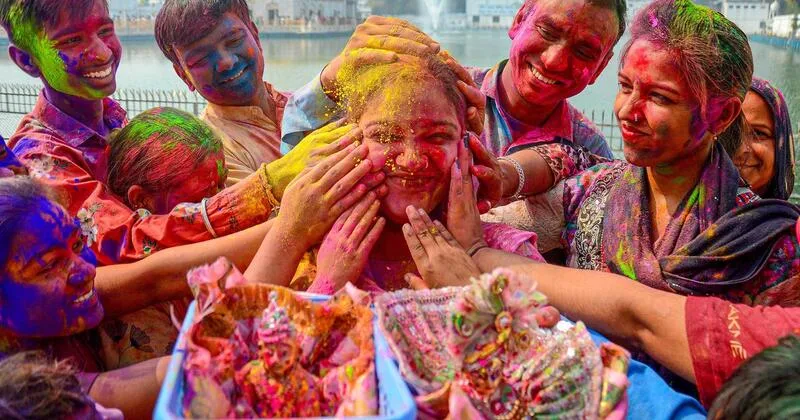
As India prepares to celebrate Holi with colour, music and mass public gatherings across cities and villages, much of the world remains on edge amid war, terror alerts and geopolitical instability. From Europe’s tightened security during Christmas, Jewish festivals to escalating tensions during Ramazan in the Arab World and ongoing open war between Pakistan and Afghanistan in South Asia, the global security landscape presents a stark contrast to India’s festive calm.
Holi celebrations mark an atmosphere of stability
Across India, from the temple towns of Mathura and Vrindavan in Uttar Pradesh to metropolitan centres like Delhi and Mumbai, millions are set to celebrate Holi in open streets without fear of large-scale disruption. Holi, the Hindu festival symbolising the triumph of good over evil and the arrival of spring, has traditionally drawn massive public participation. This year, security agencies have maintained routine vigilance, but there have been no nationwide terror alerts disrupting celebrations. According to India’s Ministry of Home Affairs data over recent years, major terror incidents have significantly declined compared to the early 2000s. The National Investigation Agency (NIA) has repeatedly highlighted the dismantling of several extremist modules. Government officials have credited improved intelligence coordination and border management for strengthening internal security.
Security experts note that India has managed to balance festive openness with preventive policing. Public gatherings for Holi, including high-footfall events in temple towns and university campuses, are proceeding in a largely peaceful environment.
Christmas and Jewish communities under heightened security shadow
In contrast, several European nations have celebrated Christmas in recent years under heightened terror alerts, with Christian communities gathering under visible security arrangements. Following past Islamic terror attacks such as the 2016 Berlin Christmas market attack, subsequent lone-wolf incidents in France and the UK, and the Bondi Beach attack in Australia in 2025, Western governments routinely deploy armed patrols around churches, markets and public squares during Christmas.
Countries, including Germany and France, have maintained high security levels under their national terror threat frameworks. Media reports from agencies such as Reuters and the BBC have frequently documented large-scale police deployments, installation of concrete barriers, and drone surveillance during festive periods.
European intelligence agencies continue to warn of radicalised individuals inspired by Islamic terror and extremist networks. As a result, Christmas celebrations often take place under visible security presence, reflecting persistent threat perceptions and concerns about the safety of Christian worshippers and public gatherings.
The October 2024 attack by Hamas in Israel during the Jewish festival of Simchat Torah, in which around 1,200 people were killed, and hundreds were taken hostage, has further heightened global security concerns surrounding Jewish communities. In the aftermath of the attack, synagogues and Jewish institutions across parts of Europe and other Western nations witnessed reinforced security deployments amid fears of spillover violence and antisemitic incidents. Governments increased police patrols around Jewish neighbourhoods and religious centres, reflecting broader anxieties over the safety of Jewish worshippers and public gatherings.
West and South Asia amid conflict during Ramazan
In West Asia, Muslims are observing this year’s Ramazan, a sacred month of fasting, prayer and reflection, amid the ongoing war triggered after the killing of Iranian Supreme Leader Ali Khamenei by the coordinated attack of the US and Israel. The conflict has escalated into direct military exchanges involving Iran, Israel, the United states and several Arab states.
Following Khamenei’s death, Iran launched retaliatory missile and drone strikes that triggered air defence responses across parts of the Gulf. International news agencies have reported missile alerts and interceptions over Saudi Arabia, the United Arab Emirates, Qatar and Bahrain, with debris from intercepted projectiles falling near civilian zones. Arab governments publicly condemned Tehran’s actions, calling the attacks a dangerous escalation that threatened regional stability during Ramadan.
Saudi Arabia and the UAE reinforced critical oil and energy installations after Iranian threats of further strikes. Qatar reportedly activated air defence systems following missile warnings, while Bahrain heightened security around strategic facilities hosting Western military assets. Arab foreign ministries issued coordinated statements accusing Iran of destabilising the region during a sacred religious period.
The confrontation has deepened divisions within the Muslim world itself, with Arab states aligning against Tehran’s military posture. Security analysts describe the situation as an open power struggle between major Muslim-majority states, unfolding during Ramadan under conditions of heightened alert.
Meanwhile, in South Asia, tensions between Pakistan and Afghanistan remain volatile, with cross-border firing and militant incidents reported along the Durand Line. Armed clashes and political instability continue to shape the security environment in both countries.
For Muslims across parts of West Asia and the Pakistan–Afghanistan belt, Ramadan prayers are proceeding under reinforced security deployments, missile alerts and regional war tensions.
Against this backdrop of open hostilities between Muslim states in West Asia and instability in South Asia, India’s relatively stable security environment stands out as it prepares for large-scale Holi celebrations without nationwide terror alarms or war threats.
India’s s strategic and internal security posture
India’s approach has combined counter-terror operations, border fencing, coastal surveillance and intelligence modernisation. Following past attacks such as the 2008 Mumbai terror strikes, India overhauled its coastal security architecture and created specialised agencies like the National Investigation Agency. Analysts point to the abrogation of Article 370 in Jammu and Kashmir in 2019 as a major political shift, after which official data indicates a decline in stone-pelting incidents and organised strikes, though sporadic militant encounters continue. India has also enhanced cooperation with global partners on counter-terror financing through platforms such as the Financial Action Task Force (FATF). Pakistan was placed on the FATF grey list between 2018 and 2022, underscoring regional counter-terror scrutiny. Despite facing complex border challenges with both China and Pakistan, India has largely insulated its major cities from large-scale terror disruptions in recent years.
In addition, security agencies have recently operationalised the PRAHAR initiative to strengthen rapid-response counter-terror capabilities and intelligence coordination, while targeted operations such as Operation Sindoor have focused on dismantling cross-border terror infrastructure linked to Pakistan, particularly in the aftermath of the 2025 Pahalgam terror attack , reinforcing India’s continued emphasis on pre-emptive security action and terror infrastructure neutralisation.
While no nation is entirely immune to security threats, India’s ability to host mass festivals such as Holi without widespread fear reflects a degree of internal stability that contrasts with parts of Europe and conflict-hit regions.
As colours fill the streets and communities gather in celebration, the imagery emerging from India is one of vibrancy and openness. In a world grappling with war, terror alerts and geopolitical rivalries, where Christians in parts of Europe celebrate Christmas under heavy security and Muslims in sections of West Asia and the Pakistan–Afghanistan belt observe Ramazan amid conflict tensions, India’s festive normalcy sends a powerful message of resilience. For many observers, Holi 2026 is not just a cultural celebration; it is also a quiet testament to India’s security preparedness and social cohesion at a time when much of the world remains on guard.