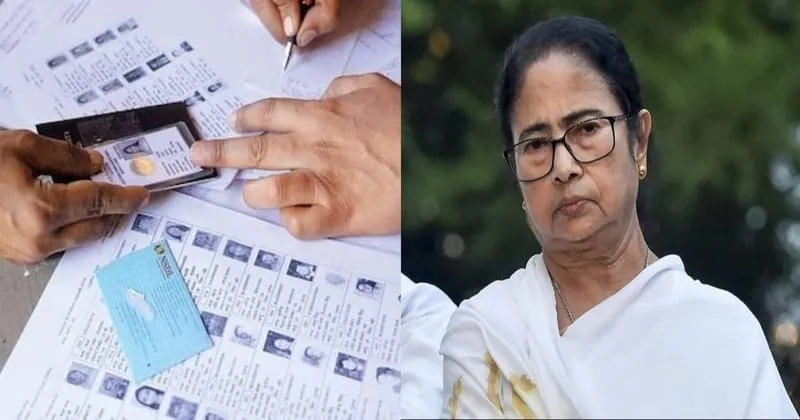
Kolkata: West Bengal’s political landscape has once again been stirred by controversy, this time over the Special Intensive Revision (SIR) of electoral rolls and the scrutiny of nearly 60 lakh voter entries. The issue has triggered sharp reactions from the ruling All India Trinamool Congress (TMC) and its chief, Mamata Banerjee, who has vocally opposed the exercise.
This explains why Mamata Banerjee has been screaming against SIR.
Out of 60 lakh pending cases under scrutiny, the top 5 districts with the highest number of voters under review are all along the Bangladesh border, districts with significantly high Muslim populations as per the… pic.twitter.com/q86NKsgHcj
— Amit Malviya (@amitmalviya) February 28, 2026
At the heart of the debate are the numbers emerging from districts along the Bangladesh border. Of the 60 lakh cases reportedly under scrutiny, the top five districts with the highest number of voters under review are:
Murshidabad – 11 lakh (66 per cent Muslim population as per Census)
Malda – 8.3 lakh (51 per cent)
Uttar Dinajpur – 4.8 lakh (50 per cent)
North 24 Parganas – 5.9 lakh (26 per cent)
South 24 Parganas – 5.2 lakh (36 per cent)
Four of these five districts share porous international borders with Bangladesh, a factor that has historically made them politically and demographically sensitive. The concentration of cases in these regions has raised questions among opposition parties about alleged irregularities in voter enrolment over the years.
WC hero, Ministers among 60 lakh under cloud
The controversy has deepened with prominent names surfacing among those reportedly flagged during scrutiny. Wicketkeeper Richa Ghosh, one of the stars of India’s ICC Women’s World Cup-winning team, is said to be among those whose voter status has come under review.
Former footballer-turned-coach Mehtab Hossain, who represented India in 30 international matches over nine years, has also reportedly found himself on the list. More significantly, three Ministers in the Mamata Banerjee government, Shashi Panja, Md Ghulam Rabbani and Tajmul Hossain, are said to be among those whose voter records are under scrutiny.
Adding to the list is Yasin Pathan, who won the prestigious Kabir Puraskar in 1954 for helping protect temples in West Midnapore during communal unrest.
All six are reportedly among the 60 lakh-odd voters who discovered over the weekend that their names may not automatically qualify them to vote in the next Assembly election unless verification issues are resolved.
TMC’s defensive posture
Mamata Banerjee has strongly criticised the SIR process, calling it politically motivated and an attempt to target specific communities. However, critics argue that her resistance appears less about safeguarding democratic rights and more about shielding systemic lapses that have now come under scrutiny.
Opposition leaders claim that if decorated sportspersons, senior ministers and award recipients can be flagged, it points either to deep administrative failures in maintaining accurate electoral rolls or to years of casual enrolment practices under the state government’s watch.
The TMC has long faced accusations from rivals of overlooking irregular migration and demographic changes in border districts for electoral consolidation.
Border districts and electoral arithmetic
Districts such as Murshidabad and Malda have played a decisive role in West Bengal’s electoral outcomes. With substantial minority populations, they have often been strongholds of the TMC. Political observers note that a stricter voter verification process in these areas could potentially reshape constituency-level equations.
With Assembly elections on the horizon, the stakes are high. The scrutiny of 60 lakh voter entries, particularly in strategically crucial border districts, has become more than an administrative exercise; it is now a political flashpoint.