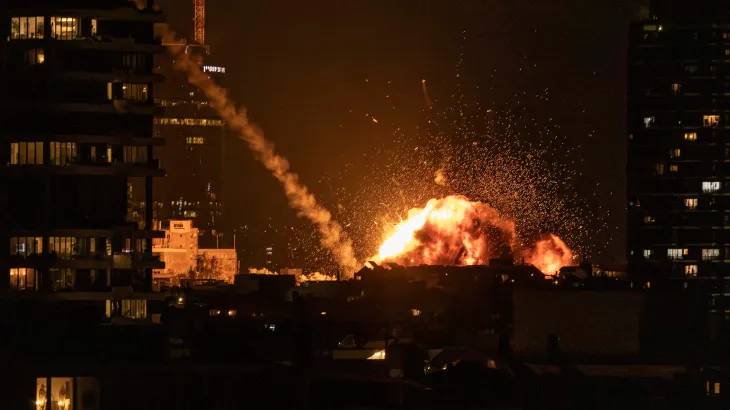
As dramatic and conflicting reports swirl around the fate of Iran’s Supreme Leader and tensions surge following joint U.S.-Israeli strikes, the political reactions on both sides of the Atlantic have revealed a striking contrast. In Israel, even opposition leaders have projected national unity amid escalating hostilities with Tehran. In the United States, however, the military action has exposed sharp partisan divisions, with several prominent Democratic figures openly criticising the strikes and warning against deeper entanglement in another Middle Eastern conflict.
The unfolding crisis has not only intensified the military confrontation between Israel, the United States, and Iran, but has also laid bare fundamentally different political instincts, one emphasising wartime cohesion and deterrence, the other prioritising restraint, legality, and domestic concerns over foreign escalation.
In Israel, opposition leader Yair Lapid struck a message of unity following the joint U.S.-Israeli strikes.
“I want to remind us all: The people of Israel are strong. The IDF and the Air Force are strong. The strongest power in the world stands with us,” Lapid wrote, adding that in moments like these, “we stand together and we win together.”
Lapid further declared, “There is no coalition and no opposition, only one people and one IDF, with all of us behind them.”
His remarks reflect Israel’s longstanding wartime political culture, in which opposition factions typically suspend partisan conflict during active military operations. Israel has faced repeated hostilities from Iran and its regional proxies over the years, including missile attacks and support for armed groups targeting Israeli civilians.
Israeli officials have frequently accused Tehran of directing and financing strikes that have killed and injured innocent Israelis, describing Iran as the principal architect of a multi-front pressure campaign against the Jewish state.
Reports of Khamenei’s death add to volatility
The statements come amid disputed claims that Ali Khamenei was killed in recent strikes targeting his Tehran compound. While U.S. President Donald Trump declared Khamenei dead and described the moment as an opportunity for Iranians to reclaim their country, Iranian state media denied the claim.
The lack of independent confirmation has intensified uncertainty across the region, with fears of further retaliation from Iran or its allied militias.
US opposition voices sharp criticism
In contrast to Israel’s display of cross-party unity, several American political leaders responded with sharp criticism of the military action.
New York City Mayor Zohran Mamdani called the strikes “a catastrophic escalation in an illegal war of aggression,” accusing Washington and Jerusalem of “bombing cities” and “killing civilians.” He argued that Americans “do not want another war in pursuit of regime change” and instead seek economic relief and peace.
Democratic Representative Rashida Tlaib said the American public does not want war with Iran, accusing President Trump of acting on “the violent fantasies of the American political elite and the Israeli apartheid government.”
Meanwhile, House Minority Leader Hakeem Jeffries focused on constitutional concerns, stating that Trump “failed to seek Congressional authorisation prior to striking Iran.” Jeffries warned that abandoning diplomacy could expose American troops to retaliation and said lawmakers were praying for service members placed “in harm’s way.”
Diverging political cultures
The contrast highlights differing political dynamics.
In Israel, direct exposure to missile fire and long-running hostilities with Iran have historically driven political consolidation during crises. Tehran has been accused of orchestrating or supporting attacks through regional allies, contributing to years of intermittent violence affecting Israeli civilians.
In the United States, geographic distance from the battlefield and constitutional war powers debates have often produced sharper partisan divisions over military intervention.
As speculation continues over Khamenei’s fate and the scope of potential retaliation, the political messaging from opposition figures on both sides of the Atlantic underscores the broader divide.
In Jerusalem, the emphasis is on unity behind the military establishment. In Washington, debate over legality, strategy and national interest remains intense, even as U.S. forces operate alongside Israel in an increasingly volatile theatre.