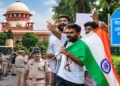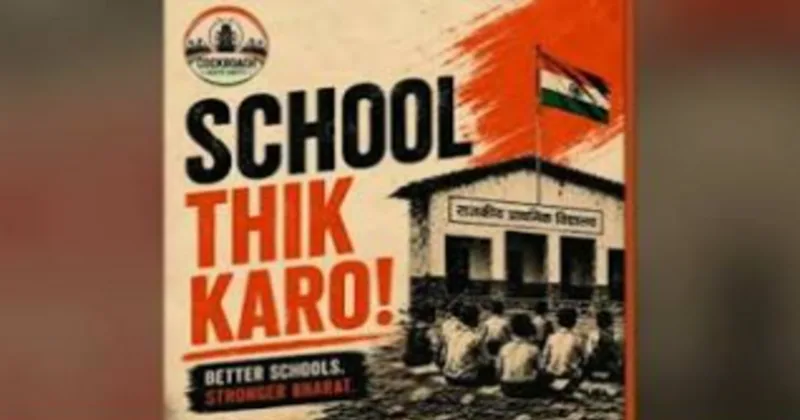
The Supreme Court has declined to entertain a PIL challenging restrictions imposed by authorities in Rajasthan and Uttar Pradesh on outsiders, journalists, YouTubers and social-media users entering government schools and filming inside their premises.
The order itself is brief. Its context, however, raises a much larger question: where does public accountability end and the privacy, dignity and safety of schoolchildren begin? In Priya Mishra v. Union of India & Ors., a Bench of Justices P.S. Narasimha and Alok Aradhe on September 1 said that it was not inclined to entertain the petition under Article 32 of the Constitution.
The petition was filed against restrictions introduced amid the “School Thik Karo” campaign. Rajasthan’s Director of Secondary Education had issued an August 16 circular requiring outsiders to obtain prior permission before entering government-school premises. Written permission was also required for photography, videography, interviews, audio recording and livestreaming.
In Uttar Pradesh, an August 19 order of the District Basic Education Officer at Ayodhya imposed similar restrictions on outsiders and social-media content creators, with comparable directions reported from several other districts.
The petitioner argued that the restrictions impaired freedoms under Articles 14, 19, 21 and 21-A. Her case sought to distinguish filming identifiable children from documenting deficient infrastructure — toilets, classrooms, drinking water, electricity or mid-day meal facilities.
That concern is not frivolous. Government schools are public institutions and deficiencies in them must remain open to scrutiny. But there is another side which cannot be wished away in the age of viral content. A child attending a government school does not thereby become public figure
Children cannot be converted into unwilling backdrops for political campaigns, social-media reels or competitive “exposé” journalism. Their faces, conversations, classrooms and vulnerabilities deserve a degree of maryada irrespective of whether their parents can afford a private school.
Unlike elected representatives, school children have not voluntarily entered public life. An insistence on prior permission therefore cannot automatically be equated with censorship. A school principal knowing who has entered the premises, why cameras are being used and whether children are being interviewed is also an elementary component of institutional responsibility.
This becomes still more important because minors occupy a specially protected position in law. Child safety, privacy and dignity are not lesser constitutional values simply because a video may be made in the name of activism.
The practical principle nevertheless deserves attention. Accountability of government schools is necessary. So is the protection of children. A camera pointed at a broken classroom wall may serve public interest. A camera thrust into a child’s face without permission may not. In an age where outrage itself has become digital currency, Bharat’s children deserve scrutiny of the system without becoming content for the system’s critics.