The United States and Israel carried out missile strikes on Iran on Saturday. They said the attack was preventive in nature. Large explosions were reported in different parts of Tehran. This has sharply increased tensions in the Middle East and raised fears of a fresh military conflict. The strikes happened even as diplomatic talks were ongoing between Iran and the United States.
Reports say the presidential building complex in Tehran was also targeted. Iran’s Supreme Leader, Ayatollah Ali Khamenei, has been shifted to a secure location for safety.
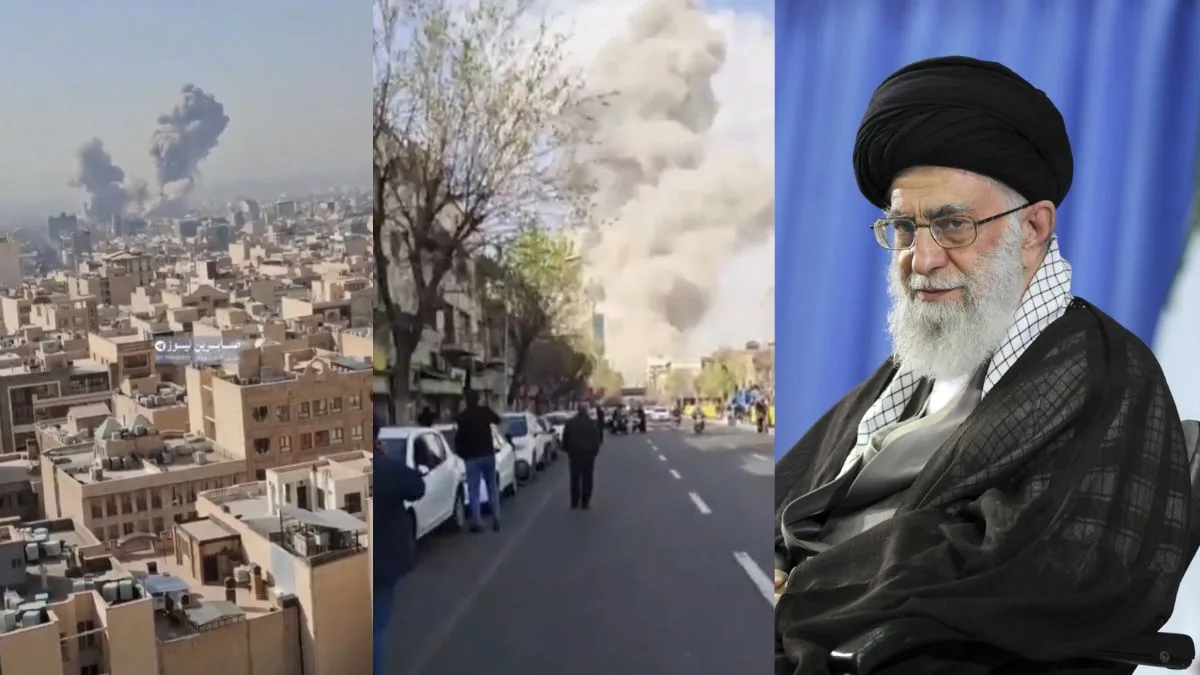
Missiles struck multiple locations across central and eastern Tehran on Saturday, sending thick plumes of smoke rising over parts of the Iranian capital, according to Reuters, which cited local media reports. The strikes mark a sharp escalation in tensions between Israel and Iran, raising concerns of a wider regional confrontation.
Watch Videos Here…
🚨 HUGE! ISRAEL HAS LAUNCHED PREVENTATIVE ATTACK AGAINST IRAN.
EXPLOSIONS reported in Tehran. Air raid sirens sound across Israel 💥
— Iran vs Israel/US….? pic.twitter.com/KdBWiBrLjS
— Megh Updates 🚨™ (@MeghUpdates) February 28, 2026
In an official statement, Israeli Defence Minister Israel Katz said the operation was intended to eliminate threats posed by Iran. “The State of Israel launched a pre-emptive attack against Iran to remove threats to the State of Israel,” he said. Israeli defence officials added that the action was carried out in coordination with the United States.
Iran’s Supreme Leader Ayatollah Ali Khamenei Shifted to save house
Following the strike, Israel’s military imposed emergency restrictions across the country. Authorities announced a temporary prohibition on educational activities, public gatherings, and most workplace operations, while exempting essential services. The measures signalled preparations for possible retaliation.
The latest action comes months after Israel and Iran were engaged in a 12-day aerial confrontation in June, one of the most direct military exchanges between the two long-standing adversaries. Since then, both sides have traded warnings, with Israel and the United States cautioning that military options remained on the table if Iran continued advancing its nuclear and ballistic missile programmes.
Diplomatic efforts had resumed earlier this year, with Washington and Tehran reopening negotiations in February in a bid to resolve their decades-long standoff and prevent a broader conflict. However, significant differences remain.
Israel has insisted that any agreement must go beyond limiting uranium enrichment and instead ensure the full dismantling of Iran’s nuclear infrastructure. It has also demanded that restrictions on Iran’s missile capabilities form part of any comprehensive deal.
Iran, for its part, has expressed willingness to negotiate limits on its nuclear programme in exchange for sanctions relief but has categorically ruled out talks on its missile development. Tehran has also warned that neighbouring countries hosting US military forces could face consequences if American bases are used to launch attacks against it.
With both military and diplomatic tracks now colliding, the situation threatens to push an already volatile region into renewed instability.