Delhi: The Indian Air Force (IAF) has released dramatic footage highlighting the formidable capabilities of the S-400 Triumf long-range air defence system that safeguards Indian airspace. Known in India as “Sudarshan,” the system has reportedly set a new global benchmark by successfully engaging one of the longest-range targets ever recorded in operational conditions.
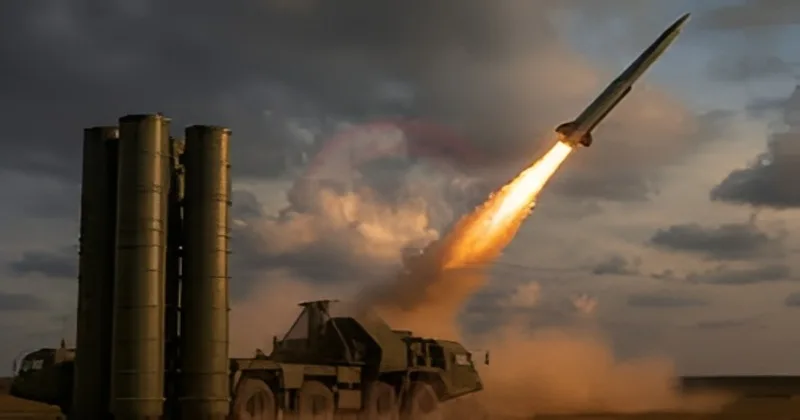
During the military operation ‘Operation Sindoor’ in May 2025, defence officials disclosed that the Sudarshan system accurately neutralised a target located approximately 300 kilometres away, deep inside Pakistani territory. According to officials, this marks the first instance in military history where a missile defence system has struck a target at such an extended range in a live operational scenario. The released footage shows radar systems identifying the hostile target before a missile is launched, streaking across the sky and destroying the objective within seconds. Defence analysts describe the demonstration as a powerful signal of India’s expanding air defence capabilities, emphasising that even threats beyond visual range are well within the system’s reach. India had signed a $5.4 billion agreement with Russia in 2018 to procure five units of the S-400 system. Built using advanced Russian technology, the platform is regarded as one of the most sophisticated surface-to-air missile defence systems in the world.
Record-breaking strike during ‘Operation Sindoor’
Officials stated that the successful 300-kilometre engagement during Operation Sindoor represents a historic achievement in modern air warfare. The system’s advanced radar network detected and tracked the target with precision before launching a missile that eliminated it within moments. Military experts note that while the S-400 is designed for ranges of up to 400 kilometres depending on the missile variant, achieving such operational accuracy at around 300 kilometres demonstrates exceptional integration between radar, command systems and missile guidance.
The footage released by the IAF captures the entire sequence, from radar identification to missile launch and final impact. Defence authorities say the strike serves as a strong warning that hostile aircraft, drones or missile systems cannot evade Indian air defences simply by remaining beyond the visible horizon. The system’s ability to engage targets at extended distances enhances India’s strategic deterrence posture. It ensures that threats can be neutralised before entering critical airspace, significantly strengthening national security architecture.
#WATCH | For the first time, the Indian Air Force shares a video showcasing the Sudarshan S-400 long-range air defence missile system in operation, along with a caption of scoring the longest ever kill recorded in military history.
The Indian Air Force had secured the kill… pic.twitter.com/lDxQx2vynu
— ANI (@ANI) February 26, 2026
Technical superiority and multi-layered defence
The S-400 Triumf system, referred to domestically as Sudarshan, is often compared to the mythological Sudarshan Chakra because of its speed and destructive precision. It is capable of intercepting fighter jets, unmanned aerial vehicles (UAVs), cruise missiles and ballistic missiles.
One of the system’s most powerful components is the 40N6 long-range missile, which can strike targets up to 400 kilometres away. Its radar systems are capable of detecting aerial movements at distances of up to 600 kilometres, giving operators early warning and tracking capabilities.
Sudarshan employs a multi-layered defence architecture. It is equipped with four different types of missiles designed for varying ranges, from short-range to ultra-long-range engagements. This layered approach ensures that both nearby and distant threats can be countered effectively.
The system can reportedly track over 100 aerial targets simultaneously and engage up to 36 of them at once. Such capacity makes it one of the most powerful air defence platforms currently in service worldwide.
Another key feature is its rapid deployment capability. The system can become operational within approximately five minutes, allowing a swift response during emergencies. Its advanced radar technology is also claimed to have the ability to detect and intercept stealth aircraft, cruise missiles and ballistic threats, assets traditionally considered difficult to track.
Strengthening India’s air shield
Defence officials emphasise that the S-400 system plays a crucial role in countering potential threats from neighbouring countries such as China and Pakistan. The system’s extended radar coverage allows it to monitor aircraft movements from long distances, potentially identifying hostile activity shortly after take-off. By integrating Sudarshan into India’s broader air defence grid, alongside indigenous systems like Akash and frontline fighter aircraft such as Tejas, Rafale, Sukhoi-30MKI, MiG-29 and Jaguar, the country has significantly enhanced its aerial security framework.
The Sudarshan system is also expected to feature prominently in the upcoming ‘Vayu Shakti’ exercise at Pokhran, where it will once again demonstrate its capabilities before defence observers.
Officials state that the recent 300-kilometre engagement during Operation Sindoor underlines India’s growing air power and technological advancement. The strike, they say, reinforces the message that India now possesses an “invisible shield” capable of intercepting aerial threats well before they approach strategic cities such as Delhi.
With its exceptional range, precision, rapid deployment capability and multi-target engagement strength, Sudarshan stands as one of the most formidable pillars of India’s modern defence system, a symbol of the country’s expanding strategic reach and preparedness in an increasingly complex security environment.