Sanskrit in Termez: Ancient monasteries preserving devotion
September 15, 2026
  • Read Ecopy
  • Circulation
  • Advertise
  • Careers
  • About Us
  • Contact Us
Android AppiPhone AppArattai
Organiser
  • ‌
  • Bharat
    • Assam
    • Bihar
    • Chhattisgarh
    • Jharkhand
    • Maharashtra
    • View All States
  • World
    • Asia
    • Europe
    • North America
    • South America
    • Africa
    • Australia
  • Editorial
  • International
  • Opinion
  • RSS @ 100
  • More
    • World Hindu Congress 2026
    • Op Sindoor
    • Analysis
    • Sports
    • Defence
    • Politics
    • Business
    • Economy
    • Culture
    • Special Report
    • Sci & Tech
    • Entertainment
    • G20
    • Azadi Ka Amrit Mahotsav
    • Vocal4Local
    • Web Stories
    • Education
    • Employment
    • Books
    • Interviews
    • Travel
    • Law
    • Health
    • Obituary
  • Subscribe
    • Subscribe Print Edition
    • Subscribe Ecopy
    • Read Ecopy
  • ‌
  • Bharat
    • Assam
    • Bihar
    • Chhattisgarh
    • Jharkhand
    • Maharashtra
    • View All States
  • World
    • Asia
    • Europe
    • North America
    • South America
    • Africa
    • Australia
  • Editorial
  • International
  • Opinion
  • RSS @ 100
  • More
    • World Hindu Congress 2026
    • Op Sindoor
    • Analysis
    • Sports
    • Defence
    • Politics
    • Business
    • Economy
    • Culture
    • Special Report
    • Sci & Tech
    • Entertainment
    • G20
    • Azadi Ka Amrit Mahotsav
    • Vocal4Local
    • Web Stories
    • Education
    • Employment
    • Books
    • Interviews
    • Travel
    • Law
    • Health
    • Obituary
  • Subscribe
    • Subscribe Print Edition
    • Subscribe Ecopy
    • Read Ecopy
Organiser
  • Home
  • Bharat
  • World
  • Operation Sindoor
  • Editorial
  • Analysis
  • Opinion
  • Culture
  • Defence
  • International Edition
  • RSS @ 100
  • Magazine
  • Read Ecopy
Home World Asia Central Asia

Sanskrit Beyond India: How ancient Buddhist monasteries in Termez preserved a transregional language of devotion

Nearly two thousand years ago, Sanskrit journeyed far beyond the Indian subcontinent, thriving in the Buddhist monasteries of present-day Uzbekistan. Inscriptions at Termez attest to its role as a vibrant language of devotion, scholarship, and cross-regional exchange along the Silk Route

WEBDESKWEBDESK
Feb 28, 2026, 01:40 pm IST
inCentral Asia, World, Asia, Culture, International Edition
Follow on Google News
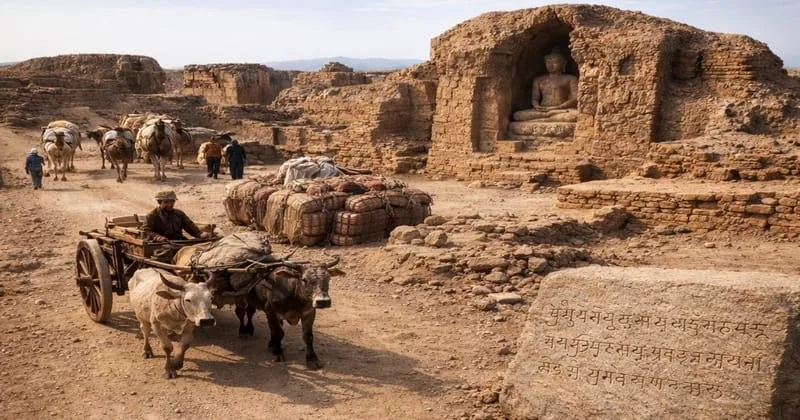
Representative image

Representative image

Facebook
Twitter
WhatsAppTelegramEmail

Nearly two millennia ago, Sanskrit, the classical language of India, flourished far beyond the subcontinent, reaching the lands of present-day Uzbekistan. Archaeological discoveries in the Termez region reveal that Sanskrit was not a distant curiosity but a living language of devotion, scholarship, and monastic life deep in Central Asia.

Samskrit in Uzbekistan!
🔥🔥🔥🔥🔥🔥🔥🔥

This may be shocking but absolutely true!

Long before modern borders, before nation-states, before even the idea of “South Asia” and “Central Asia” as separate civilisations — Samskrit was already travelling across the Silk Route.

In… pic.twitter.com/3434IiDhXj

— Jijith Nadumuri Ravi (@Jijith_NR) February 25, 2026

At the ancient Buddhist monastic complexes of Kara-Tepe and Fayaz-Tepe, archaeologists have uncovered inscriptions written in Indian scripts, containing devotional and dedicatory formulas in Sanskrit. These inscriptions were not casual graffiti by passing traders; they were integral components of functioning monasteries, reflecting a sophisticated religious and intellectual ecosystem. Manuscript fragments, stone carvings, and dedicatory formulas testify that Sanskrit served as both a sacred and scholarly language, facilitating the transmission of Buddhist thought in its classical Indian form.

Termez was a vital junction on the Silk Route, connecting India, Bactria, Persia, and China. Along this corridor, monks, merchants, and pilgrims carried not only goods but also texts, rituals, philosophies, and cosmologies. Sanskrit inscriptions in Central Asia reveal that the movement of ideas was as dynamic and structured as the trade of silk, spices, and precious stones. Monasteries along the route were centres of learning, where Sanskrit functioned as the medium for ritual, scholarship, and spiritual practice.

Also Read: Delhi Car Blast Probe: NIA arrests two J&K residents linked to Ansar Ghazwat-ul-Hind for supplying weapons

The presence of Sanskrit in Termez challenges conventional notions of geography and cultural boundaries. Central Asia was not a periphery of Indian civilisation but an active frontier, a region where Indian intellectual traditions were cultivated, translated, and transmitted across vast distances. The Silk Route was not merely a trade network; it was a knowledge highway, connecting diverse regions through shared civilisational spaces.

Sanskrit in Termez highlights a world in which intellectual and spiritual exchange was already transregional and globalised, nearly two thousand years ago. The Gangetic plains of India, the Oxus corridor, and the monasteries of Central Asia were linked by a living network of language, thought, and devotion. Stone inscriptions, manuscript fragments, and dedicatory formulas do more than preserve history; they record a cosmopolitan intellectual world where Sanskrit travelled across mountains, rivers, and deserts, carrying the ideas, rituals, and texts of Indian civilisation far beyond its birthplace.

Sanskrit’s journey along the Silk Route stands as a testament to the enduring reach of Indian scholarship and spiritual life, demonstrating that the transmission of knowledge has always transcended borders, long before the modern era of globalisation.

 

Topics: BuddhismSanskritindian civilisationCentral AsiaSilk RouteAncient MonasteriesHistorical Languages
Share
Tweet
SendShareSend
✮ Subscribe Organiser YouTube Channel. ✮
✮ Join Organiser's WhatsApp channel for Nationalist views beyond the news. ✮
Previous News

Congress’ Ideological Shift Claim Falls Flat as Jamaat-e-Islami Book Calls Democracy, Secularism ‘Superstitions’

Next News

India’s SIM-Binding Mandate: How the DoT is forcing messaging apps to link services strictly to active SIM cards

Related News

‘India was not poor; it was made poor’: The truth re-emerges through Jema Ferrer’s perspective

Madurai Meenakshi Temple Tamil mantras row: What the Madras High Court held and why it refused to intervene

Madras HC (Left), Meenakshi Temple (Right)

Tamil hymns can’t be mandated to recite alongside Sanskrit at Meenakshi Temple kumbabhishekam: Madras HC

RSS Sarsanghchalak Mohan Bhagwat

Universal Oneness in America: What RSS Sarsanghchalak Mohan Bhagwat’s New York speech really means

Mohan Bhagwat’s New York address on Hindutva’s message of unity comes amid opposition from Zohran Mamdani and Asif Mahmood

Will Mamdani and Asif Mahmood understand the message of Hindutva from New York?

Representative Image

Who Will Read Bharat? Sanskrit, civilizational wisdom and India’s three-language policy

Load More

Latest News

M.A. Baby with Pinarayi Vijayan - CPIM extended state committee meeting at Kozhikode

Keralam: CPI(M) blames cadre for electoral setback, but keeps Pinarayi and Govindan beyond criticism

Benjamin Netanyahu-Ahmed al-Sharaa
with Recep Tayyip Erdoğan (Left to Right)

Israel–Turkey: A New Strategic Rivalry in the West Asia

BJP Karnataka to launch statewide padayatra against Congress govt over two-stanza Vande Mataram rule

Māori elders invited to India’s global gathering on Ancestral wisdom and modern challenges

BRICS New Delhi Declaration 2026

BRICS New Delhi Declaration 2026: Science, technology, energy & human capital for resilient global south

RSS voluneterss distributing food during Assam flood

RSS: When SEWA is dharma

Representative Image

Post-matric scholarship for SC Students: Who can apply and what does the scheme cover?

Leaders come together at the BRICS Summit in New Delhi on September 12

BRICS Summit 2026: Transforming “Pyramid of privilege” into ” platform of partnership”

BRICS after New Delhi declaration: A strategic makeover

Heads of states at the 18th BRICS Summit 2026

BRICS 18th Summit, 2026 – Bharat ascending with a shared vision into a win-win collaboration of the Global South

Load More
  • Privacy
  • Terms
  • Cookie Policy
  • Refund and Cancellation
  • Delivery and Shipping

© Bharat Prakashan (Delhi) Limited.
Tech-enabled by Ananthapuri Technologies

  • Home
  • Search Organiser
  • Bharat
    • Assam
    • Bihar
    • Chhattisgarh
    • Jharkhand
    • Maharashtra
    • View All States
  • World
    • Asia
    • Africa
    • North America
    • South America
    • Europe
    • Australia
  • Editorial
  • Operation Sindoor
  • Opinion
  • Analysis
  • Defence
  • Culture
  • Sports
  • Business
  • RSS @ 100
  • Entertainment
  • More ..
    • Sci & Tech
    • Vocal4Local
    • Special Report
    • Education
    • Employment
    • Books
    • Interviews
    • Travel
    • Health
    • Politics
    • Law
    • Economy
    • Obituary
  • Subscribe Magazine
  • Read Ecopy
  • Advertise
  • Circulation
  • Careers
  • About Us
  • Contact Us
  • Policies & Terms
    • Privacy Policy
    • Cookie Policy
    • Refund and Cancellation
    • Terms of Use

© Bharat Prakashan (Delhi) Limited.
Tech-enabled by Ananthapuri Technologies