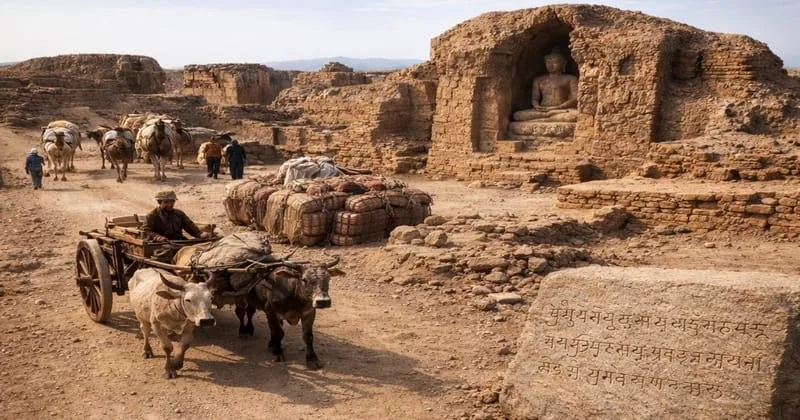
Nearly two millennia ago, Sanskrit, the classical language of India, flourished far beyond the subcontinent, reaching the lands of present-day Uzbekistan. Archaeological discoveries in the Termez region reveal that Sanskrit was not a distant curiosity but a living language of devotion, scholarship, and monastic life deep in Central Asia.
Samskrit in Uzbekistan!
🔥🔥🔥🔥🔥🔥🔥🔥This may be shocking but absolutely true!
Long before modern borders, before nation-states, before even the idea of “South Asia” and “Central Asia” as separate civilisations — Samskrit was already travelling across the Silk Route.
In… pic.twitter.com/3434IiDhXj
— Jijith Nadumuri Ravi (@Jijith_NR) February 25, 2026
At the ancient Buddhist monastic complexes of Kara-Tepe and Fayaz-Tepe, archaeologists have uncovered inscriptions written in Indian scripts, containing devotional and dedicatory formulas in Sanskrit. These inscriptions were not casual graffiti by passing traders; they were integral components of functioning monasteries, reflecting a sophisticated religious and intellectual ecosystem. Manuscript fragments, stone carvings, and dedicatory formulas testify that Sanskrit served as both a sacred and scholarly language, facilitating the transmission of Buddhist thought in its classical Indian form.
Termez was a vital junction on the Silk Route, connecting India, Bactria, Persia, and China. Along this corridor, monks, merchants, and pilgrims carried not only goods but also texts, rituals, philosophies, and cosmologies. Sanskrit inscriptions in Central Asia reveal that the movement of ideas was as dynamic and structured as the trade of silk, spices, and precious stones. Monasteries along the route were centres of learning, where Sanskrit functioned as the medium for ritual, scholarship, and spiritual practice.
The presence of Sanskrit in Termez challenges conventional notions of geography and cultural boundaries. Central Asia was not a periphery of Indian civilisation but an active frontier, a region where Indian intellectual traditions were cultivated, translated, and transmitted across vast distances. The Silk Route was not merely a trade network; it was a knowledge highway, connecting diverse regions through shared civilisational spaces.
Sanskrit in Termez highlights a world in which intellectual and spiritual exchange was already transregional and globalised, nearly two thousand years ago. The Gangetic plains of India, the Oxus corridor, and the monasteries of Central Asia were linked by a living network of language, thought, and devotion. Stone inscriptions, manuscript fragments, and dedicatory formulas do more than preserve history; they record a cosmopolitan intellectual world where Sanskrit travelled across mountains, rivers, and deserts, carrying the ideas, rituals, and texts of Indian civilisation far beyond its birthplace.
Sanskrit’s journey along the Silk Route stands as a testament to the enduring reach of Indian scholarship and spiritual life, demonstrating that the transmission of knowledge has always transcended borders, long before the modern era of globalisation.