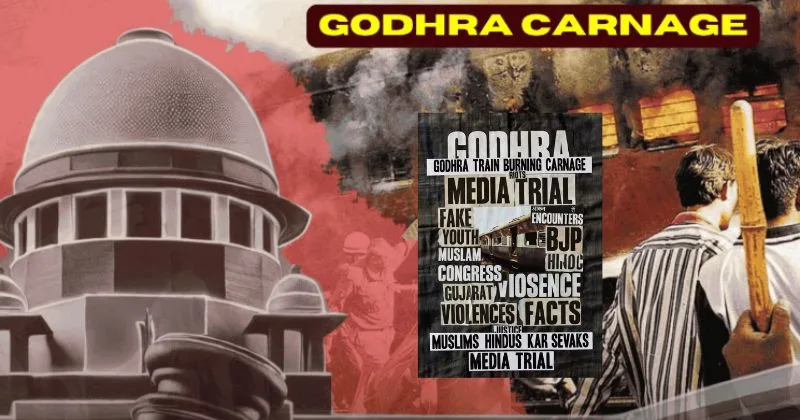
On 27 February 2002, coach S-6 of the Sabarmati Express was set ablaze near Godhra, killing 59 kar sevaks returning from Ayodhya. The horror of the flames inside a locked railway compartment was immediate and undeniable.
Today is the 24th Anniversary of the Godhra Train Burning or Godhra Hindu Massacre ,an incident that occurred on the morning of 27 February 2002, in which 59 Hindu pilgrims karsevaks returning from Ayodhya, were killed in a fire inside the Sabarmati Express train near the Godhra… pic.twitter.com/znH5SDpzCv
— सुदीप कुमार मैती-সুদীপ কুমার মাইতি-Sudip Kr. Maity (@sudipkmaity) February 26, 2026
What followed, however, was not only a criminal investigation but a fierce national argument over what had actually happened. Official investigations like the Nanavati-Mehta Commission (2008) and court convictions upheld it as arson by a mob, rejecting internal-origin theories.
It was a pre-planned conspiracy and act of arson, not an accident, say the findings accepted by the court. This has been upheld through multiple layers of judicial scrutiny, with ongoing appeals in the Supreme Court as of early 2026.
But for nearly a decade before trial and appeals concluded, competing explanations circulated in media debates, political speeches and activist forums.
Some voices cast doubt on whether the coach had been set on fire from outside. Others suggested the blaze may have been accidental. Still others warned against “communalising” the incident before investigations were complete.
When the courts finally ruled, those alternate explanations did not prevail.
The Accidental Fire Theory Gains Oxygen
In the early 2000s, as the criminal case progressed slowly through investigation and trial, sections of commentary began entertaining the possibility that the blaze originated inside the coach. Many factions had begun muddying public understanding before judicial authorities could take up the case.
Here’s an excerpt from the book written by journalist Rajdeep Sardesai, titled “Narendrabhai, The Man From Gujarat”, wherein he indirectly calls the Godhra tragedy an opportunity that benefited Prime Minister Narendra Modi when he was still the chief minister of Gujarat.
“Modi’s big chance came on February 27, 2002. I was showering that morning when a call came from an old journalist friend from Gujarat, Deepak Rajani,” writes Sardesai.
“Rajani managed a small evening paper in Rajkot and had excellent contacts in the police. ‘Rajdeep, bahut badi ghatna hui hai Godhra mein. Sabarmati Express mein aag lagi hai. Kaie VHP kar sevak us train mein thhe. Terror attack bhi ho sakta hai’ (There’s been a big incident at Godhra. The Sabarmati Express with many kar sevaks aboard has caught fire. It could even be a terror attack). In the age of instantaneous breaking news, it isn’t easy to separate fact from hyperbole. What was clear, though, was that a train compartment had caught fire and several kar sevaks (volunteers) were feared dead.”
By Rajdeep’s own admission, “A few hours later, as the information became clearer, it was apparent that this was no ordinary train fire. A mob of local Muslims in Godhra had attacked the train, a fire had started and several people had died. The backdrop to this tragedy had been an attempt by the VHP to reignite the Ram temple movement by launching another shila pujan (foundation stone-laying ceremony) in Ayodhya. Several kar sevaks from Gujarat had joined the programme and were returning from Ayodhya when the train was attacked. That evening, Modi, visiting the site in Godhra, suggested that the kar sevaks had been victims of a terror conspiracy. The VHP was even more aggressive; a bandh was called in Gujarat the next day.”
And yet, for years, he kept on batting for the school of conspiracy that believed and preached that the “Gujarat riots were engineered”.
About his interactions with Congress leader Kamal Nath on the Gujarat elections in December 2002, he writes: “Only a day earlier, I had predicted on our election analysis programme on television that Modi might win a two-thirds majority. Most exit polls had been a little more conservative in their estimates. My logic was simple, the post-Godhra riots had divided Gujarat on religious lines and the Hindu vote bank had been consolidated by Modi.”
Shekhar Gupta (The Indian Express, later The Print) has referenced the accident theory in editorials. In a 2002 piece, “Pot is Blacker than the Kettle,” he discussed anti-Muslim sentiments pre-dating Godhra, implying the incident was not isolated arson but part of building tensions.
In a 2020 tweet, he highlighted the Banerjee Commission’s finding: “Modi govt sits on appointment of son of ex-SC judge whose inquiry commission had pronounced Godhra train fire ‘accidental’.”
Modi govt sits on appointment of son of ex-SC judge whose inquiry commission had pronounced Godhra train fire ‘accidental’@maneeshchhibber reports#ThePrintExclusivehttps://t.co/wRuPVubloQ
— Shekhar Gupta (@ShekharGupta) January 29, 2020
In a 2019 article for The New Yorker (titled “Blood and Soil in Narendra Modi’s India”), journalist Rana Ayyub described the trigger for the Sabarmati Express fires as an “argument between people on the platform and karsevaks” that escalated, leading to the coach catching fire under uncertain circumstances. Her overall framing in her published pieces treats the Godhra train burning as the flashpoint for what she alleges was a state-enabled anti-Muslim pogrom.
Politicians Hijack the Godhra Carnage Tragedy
Shankersinh Vaghela, former chief minister of Gujarat; made statements aligning with this claim in a November 23, 2022, interview with NewsLaundry’s executive editor Atul Chaurasia. In the discussion (titled something along the lines of a Gujarat politics deep-dive, available on NewsLaundry’s YouTube channel), Vaghela explicitly alleged that the Godhra train burning on February 27, 2002, was orchestrated from within, implying involvement by RSS insiders or BJP-affiliated vested interests, to incite communal riots and secure electoral victories for the BJP and Narendra Modi in the 2002 Gujarat assembly elections. He framed it as a deliberate act to polarize Hindu-Muslim communities, exploiting the incident to turn “protectors into predators” and ensure the BJP’s rise to power, stating that without Godhra and the subsequent riots (“Jalvaya”), the BJP would not have gained dominance.
Godhra train burning was preplanned and executed for Narendra Modi and BJP's electoral victory in 2002 assembly elections – Shankersinh Vaghela, Former Gujarat CM👇 (1/2) pic.twitter.com/YVfMHO31bO
— Ravi Nair (@t_d_h_nair) November 25, 2022
Another case in point is that of Lalu Prasad Yadav (former Rail Minister, United Progressive Alliance). He appointed the Banerjee Commission in 2004, which concluded the fire was an accident caused internally (e.g., possibly from cooking or a short circuit), ruling out premeditation or external arson. Yadav publicly cited the report to criticise the Narendra Modi-led Gujarat government, implying the arson narrative was fabricated for political gain. Even the New York Times reported widely on this possibility. He dismissed conspiracy claims and used the findings to counter BJP narratives during elections.
Media Scepticism and Framing
In the years between 2002 and the 2011 trial verdict, prominent journalists and commentators frequently urged caution about accepting early police claims at face value. Some televised debates and columns emphasised the need for forensic clarity before declaring the incident a premeditated communal conspiracy.
In principle, scepticism toward official versions is a cornerstone of journalism. Yet critics later argued that, in this instance, repeated emphasis on alternate possibilities, including accidental ignition, risked creating an impression of uncertainty long after investigators had presented evidence supporting deliberate arson.
Equally significant was the shift in focus. Public discourse soon concentrated overwhelmingly on the state-wide violence that followed the coach burning tragedy at Godhra. While the scale of those riots demanded scrutiny, the trivialisation of the cause of fire that burnt that Sabarmati Express coach reeked of media trial and bias.
The argument from critics is not that journalists should not question official claims. It is that the cumulative effect of sustained doubt, amplified across platforms, may have influenced public perception before courts had tested evidence under cross-examination.
Activism and Emphasis
Several high-profile civil society activists who became central to the Gujarat 2002 litigation concentrated their advocacy on riot cases and alleged failures of governance. In public discourse, the Godhra incident was sometimes treated as contested terrain rather than a settled fact.
Supporters of these activists argue that their mandate was to pursue justice in riot cases, not to prosecute the Godhra accused. Critics counter that public messaging, which foregrounded alternate fire theories or downplayed the communal targeting alleged in the charge sheet, contributed to confusion about what investigators had concluded.
It is important to note that criminal courts did not indict journalists or activists for interference in the Godhra trial. The debate here concerns narrative influence, not legal culpability.
What the Judiciary Decided
After years of investigation and courtroom proceedings, a special court in 2011 convicted multiple accused, holding that the coach had been deliberately set on fire by a mob as part of a criminal conspiracy.
In 2017, the Gujarat High Court upheld key convictions, modified certain sentences and acquitted some accused for lack of sufficient evidence, but did not accept the accidental-fire explanation. The High Court upheld the convictions of all 31, accepting the prosecution’s case of a conspiracy. It commuted the death sentences of the 11 to life imprisonment (citing factors like age, time served, and balanced justice) but maintained the life terms for the others.
In 2022, the Supreme Court of India commuted death sentences to life imprisonment. Crucially, it did not overturn the core finding that the blaze was
a deliberate act of arson.
By the end of the appellate process, the legally established conclusion was unambiguous: the fire was not accidental.
The Gap Between Discourse and Adjudication
The Godhra case illustrates a recurring phenomenon in high-stakes national crises: the divergence between public narrative and judicial determination.
In the heat of political contestation, alternative explanations can gain traction. Committees may raise technical doubts. Commentators may question motives, evidence or timing. All of this unfolds long before cross-examination, forensic scrutiny and appellate review complete their course.
When the courts finally ruled, they did so after weighing witness testimony, forensic reports and evidentiary standards that public debate does not always apply.
That distinction matters.
A Question of Responsibility
Democracy thrives on scrutiny. But it also depends on restraint, especially when criminal trials are ongoing. The Godhra episode forces a difficult question: how should journalists, politicians and activists balance scepticism with sensitivity in the immediate aftermath of mass-casualty crimes?
For critics of the early accidental-fire narrative, the concern is that prolonged public doubt may have obscured the gravity of what investigators described as a targeted act of violence.
For defenders of that scepticism, the argument remains that questioning official accounts is not denial, it is due diligence.
Two decades on, the record is clear on one point. The courts, including the highest in the land, upheld the finding of deliberate arson.
The public debate that preceded those rulings remains part of India’s political memory. But the judicial conclusion stands as the legally binding account of what happened inside coach S-6 on that February morning in 2002.