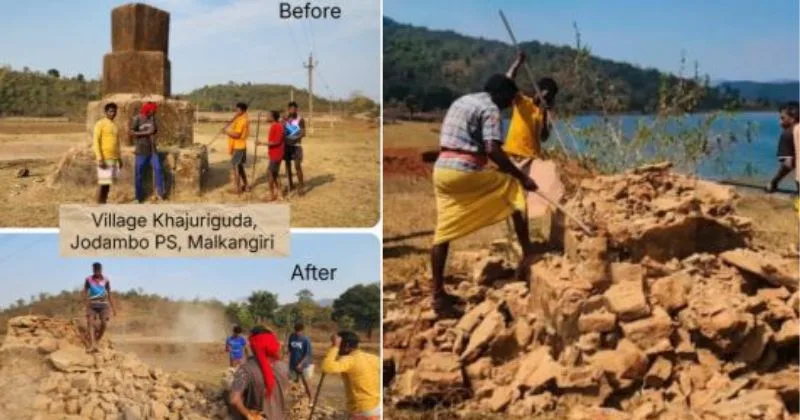
BHUBANESWAR: In a significant indication of the declining influence of Maoism in Odisha, villagers in Malkangiri district have demolished as many as 20 memorial pillars erected by Maoists, symbolically rejecting the fear once imposed by the red terror group. The development comes alongside another major revelation from Kandhamal district, where the decomposed body of a senior Maoist leader, allegedly murdered by his own associates for planning to surrender, has been recovered from a forest.
Villagers Reject Maoist Influence in Malkangiri
Residents of remote villages including Ghanbeda and Khajuriguda have voluntarily dismantled memorial structures built by Maoists in memory of slain cadres. Similar scenes were reported from the Swabhiman area as well as Kalimela, Mathili and Khairput regions, once considered core Maoist strongholds.
Local people said the memorials had long stood as symbols of intimidation and control. By collectively removing them, villagers sent a clear message that they now prefer peace and development over fear and violence.
Malkangiri was once regarded as a major Maoist bastion in Odisha. However, with the weakening of the insurgent network, public confidence has grown, encouraging communities to openly distance themselves from extremist ideology. Villagers stated that Maoists obstructed basic development activities and kept the population under constant threat. Now, they wish to move forward with normal life and economic progress.
Officials attribute the change to sustained joint efforts by district police and civil administration over the past several years, which helped restore confidence among residents. The move is also being seen as a positive sign in the context of the district gradually emerging from insurgency-affected status.
District Superintendent of Police Vinod Patil said people are choosing opportunities, stability and development instead of conflict and isolation. He added that police remain committed to maintaining peace, ensuring security and supporting development initiatives in the region.
Internal Rift Among Maoists Surfaces
Meanwhile, in Kandhamal district, a shocking incident has exposed deep fractures within the Maoist ranks. The decomposed body of a senior Maoist leader was recovered from a shallow grave in Pakari forest near Kutibari village. The recovery was confirmed by Daringbadi police.
The deceased was identified as 31-year-old Anwesh alias Renu, a resident of Sukma district in neighbouring Chhattisgarh. He served as the second platoon commander in the Kandhamal-Kalahandi-Boudh-Nayagarh (KKBN) division of the banned CPI (Maoist) organisation.
Police said the recovery followed disclosures made by two active Maoist cadres, Nitu and Rupa, who surrendered before Kandhamal police earlier this month. According to their statement, Anwesh had expressed his intention to surrender and return to the mainstream on January 28. Angered by this decision, senior divisional leader Sukuru allegedly executed him brutally.
To prevent panic and stop other members from leaving the organisation, the body was buried deep inside the forest. Acting on the information, police teams excavated the remains and sent them to Daringbadi hospital for post-mortem examination.
Fear Within the Organisation
The surrendered cadres also revealed the deteriorating condition of the KKBN division. They claimed the Maoist presence in Kandhamal has reduced to about 25 active members, currently led by Sukuru and Sheila.
According to them, several remaining members are tired of violence and want to avail themselves of the government’s rehabilitation policy. However, they fear retaliation as Sukuru has allegedly threatened death to anyone attempting to surrender.
Following the discovery, security forces have been placed on high alert in the district. Kandhamal SP Harisha B.C. confirmed deployment of two platoons of forces in the Pakari forest region to prevent any retaliatory activity.
In a recorded video message, surrendered cadres Nitu and Rupa appealed to remaining Maoist members to abandon the culture of fear and join the mainstream by taking advantage of government rehabilitation schemes.
Changing Ground Reality
Security officials believe the two developments villagers dismantling Maoist symbols in Malkangiri and internal killings within the organisation in Kandhamal, indicate a major weakening of Maoist influence in southern Odisha.
The shift reflects growing public trust in governance and development initiatives, along with increasing disillusionment among cadres. Authorities say continued rehabilitation programmes and security operations are expected to further reduce extremist presence in the region.