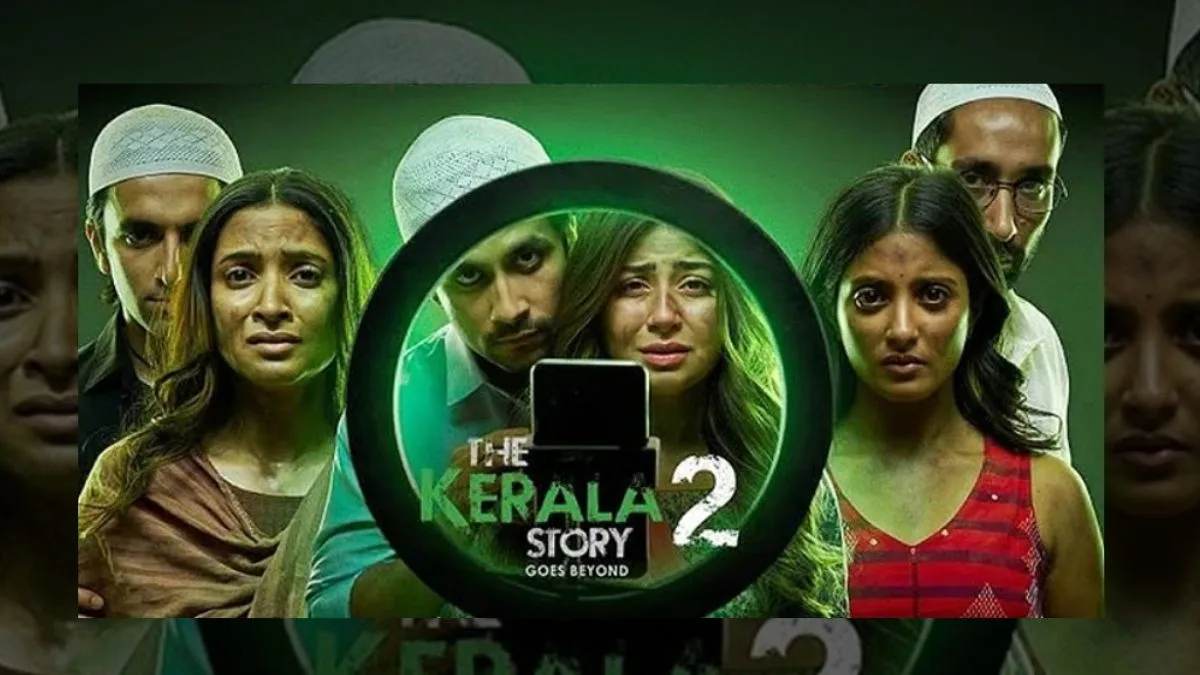
When a film creates so much fear that the courts have to be approached before its release, it means the truth is becoming uncomfortable. The Kerala Story 2 is at exactly that juncture today. The Kerala High Court has halted this film, which was scheduled to release in theatres on February 27, 2026. Petitions were filed alleging that the film will tarnish the state’s image, spread communal tension, and divide society. But no one is willing to ask the fundamental question: Can reports presented in the Kerala Assembly also be propaganda?
The film is a sequel to The Kerala Story, released in 2023. Like the first film, this film explores fraudulent religious conversion, but this time the story moves beyond Kerala to Madhya Pradesh, Rajasthan, and Uttar Pradesh. The trailer claims to be inspired by real events, and this claim sparked an uproar. Some filmmakers and self-proclaimed secularists called it propaganda. Petitioners who challenged the film in court said it paints Kerala in a communal light and tarnishes its dignity. The director then publicly threatened to quit filmmaking if anything is proven wrong. It must be said that this confidence doesn’t come lightly; it’s backed by facts.
On February 25, 2026, the Kerala High Court heard the matter, and a single bench of Justice Bechu Kurian Thomas directed the producers to withhold the film’s rights until a final decision was reached. The following day, the High Court issued an order halting the film’s release.
During the hearing, the Central Board of Film Certification’s U/A certificate was also questioned. The court asked why an A certificate wasn’t granted, given the subject’s sensitivity. But the bigger question is: does the mere inclusion of a state’s name in the title constitute an attack on its dignity? If so, would films like Go Goa Gone, Once Upon a Time in Mumbai, or Delhi Belly also have tarnished the image of their respective cities?
In fact, this controversy is not new. “The Kerala Story,” released in 2023, also faced legal challenges. Before that, in 2022, petitions were filed across the country regarding “The Kashmir Files.” Each time, the argument was that the film would disrupt social harmony. Each time, the courts struck a balance, upholding freedom of expression.
Now, let’s turn to the core question: fraudulent conversion. Changing someone’s religion does not necessarily mean conversion through force, inducement, or deception. The Constitution prohibits this. For this reason, states like Uttar Pradesh, Madhya Pradesh, Uttarakhand, Gujarat, and Haryana have enacted special laws. These laws were not enacted without reason; they were supported by complaints and thousands of cases filed so far.
At the national level, the National Crime Records Bureau does not release separate consolidated data on forced conversions. Therefore, the debate often becomes emotional. However, where state laws exist, the recorded data are available, and the Kerala case is even linked to reports tabled in the Assembly.
The 2011 census shows that the Muslim population in Kerala was 26.56 per cent, compared to 17.4 per cent in 1951. Between 2001 and 2011, the Muslim population grew by 12.8 per cent, while the state’s overall population grew by 4.9 per cent. During the same period, the growth rate for Hindus was 2.23 per cent and for Christians was 1.38 per cent. Clearly, there is a discrepancy in the growth rates. Conversion isn’t the only reason; it’s also due to the higher fertility rate of Muslims, social structure, and other factors. However, completely denying conversion would be a blind eye to the facts.
In 2012, then-Chief Minister Oommen Chandy told the Kerala Assembly that between 2006 and 2012, 7,713 people converted to Islam, of whom 2,667 were girls. According to the report, most of the cases involved interfaith marriages. This wasn’t a filmy dialogue, but official information presented by the government. In 2015, Jagrutha, the mouthpiece of the Kerala Catholic Bishops’ Council, claimed that approximately four thousand girls converted to Islam between 2005 and 2012, most of whom embraced Islam.
Naturally, if thousands of people convert over time, a sociological study is required, and when a sudden attraction to a particular community is observed, it is natural to raise suspicions. Therefore, no one can deny this reality in Kerala today. Therefore, what is depicted in the film is the reality experienced by all these young women, what they have gone through day and night. It is true that freedom of expression is not absolute in a democratic country like India, but it is not meaningless either. If every sensitive topic is banned, the cinema will become a mere hollow medium of entertainment. The courts will deal with the law, public order, decency, and morality. But society must also introspect whether it is prepared to face difficult questions.
The truth is that the issue of religious conversion is multifaceted; yet, if official data exists, if reports have been presented in the Assembly, and if the media has analysed trends in religious conversion, how can making a film on this subject be illegal? Challenge “The Kerala Story 2” in court, definitely do so, verify the facts, and debate the certification. But don’t claim that the subject doesn’t exist. Because the data exists, from the census, the Assembly, and media reports.
Though the Kerala High Court have stayed the release of ‘The Kerala Story 2’, the debate will continue. And perhaps this is the true power of democracy: the Indian Constitution guarantees the freedom to ask questions, express disagreement, and examine the facts to everyone equally. Ultimately, truth doesn’t change with a court order. It must be said that it remains recorded in data, preserved in documents, and comes to light from time to time. The question is whether we are willing to face the facts we don’t want to see. Because history bears witness: films can be stopped, but no one can deny the statistics that are blaring across the country that Hindu and other non-Muslim girls are the targets of love jihad! The game of Islamic conversion is being conducted in a completely planned manner, and it must be stopped at all costs.