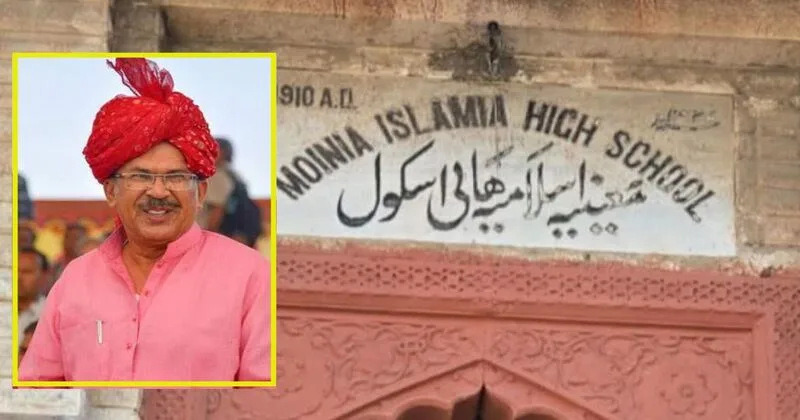
Ajmer, the heart of Rajasthan, known as the confluence of history, spirituality, and valour, has become the centre of a new cultural environment in recent years after State Assembly Speaker Vasudev Devnani initiated the replacement of Mughal and British-era names, one by one, with names associated with local and Indian pride. This initiative by Assembly Speaker Vasudev Devnani is not merely an administrative decision but also a remarkable and commendable effort to redefine the city’s historical identity.
Due to its unique geographical location, Ajmer served as the headquarters of the Rajputana Agency during the British period. Consequently, for decades, many of the city’s streets, buildings, and public spaces were named after British officials or, later, Mughal rulers, reflecting the influence of the Mughal era. Assembly Speaker Devnani believed that such names should be re-examined in independent India. He argued that the city’s identity should be associated with its own heroes, saints, and freedom fighters, not with colonial symbols.
Under this innovative initiative of Assembly Speaker Vasudev Devnani, the names of some important places in Ajmer city have been changed. Devnani has played a key role in connecting it with the Indian cultural context and giving names of Indian and local significance. Recently, on his initiative, the name of Moiniya Islamia School in Ajmer was changed to Government Higher Secondary School, Station Road. Earlier, he had also changed the name of King Edward Memorial, which had British-era references, to Dayanand Vishranti Grih. Also, Ajmer’s Foy Sagar Lake has been renamed Varun Sagar, giving it a new identity. Until now, Ajmer’s Foy Sagar Lake was known by the name of a British engineer, Foy.
In addition, Devnani renamed the Rajasthan Tourism Development Corporation’s (RTDC) Hotel Khadim in Ajmer as Hotel Ajaymeru, the elevated road as Ram Setu, the Christian Ganj Police Station as Krishna Ganj Police Station, the road from Agra Gate to Agrasen Square as Sant Shiromani Ramdev Marg, the road from St. Stephen Square to Jhalkari Bai as Veerangna Jhalkari Bai Marg, the road in Panchsheel Nagar as Shaheed Major Natwar Singh Shaktawat Marg, the road from Ana Sagar to Prem Nagar as Shaheed Avinash Maheshwari, and Chaurasiawas Road as Prem Prakash Ashram Marg.
This renaming initiative sparked widespread discussion not only in the historic city of Ajmer but across the country. Supporters argued that this was a necessary step towards Indian identity and cultural self-respect. They argued that when colonial names were being changed in other parts of the country, including India’s capital, New Delhi, why should Ajmer remain untouched by this process? Critics, however, questioned whether renaming would address the challenges of real development. However, Devnani clarified that serious efforts are being made to pursue both development and cultural restoration in Ajmer.
Devnani argued that in independent India, local history, saint traditions, and freedom movement heroes should be honoured, rather than symbols associated with colonialism or invaders. He argued that name changes are not merely symbolic, but rather a matter of cultural pride. Many places across the country are undergoing renaming, with names associated with colonialism or invaders being changed to those of Indian heroes. This initiative in Ajmer is also considered part of a broader national trend. It is presented as a cultural renaissance and historical consciousness. Thus, Assembly Speaker Devnani has delivered on his promises.
This initiative by Assembly Speaker Vasudev Devnani has sparked a new debate about identity and history in Ajmer. The name change process raises the question of how to honour a city’s memory and symbols. For supporters, it is an attempt to restore Indian pride. It is undeniable that this initiative has added an important chapter to Ajmer’s political and cultural discourse. Along with development, the politics of symbols has also become part of the narrative of modern India, and in Ajmer, this narrative seems to be taking on a new dimension with Devnani’s initiative.
Prime Minister Narendra Modi’s proposed visit to Ajmer on February 28
Assembly Speaker Vasudev Devnani on Sunday performed the groundbreaking ceremony for Prime Minister Narendra Modi’s proposed visit to Ajmer on February 28 and reviewed the preparations for the massive public meeting at Kayad Vishramsthal in Ajmer. Union Minister of State for Agriculture Bhagirath Choudhary, former MP Omkar Singh Lakhawat, Chairman of Rajasthan Heritage Promotion Authority, and local leaders and activists were also present on the occasion.