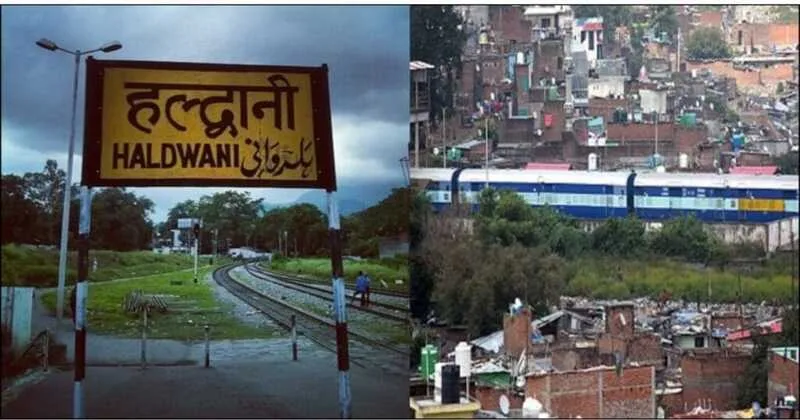
HALDWANI: The controversy surrounding Banbhoolpura, a locality situated close to Haldwani Railway Station in Uttarakhand, has evolved into one of the most significant urban land disputes in the state in recent years. The area, particularly the settlement popularly referred to as Ghafoor Basti or Dholak Basti, has been at the centre of allegations of large-scale encroachment on railway land.
For decades, houses and small commercial establishments reportedly came up on land owned by the Indian Railways without formal authorisation. As the settlement expanded, concerns were repeatedly raised by authorities over unregulated construction, narrowing lanes, and the strain on civic infrastructure. The issue intensified after the state administration initiated steps to clear what it termed illegal encroachments.
In 2024, an attempt to remove structures led to violent clashes, highlighting the sensitivity of the issue and raising serious law-and-order concerns. The violence underscored the complexity of balancing eviction drives with humanitarian considerations and community sentiments.
The legal battle over the land eventually reached the Supreme Court of India. During a hearing on February 24, 2026, a bench of the apex court observed that the land in question belongs to the government and that encroachments cannot be regularised merely on account of long-term occupation. The Court acknowledged the submissions made by the Uttarakhand government, the Railway Ministry, and the Union government regarding the ownership status of the land.
At the same time, the Supreme Court also recognised the need for a structured rehabilitation process. It accepted the government’s proposal that eligible occupants could be considered for housing under schemes such as the Pradhan Mantri Awas Yojana (PMAY). Those who do not meet eligibility criteria may be provided temporary financial assistance of Rs 2,000 per month for six months to facilitate relocation.
Senior advocates appearing for the occupants argued for protection against eviction, while government counsel maintained that public land cannot be permanently occupied without legal sanction. The Court directed that from March 19 to March 31, district authorities and the District Legal Services Authority conduct camps in the Banbhoolpura area to accept and scrutinise applications from residents seeking rehabilitation benefits.
The final decision in the matter is expected after March 19, following the completion of this process.
Administrative and Security Concerns
Beyond the legal arguments, the Banbhoolpura issue has raised broader questions about urban governance. Officials have described the settlement as densely populated and administratively challenging. Law enforcement agencies have previously identified the area as sensitive, citing instances of crime and difficulties in carrying out enforcement operations.
Critics argue that delays in addressing encroachments over the years contributed to the present situation. Successive administrations are accused by political opponents of avoiding decisive action due to electoral considerations. However, such claims remain part of political debate and have not been formally adjudicated.
Demographic and Social Dimensions
The dispute has also brought attention to demographic changes within the locality. Residents who have lived in the area for decades claim that migration from other states increased population density and altered the social character of the neighbourhood. Some long-term inhabitants say they now face uncertainty due to actions taken against what authorities describe as unauthorised occupants.
Urban planners note that rapid and unregulated settlements on public land often create overlapping social, economic, and infrastructural challenges. Narrow access roads, lack of sanitation facilities, and insufficient civic amenities compound the risks during eviction or redevelopment drives.
Political Reactions
The matter has drawn political reactions at both the state and national levels. Supporters of the Uttarakhand government, led by Chief Minister Pushkar Singh Dhami, have described the court’s observations as a validation of efforts to reclaim public land while ensuring relief for the genuinely needy. Opposition leaders, meanwhile, have called for a humane and transparent rehabilitation process.
The case has also featured high-profile legal representation for the occupants, indicating the broader constitutional implications tied to housing rights, due process, and the state’s obligation to balance development with welfare.
With the Supreme Court’s directions in place, attention now shifts to the on-ground implementation of the application and verification process. District authorities have reportedly begun preparations for camps to facilitate documentation and eligibility assessment.
The final verdict, expected after the completion of this interim process, will likely set an important precedent regarding how large-scale encroachments on public land are handled—particularly in cases where thousands of residents are involved.