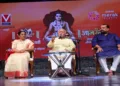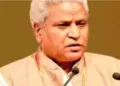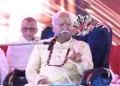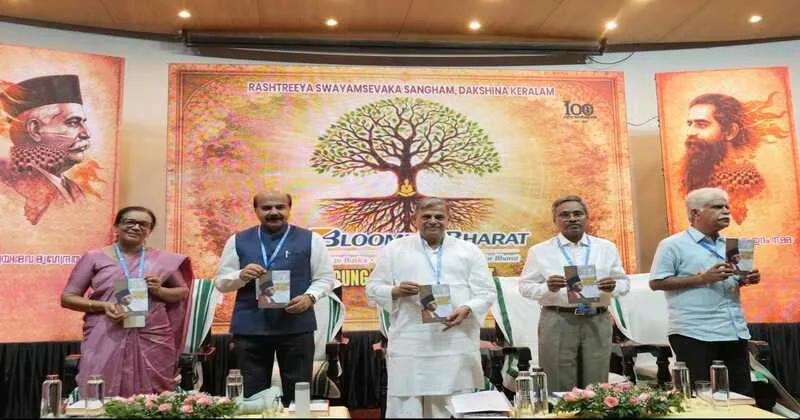
Thiruvananthapuram: Dattatreya Hosabale, Sarkaryavah of the Rashtriya Swayamsevak Sangh (RSS), said that a Hindu nation is not a religious nation but one founded on Dharma. Addressing the inaugural session of the Blooming Bharat: Young Intellectual Meet at the Rajiv Gandhi Centre for Biotechnology in Thiruvananthapuram, he asserted that Bharat is an ancient civilisation and should not be understood through Western definitions of nationhood. The programme was organised as part of the RSS’s centenary celebrations.
Dattatreya Hosabale, who hails from Karnataka, said Kerala is a neighbouring state for him, but it was unfortunate that the idea of the nation often has to be explained in a foreign language. “The traditions, culture and philosophy of this land cannot be fully conveyed through any other language,” he said, adding that this is why confusions arise between the terms India and Bharat. He pointed out that India derives from Indus, a rendering of Sindhu, and that the two words carry different civilisational meanings.
Dharma as the Civilisational Thread
Hosabale said Sanskrit forms the cultural basis of the nation and that Hinduism represents a civilisational ethos rather than a narrow religious identity. Even during the British period, he argued, Bharat remained a Hindu nation in spirit, with spirituality at its core. Drawing on cultural examples, he noted that whether music is Carnatic or Hindustani, it ultimately rests on the same seven notes. Likewise, India’s diverse dance traditions are deeply shaped by shared civilisational figures such as Radha, Krishna, Shiva and Parvati.
He cited socialist thinker Ram Manohar Lohia, who described Rama as connecting North and South, Krishna as linking East and West, and Shiva as influencing the entire country, symbolising Bharat’s unity. Hosabale also recalled how C. N. Annadurai, despite being critical of certain traditions, spoke strongly against China in the Rajya Sabha during the invasion and referred to the Himalayas as Shiva’s abode. Referring to Jawaharlal Nehru, Hosabale said the former Prime Minister had once bowed to the ancestors who unified India through pilgrimages. He added that the twelve Jyotirlingas, 52 Shakti Peethas and the Chaturmathas established by Adi Shankaracharya together demonstrate a shared national culture.
Literary icon Bankim Chandra Chattopadhyay, who wrote Vande Mataram, had personified Bharat as Saraswati, Lakshmi and Durga, symbols of knowledge, wealth and strength. “These are cultural metaphors, not religious dogma,” Hosabale said, recalling how retired Justice Muhammad Karim Chagla once described himself as a “cultural Hindu.” He also pointed to Indonesia, noting that while religions may change, civilisational roots endure. The Ramayana remains dear there, he said, underscoring Hinduism as a moral and cultural value system.
Language, unity and national institutions
Hosabale observed that many government and public sector institutions in India have adopted the idea of Dharma Rajya. In the Supreme Court, the maxim “Yato Dharma Tato Jaya” (Where there is Dharma, there is victory) is inscribed, while the old Parliament House carried the words “Dharma Chakra Pravartanaya” behind the Speaker’s chair. Calling language humanity’s greatest asset, he cautioned against its politicisation as a tool for division.
Several dignitaries attended the event, including NAAC Director Dr Ganesan Kannanbiran, Kerala University Vice-Chancellor Dr Mohanan Kunnummal, APJ Abdul Kalam Technological University Vice-Chancellor Dr Sisa Thomas, and RSS Dakshin Kerala Prantha Sanghchalak Prof. M. S. Ramesan. Three books, Sangh and Freedom Struggle, Invasion and Resistance: A Thousand Years of Struggle History, and National Transformation through Pancha Parivarthanam, were released by Hosabale. The Malayalam translations were done by P. Santosh.
In subsequent sessions, SOHO founder Sridhar Vembu and former Indian Space Research Organisation chairman S. Somanath addressed the gathering. Regional assistant K. B. Sreekumar delivered the welcome address, Dr Vysakh Sadashivan proposed the vote of thanks, and C. I. Vipin Kumar outlined the next steps. Young researchers and PhD scholars from Thiruvananthapuram, Kollam, Alappuzha and Pathanamthitta districts participated in the meet, which concluded with a call to deepen intellectual engagement rooted in Bharat’s civilisational values.