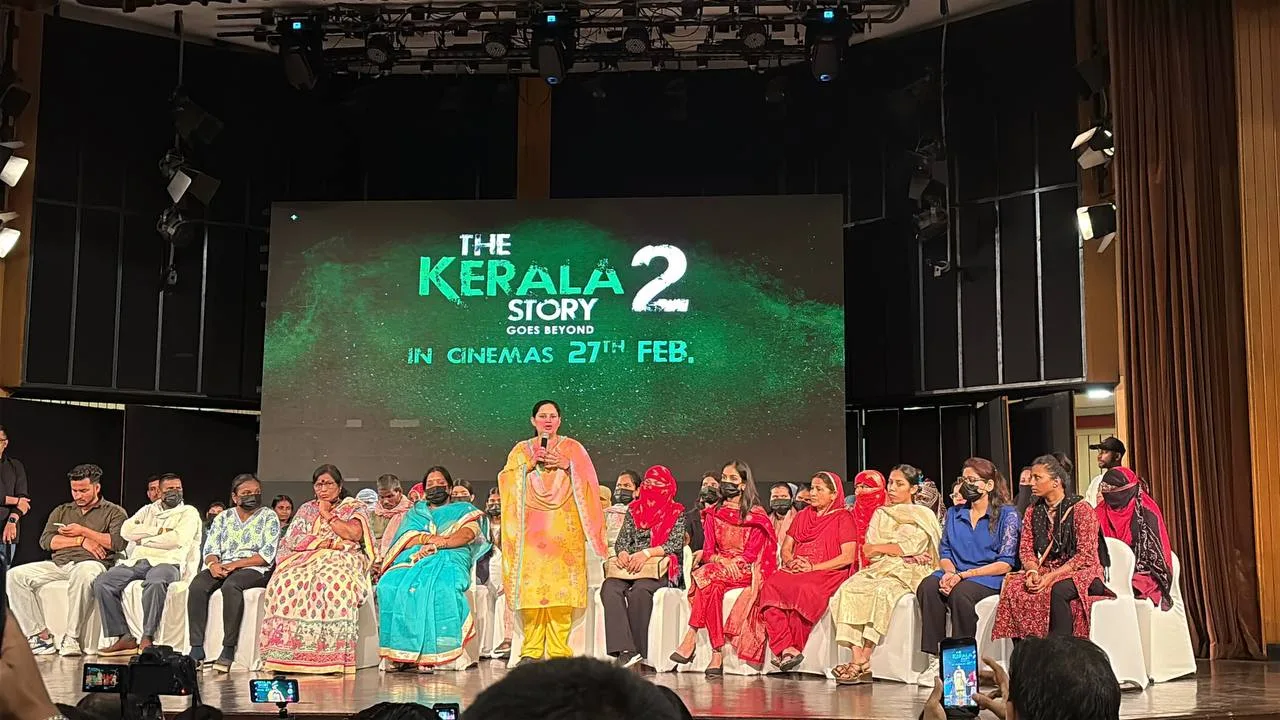
At a public event organised at the India Habitat Centre in New Delhi ahead of the release of the film Kerala Story 2: Goes Beyond, a woman from Madhya Pradesh shared a detailed testimony alleging that she was lured into a relationship, taken away from her home and later confined in religious institutions linked to Islamic cleric Kaleem Siddiqui.
The filmmakers organised the event amid allegations that the upcoming film promotes propaganda. In response, the organisers presented testimonies of 33 women from across Bharat, who described experiences they said reflected real-life incidents similar to those depicted in the film.
Narrating her experience, the survivor said, “I came here in 2013. I got acquainted with a boy named Naveen Rana through Facebook. Naveen Rana came to take me from Indore in Madhya Pradesh and I went with him. Because he used the surname Rana and I belonged to a Brahmin family, I trusted him. In our family, marriage is expected within the Brahmin community, so my family would never have agreed. Naveen came to take me and we came to Delhi.”
She said that after reaching Delhi she met one of his associates.
“In Delhi, we met one of his friends named Shahnawaz. After bringing me there, they said they did not have a place to stay. Then they told me they would take me to a madrasa in Uttar Pradesh. It was the madrasa of Maulana Kaleem Siddiqui.”
Describing the conditions there, she said, “I was taken there. There was such strict security that no woman could go outside and no man could come inside. Guards were stationed at the gates. When I reached there, I saw many other girls like me. They told me they were only supporting us.”
She said she was questioned about her background and food habits.
“After some time they began asking questions like whether I ate non-vegetarian food. I said no, because I belonged to a Brahmin family.”
She repeatedly asked to meet Naveen Rana.
“I asked them to call Naveen. They said he was not coming and was away somewhere.”
Later she was shifted to another madrasa.
“Later I was taken to another madrasa in Meerut. There they told me I would have to stay for some time. I asked them to call Naveen first.”
When he finally came, she said he told her, “Now you are far away from your home.”
She said her phone had been taken away.
“I did not have a phone with me because he had taken it, so I had no way to contact my family.”
She further quoted him as saying, “I love you very much. You will have to study Islam here. We have to do nikah, so you must study and learn Islam.”
She added, “He met me only for five minutes and then left.”
She described how madrasa authorities began religious instruction.
“After that, the woman in the madrasa who taught us said I had to recite the kalma. She taught me the kalma.”
She described the routine imposed on them.
“We were woken up at 4 a.m. for prayers called Tahajjud. That was how the day began. At 7 a.m. we were given only tea. This treatment was given only to the Hindu girls, not to their own girls. We were given only chutney and rice during the day and at night only chutney and two rotis.”
She alleged coercion linked to religious learning.
“They said if we did not memorise Islamic verses, prayers and Quran, we would continue to be treated like that. I kept begging them to send me home, but they refused.”
According to her testimony, Naveen Rana eventually disappeared.
“After that Naveen completely disappeared and never came to meet me again.”
She said she was later taken to Phulat where she met Kaleem Siddiqui, “Later I was taken to a place called Phulat. There I met Maulana Kaleem Siddiqui. He arranged my marriage with a Maulana.”
After marriage she was taken to Muzaffarnagar, “After that Maulana kept me in Muzaffarnagar. Whenever he went out, he locked the house.”
“He used to say on the phone: ‘Do not trust her. She is educated. She has an MBA. She is broad-minded and may run away.’ He kept me locked like that.”
The marriage ended in divorce.
“After some time he divorced me. I had thought that if I won his trust I might get a chance to escape, but he never trusted me.”
She said she was again taken to the madrasa.
“After the divorce I was taken back to the Phulat madrasa. There they told me I would have to marry again and that I could not return home because my family would not accept me.”
She described strict dress rules imposed on her.
“They forced me to wear a burqa and remain fully covered. Even my hands and feet were covered with gloves and socks so that no part of my body was visible.”
She said another marriage was arranged, “Then they arranged another nikah for me.”
Describing the years that followed, she said, “After that I remained trapped in this situation from 2013 onward. My case is still ongoing.”
She alleged she was repeatedly subjected to halala, “They made me undergo halala. In the name of halala, I was married to my husband’s brother-in-law and then divorced, after which I was taken back again.”
She said another marriage was arranged in 2019, “In 2019, another marriage was arranged. He was a hafiz of half the Quran. I could not go out or escape. He kept me for four years and then divorced me.”
She alleged further confinement, “After that his family confined me in a room and did not allow me to go anywhere. Later he rented a flat and kept me hidden there. Again halala was arranged with his brother-in-law.”
She said she was physically abused, “While I lived in the flat, I was beaten and abused. I had no way to escape.”
She said she eventually found help, “Then I became friends with a woman who gave me courage.”
With her assistance she approached police, “With her support, I went to the nearby police station and filed a complaint that I had been forced into halala and that this had been happening since 2013.”
However, she alleged that the complaint was diluted.
“But the Station House Officer registered it only as a domestic dispute between husband and wife and told me to settle the matter in court. When I saw the FIR, I realised it had been written as a husband-wife dispute.”
She alleged corruption.
“Every time the accused went there, he paid money because he ran a madrasa and a large school and had good earnings. He would pay money and get away.”
She said the legal fight continues.
“My case is now in court. My friend, her husband and our supporters are helping me fight the case.”
She appealed for honest administration, “I want to say that if the administration does not take money, they can truly stand for justice. He always paid money and I was repeatedly assured that I would receive help, but I received none.”
She said she continues to fight, “For one and a half years I have been struggling and I am still fighting. I will not back down. I have no support from my family because I come from a Brahmin family where honour is considered very important. Now the only family I have is the people who are supporting me.”
Speaking about the film, she said, “This film teaches us a lot. Such films should be made because they show us reality. This is not a story. These are things that really happen to girls. Instead of meaningless films, such films should be made that show what girls actually face.”