Abhyudaya – Industry Leadership Conclave 2026: Fostering the A-I partnership
June 23, 2026
  • Read Ecopy
  • Circulation
  • Advertise
  • Careers
  • About Us
  • Contact Us
Android AppiPhone AppArattai
Organiser
  • ‌
  • Bharat
    • Assam
    • Bihar
    • Chhattisgarh
    • Jharkhand
    • Maharashtra
    • View All States
  • World
    • Asia
    • Europe
    • North America
    • South America
    • Africa
    • Australia
  • Editorial
  • International
  • Opinion
  • RSS @ 100
  • More
    • Op Sindoor
    • Analysis
    • Sports
    • Defence
    • Politics
    • Business
    • Economy
    • Culture
    • Special Report
    • Sci & Tech
    • Entertainment
    • G20
    • Azadi Ka Amrit Mahotsav
    • Vocal4Local
    • Web Stories
    • Education
    • Employment
    • Books
    • Interviews
    • Travel
    • Law
    • Health
    • Obituary
  • Subscribe
    • Subscribe Print Edition
    • Subscribe Ecopy
    • Read Ecopy
  • ‌
  • Bharat
    • Assam
    • Bihar
    • Chhattisgarh
    • Jharkhand
    • Maharashtra
    • View All States
  • World
    • Asia
    • Europe
    • North America
    • South America
    • Africa
    • Australia
  • Editorial
  • International
  • Opinion
  • RSS @ 100
  • More
    • Op Sindoor
    • Analysis
    • Sports
    • Defence
    • Politics
    • Business
    • Economy
    • Culture
    • Special Report
    • Sci & Tech
    • Entertainment
    • G20
    • Azadi Ka Amrit Mahotsav
    • Vocal4Local
    • Web Stories
    • Education
    • Employment
    • Books
    • Interviews
    • Travel
    • Law
    • Health
    • Obituary
  • Subscribe
    • Subscribe Print Edition
    • Subscribe Ecopy
    • Read Ecopy
Organiser
  • Home
  • Bharat
  • World
  • Operation Sindoor
  • Editorial
  • Analysis
  • Opinion
  • Culture
  • Defence
  • International Edition
  • RSS @ 100
  • Magazine
  • Read Ecopy
Home Bharat

Abhyudaya – Industry Leadership Conclave 2026: Fostering the A-I partnership

At Organiser’s Abhyudaya – Industry Leadership Conclave, leading academicians and industry representatives called for a decisive shift towards translational research, stressing that deeper industry–academia participation is essential for innovation-led growth as Bharat reclaims its scientific and technological strength.

Lakshmi Ranjith NairLakshmi Ranjith Nair
Feb 24, 2026, 06:30 pm IST
in Bharat, Special Report
Follow on Google News
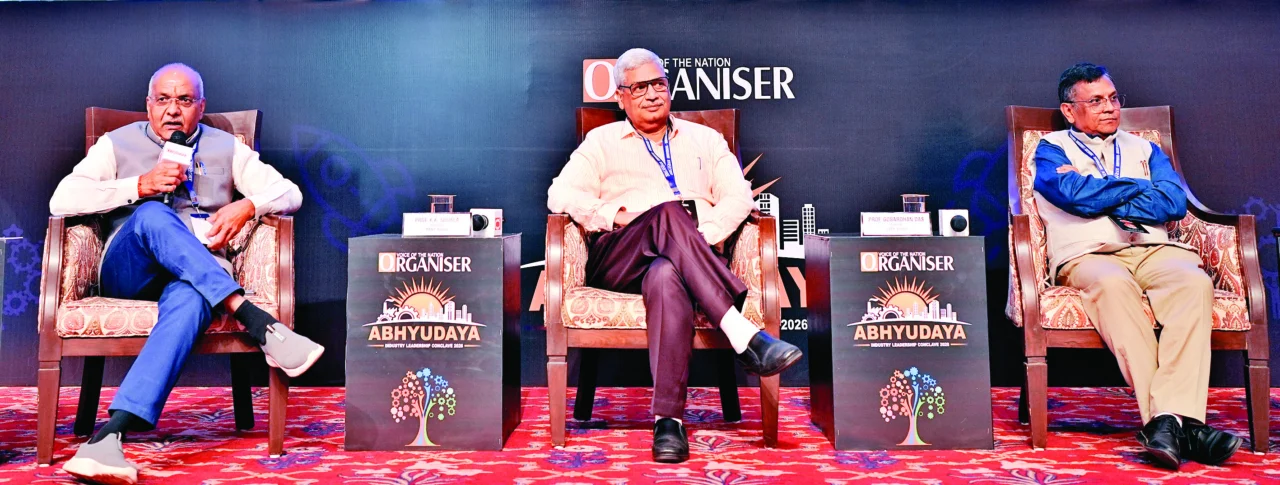
(From L to R) Deepak Sharma, FMPCCI President, moderating the session; Prof. K.K. Shukla, Director, MANIT; and Prof. Gobardhan Das, Director, IISER, on the dais

(From L to R) Deepak Sharma, FMPCCI President, moderating the session; Prof. K.K. Shukla, Director, MANIT; and Prof. Gobardhan Das, Director, IISER, on the dais

FacebookTwitterWhatsAppTelegramEmail

As Bharat positions itself at the forefront of emerging technologies, senior academicians and institutional leaders have underlined a critical shift in the country’s innovation strategy — from basic research dominance to translational and industry-linked outcomes.

Speaking at Organiser’s Abhyudaya – Industry Leadership Conclave 2026, experts asserted that Bharat should no longer be described merely as a “developing country,” but as a “re-developing nation” reclaiming lost centuries of scientific and economic leadership. “We lost nearly eight hundred years, plus another two hundred. But today we are speaking of a New Bharat,” remarked Prof Gobardhan Das, Director of IISER, emphasising resurgence through education and research.

According to Prof KK Shukla, Director, MANIT, institutions perform strongly at early Technology Readiness Levels (TRL 1–4), where problems are conceptualised, simulated, and demonstrated in laboratories. However, he added that beyond TRL 4, institutions struggle due to gaps in the ecosystem and lack of industry support.

Federation of Madhya Pradesh Chamber of Commerce and Industry (FMPCCI) President Deepak Sharma moderated the session.

Academic Excellence Now Demands Real-World Delivery

Globally, Bharat ranks third in research publications and PhD production. However, panelists raised a pressing concern: how much of this research translates into real-world products and societal impact?

“We are very good at defining and designing problems. If we speak in terms of Technology Readiness Levels (TRL), we perform well at TRL 1 and 2. Most institutions are strong at this stage because we are effective at conceptualising problems. We are also quite capable of developing those ideas further. Up to TRL 3 and 4, within laboratory settings, we perform competently.
But beyond that stage, we struggle. Progressing further requires a robust support system. The necessary innovation ecosystem is, to some extent, missing. We design the solution, we develop it, and we reach TRL 4. At that point, the process often stops. Typically, we publish a paper or file a patent—but we fail when it comes to “lab-to-land” transfer.

The bottleneck lies in scaling and commercialisation. The cost of experimentation and deployment rises sharply at advanced stages, and most government-funded institutions lack sufficient industry backing to push innovations to market.

Industry–Academia Disconnect

Industry support in Bharat accounts for roughly 30 per cent of research funding, significantly lower than in developed economies. Experts stressed that without stronger private-sector participation, lab-to-land transfer will remain limited.

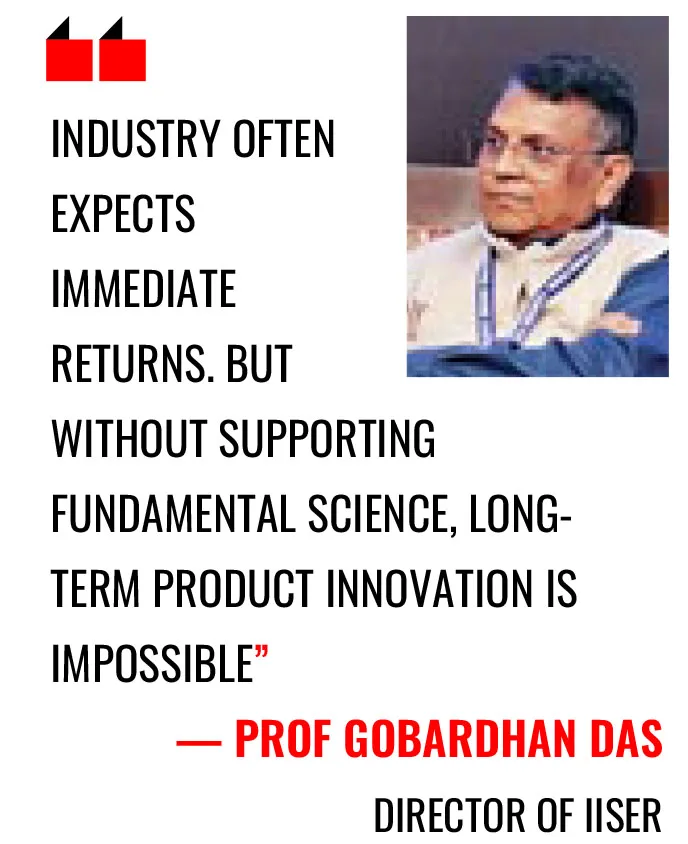
“Industry often expects immediate returns. But without supporting fundamental science, long-term product innovation is impossible,” said Prof Gobardhan Das, citing examples such as Thomas Edison’s early work on the electric bulb and Nobel laureate Katalin Kariko’s foundational RNA research that later enabled mRNA vaccines.

The discussion highlighted international models, including Taiwan, where universities maintain dedicated industry liaison offices and industry-sponsored research projects are common. “In Taiwan, even master’s projects were industry-funded. That ecosystem enables scaling,” a former visiting faculty member observed. According to the experts, the government’s policy direction is now pushing institutions beyond “know why” and “know how”— emphasising demonstrable implementation. Reforms include Industry-embedded academic units, mandatory one-year industry internships for students, recognition of technology transfer outcomes for PhD degrees, even without mandatory publication, and sector-focused AI development under the national AI Mission.
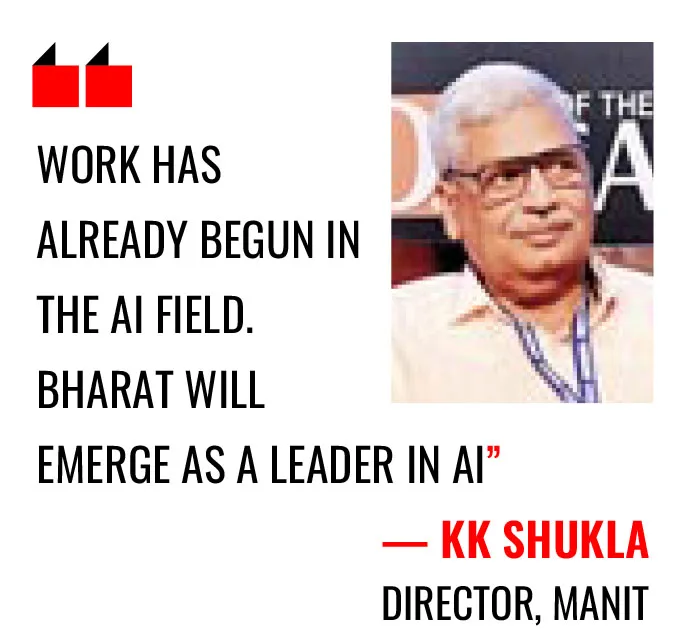
Under the Bharat’s AI Mission, the government is prioritising the development of indigenous AI models across four strategic sectors to drive inclusive and scalable growth. The major sectors where AI models are being developed are agriculture, smart infrastructure, manufacturing, and health care. According to KK Shukla, “Work has already begun in the AI field. Bharat will emerge as a leader in AI.”

Bharat Is Growing On Both Fronts

“If we look at the education sector today, there are more than 1,600 universities, around 8,850 engineering colleges, 22 IITs, 26 AIIMS institutions, approximately 855 medical colleges, and 7 IIMs. The scale is significant. On the other side, if we look at the entrepreneurial ecosystem, Bharat has around 159,000 startup companies, out of which 125 are unicorns. So Bharat is growing on both fronts—academia and industry.” said IISER Director Prof Gobardhan Das.

However, the key issue is connection. According to him, bridging the two sides is essential, as a gap still remains. Industry often expects immediate returns. At the same time, without fundamental research, products cannot emerge. Speakers repeatedly emphasised the role of young innovators. “It begins with an eighteen-year-old entering a laboratory in an engineering college,” one academic said, pointing to battery storage technology as a decisive area for technological independence. Rather than copying Western technologies, Bharat must build for itself and within itself, they argued.

The country’s youth possess immense potential but require structured mentorship and institutional support. “Our institutions have the capability. The focus earlier was on basic research. Now the time has come for synergistic engagement with industry and translational impact,” the panel concluded.

As Bharat expands both its research footprint and start-up ecosystem, the consensus was clear: bridging academia and industry is no longer optional. Without that bridge, innovation will remain confined to journals and patents. With it, Bharat could reclaim its position as a global leader in technology and production.


Topics: FMPCCIOrganiser's Abhyudaya – Industry Leadership Conclave 2026global leader in technologyA-I partnershipBharat positions
ShareTweetSendShareSend
✮ Subscribe Organiser YouTube Channel. ✮
✮ Join Organiser's WhatsApp channel for Nationalist views beyond the news. ✮
Previous News

The Colonial Gaze vs. The Dharmic View: Why the ‘Woke’ Assault on the Guru-Shishya Parampara Fails the Logic Test

Next News

Guru-guided temples essential for spiritual direction; Sanyasis key to Hindu revival

Related News

No Content Available
Load More

Latest News

Tamil Nadu: Assembly Speaker directs all bureaucrats to strictly follow warrant of precedence after Mayor-MLA row

Kamakhya Mandir

Kamakhya Mandir’s Ambubachi Mela: The ancient tradition that honours the menstruation of mother Earth

Amazon in dock for mocking Hindu Gods

Amazon File: From Ganesha to Aryabhata-Has Amazon India become a platform for Anti-Hindu narratives?

The West Bengal Budget 2026–27 aims to drive growth through infrastructure, industry, innovation and welfare

Reimagining Bengal: How the West Bengal Budget 2026–27 seeks to balance growth, welfare & economic transformation

Pratiraksha is Gujarat Police's Aadhaar-based verification platform designed to identify illegal workers and prevent identity fraud in industrial sectors

Pratiraksha: How Gujarat police uses Aadhaar verification to secure industrial workforce against identity fraud

Israel-Iran crisis has highlighted not only shifting dynamics of West Asia but also growing confidence of India's foreign policy

India, Israel and the rise of strategic autonomy in an era of global geopolitical realignment

Saleem and Jaleel arrested in forced religious conversion case

Karnataka Conversion Case: Forced conversion of Hindu woman and minor son sparks outrage; Saleem and Jaleel arrested

Bareilly Cantonment Emerges as Model for Sustainable Urban Development in India (Image Source X)

Uttar Pradesh: Bareilly Cantonment becomes India’s first carbon-negative cantonment

CM Yogi Adityanath making industry, investment and the connectivity revolution in Eastern Uttar Pradesh

The Purvanchal Growth Story: How industry, infrastructure, tourism & exports are fueling development in eastern UP

(Left) Fire at the coaching centre in Lucknow (Right) Members of ABVP extending all possible help

Lucknow Coaching Centre Fire tragedy is heartbreaking and deeply unfortunate: ABVP seeks action against culprits

Load More
  • Privacy
  • Terms
  • Cookie Policy
  • Refund and Cancellation
  • Delivery and Shipping

© Bharat Prakashan (Delhi) Limited.
Tech-enabled by Ananthapuri Technologies

  • Home
  • Search Organiser
  • Bharat
    • Assam
    • Bihar
    • Chhattisgarh
    • Jharkhand
    • Maharashtra
    • View All States
  • World
    • Asia
    • Africa
    • North America
    • South America
    • Europe
    • Australia
  • Editorial
  • Operation Sindoor
  • Opinion
  • Analysis
  • Defence
  • Culture
  • Sports
  • Business
  • RSS @ 100
  • Entertainment
  • More ..
    • Sci & Tech
    • Vocal4Local
    • Special Report
    • Education
    • Employment
    • Books
    • Interviews
    • Travel
    • Health
    • Politics
    • Law
    • Economy
    • Obituary
  • Subscribe Magazine
  • Read Ecopy
  • Advertise
  • Circulation
  • Careers
  • About Us
  • Contact Us
  • Policies & Terms
    • Privacy Policy
    • Cookie Policy
    • Refund and Cancellation
    • Terms of Use

© Bharat Prakashan (Delhi) Limited.
Tech-enabled by Ananthapuri Technologies