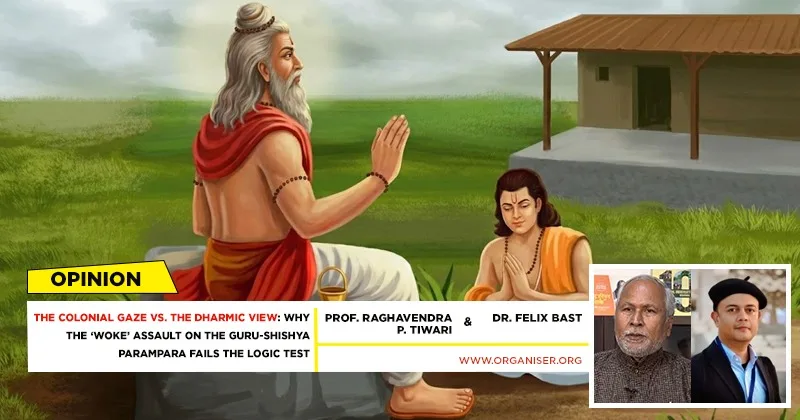
The modern Indian liberal elite is now being haunted by the ghost of a resurgence of Bharatiya civilization. This concern is amply demonstrated in a recent article published online by Scroll entitled “How the traditional guru-shishya system undermined critical thinking in India”. The author of this article uses a distorted colonial viewpoint and caricatures the historic pedagogy of India as a form of intellectual slavery. The author’s central thesis is that when the student respects the Guru, they ultimately stifle all dissent. That argument is not just a distortion of history, but rather a malevolent manipulation of history. The author frames the Indian student of antiquity as a mute automaton, and the Guru as a tyrant of dogma, and in doing so is attempting to vilify the birthplace of logic and inquiry in the world.
A delightful irony exists in that the “woke” cabal is currently busy deconstructing the past; yet at the same time, PM Narendra Modi, in his recent Pariksha Pe Charcha (PPC) Feb 2026, is calling on learners to return to the heart of India’s historical pedagogy. At PPC 2026, the Prime Minister made a call to action to the millions of students, parents and teachers who listened to him, and although he did not provide any examination tips, he was effectively updating the advanced cognitive sciences of the Vedic era for the Artificial Intelligence era. The “modern” skills the PM was promoting are critical thinking, involvement, dialectics, and civic responsibilities which were not imported from the West. Rather, these skills are integral to the lost legacy of the Gurukul, waiting to be reclaimed.
The “Former” Strategy: A Renaissance of Purva Paksha
A powerful metaphor that PM Modi used in his speech was the “Former Strategy”. He asked teachers to “plough the minds” of their students by telling them what they would be studying beforehand, not to teach right away, but to prepare the soil so that curiosity could grow. He stated that when a child comes into the classroom already engaged in thinking about the subject, the roots of understanding will develop much faster and more deeply. While this may appear to be contemporary “flipped classroom” pedagogical theory to the non-Dharmic observer, the Dharmic scholar recognizes this as an obvious application of the ancient dialectic of Purva Paksha.
The Scroll critique is based on the wrong assumption that the Guru-Shishya relationship has always been one of complete silence. However, the entire Indian philosophical framework (Mīmāṃsā Tradition) has been based upon the dialectical structure of Purva Paksha (prior view/opposite view), Khandana (rejection/destruction), and Uttara Paksha (conclusion). In the Vedic tradition, knowledge has never been presented as a monologue, but rather as a battle of wits. Students have never been simply empty vessels to be filled but instead fires to be ignited. In fact, Adi Shankara explicitly insisted that a doctrine must survive opponent-led scrutiny to be valid.
Consider the Prashna Upanishad (literally “Questions Text”) for example. The Prashna Upanishad depicts students such as Kabandhi, Bhargava and Gargya as grilling the Sage Pippalada with their philosophical inquiries. “From where are these beings created?” “Which gods support the being?” The Sage did not give his students answers directly; he provided them with the “soil” or Kshetra in which to cultivate their own questions and then wait for them to ripen.
Critics of the Guru-Shishya model confuse Shraddha (which is often mis-translated to mean blind faith) with obedience. In the Dharmic tradition, Shraddha refers to the focused attention required to receive a transmission. This is not the giving up of reason, but rather the relinquishing of the ego to make room for Vidya (knowledge) to enter. As the Prime Minister’s strategy indicates, the role of the teacher is to inspire a desire for learning in their students, not to feed the students the knowledge itself.
The Logic of the Ancients: Reclaiming Nyaya from the Colonial Myth
The most outrageous claim made today about ancient India is that there was no scope for ‘critical thinking.’ That is just ridiculous. Just open the Nyaya Shastras and you will see how absurd that claim really is. The Nyaya school of philosophy is simply the science of logic, epistemology, and inquiry. It created the set of rules for debating and determining valid knowledge (Pramana) long before Aristotle began teaching at the Lyceum. The old syllabus was very rigorous. Students had to learn the four valid ways of knowing: Pratyaksha (perception), Anumana (inference), Upamana (comparison), and Shabda (testimony).
Those who say that ancient Indian society had little ‘critical thinking’ must account for Panini. Panini’s Ashtadhyayi is not merely a textbook on grammar; it is a masterpiece of algorithmic logic and Boolean algebra, written thousands of years before there was even a silicon chip. Panini’s analysis of all aspects of language is the ultimate example of “Deep Involvement,” deconstructing language into individual phonemes with a level of sophistication that would put most of today’s coders to shame.
It is utterly absurd to suggest that the culture that produced such luminaries as Panini, Aryabhata, and the logicians of the Navya-Nyaya from Bengal lacked ‘critical thinking.’ Only a mind that has been colonized would entertain such an absurd idea. The Prime Minister’s warning against our current “Smartwatch Era,” where we are so consumed with superficial measures of success, is an appeal to return to the kind of deep thought exemplified in the works of Panini. He exhorted students to “look beyond the reels of life” and examine the “real.” This is a reference to the ancient distinction between collecting data/information and engaging in Shravana, Manana and Nidhidhyasana (a pedagogical trilogy of Adi Shankaracharya). The Gurukul did not raise parrots; it raised giants who dared to question the geocentric views of their time, as well as to question everything else, precisely because they were taught to question everything.
AI as Guide, Viveka as Master
In PPC 2026, when PM Modi said “AI has to be a guide, not a master” he echoed the same principles as in the Vedanta philosophy of Vivekam (discernment), where one has to discern what is good and what is bad. While AI can aggregate data, it cannot give you the wisdom. External tools such as palm-leaf manuscripts or large language models are all considered as Apara Vidya (worldly knowledge), whereas the synthesising agent (the consciousness), which determines the utility and ethics of the knowledge, is Para Vidya.
According to the Scroll, the guru created dependency, but this is not true; the ultimate goal of the guru is to become obsolete. Asato ma sad-gamaya is a well-known prayer from the Brihadaranyaka Upanishad, and it means “lead me from the unreal to the real”, i.e., lead me to the state of independent vision.
PM’s words to “use your intelligence” along with AI is a modern way of saying the relationship between Buddhi (the intellect) and Indriya (senses/tools). The moment we hand over our critical thinking ability to an algorithm, we fail the test of Vivekam. The ancient students were being trained to tell the difference between Preyasa (pleasant) and Shreya (good); similarly, today the distinction is between scrolling through feeds without any thought and analysing a dataset with consideration.
The Twin Siblings: Para and Apara Vidya
A very significant aspect of the Prime Minister’s speech was when he declared that “Life Skills and Professional Skills are twin siblings.” This is exemplified by a surgeon: one can be a master at cutting and sewing with their hands, yet if they lack the life skills of empathy, self-discipline, and a commitment to ethical conduct, then they will be a diminished human being who could represent a risk to all members of society.
This dichotomy clearly illustrates how empty the western industrial educational system is, which the “woken” critics of the PM seem to want to preserve. That system creates workers — the Gurukul creates complete human beings.
The Vedic environment recognised two different but complementary forms of education: Apara Vidya: Lower knowledge – sciences, grammar, economics, astronomy, warfare (professional skills); and Para Vidya: Higher knowledge – the nature of the self, ethics, consciousness, and liberation (life skills).
The Mundaka Upanishad explicitly states that both of these forms of knowledge are necessary for a civilisation to flourish. A civilisation of highly skilled sociopaths is no safer than a civilisation of incompetent saints. Therefore, when PM Modi talks about values, he is referring to the “soft skills” of titikṣā (forbearance), samatvam (equanimity), and ekāgratā (one-pointed concentration) as interlinked disciplines essential for self-mastery and knowledge, as articulated in the Bhagavad Gītā, Upaniṣads, Yoga Sūtras, and Advaita Vedānta texts. Such soft skills have enabled Indian civilisation to endure for more than 5,000 years. These were not coincidental results of the Gurukul — they were integral part of the curriculum. The liberal critique misses that in the Dharmic perspective, professional skill without personal character represents not just a tragic loss of potential — it is a violation of Dharma.
Shastrartha: The Original Perspective-Taking
Perhaps the strongest rebuttal to the ‘anti-dissenter’ rhetoric is the emphasis placed by the Prime Minister on Communication and Perspective-taking —the ability to take on the perspective of others in order to convince them. He stated that true leadership is based on being able to explain and convince people, not to coerce or force compliance through imposition.
He referenced the glorious Shastrarth (debate) tradition of India. If the Guru-Shishya tradition suppressed dissent, then what happened to Adi Shankaracharya? He did not spread Advaita Vedanta via the sword nor by silencing his adversaries. Rather, he travelled the entire length and breadth of Bharat engaging in numerous, open and robust debates with his rivals —some of whom were Buddhist, Mimansaka and Nyaya philosophers. The conditions of these debates were typically such that the loser would become the follower of the winner —an unparalleled demonstration of academic honesty. The celebrated 42-day debate between Adi Shankaracharya and Mandana Mishra, presided over by Ubhaya Bharati (Mishra’s wife), is a telling episode in India’s dialogic intellectual history.
Moreover, the foundational scripture of Sanatan Dharma, the Bhagavad Gita, acclaimed world over is in fact not an edict; it is a Samvada (conversation/dialogue). Krishna does not instruct Arjuna to engage in combat; instead, he encourages Arjuna to reflect and ask questions about each moral dilemma, fear and attachment. For 18 chapters, Krishna counsels his doubting student until the student ultimately proclaims, “Nasto Mohah Smrtir Labhda” (my delusions are shattered, I have gained my memory). This is perhaps the greatest critical thinking exercise imaginable, a guidance session in the midst of battle, wherein the student is empowered to choose his own path.
The Scroll criticism omits this history in order to depict a picture of authoritarianism. It disregards the fact that in our tradition, a guru who could not be questioned was deemed unworthy of the title. Moreover, the method of Shravana (hearing/listening), Manana (thinking/reflecting/ questioning) and Nididhyasa contemplating/meditating/ integrating) ensured that the truth was not simply accepted, but realized.
Civic Duty and the Concept of Rina (Moral Debt)
Lastly, the Prime Minister emphasized “Civic Duty”, showing respect for public space and adopting the “Vocal for Local” philosophy, and extending past the individual level of focus. In the Western paradigm, Civic Duty is generally a contractual agreement between the citizen and the State, a mutual exchange of taxes for service. In contrast, in the Dharmic paradigm, as exemplified by the Gurukul, it is viewed as a four Cosmic Obligation or Rina. These are: Deva Rina: Obligations to Nature (Environmental Stewardship) (Rigveda 1.89.1); Pitra Rina: Obligations to Ancestors (Honoring Heritage) (Manusmriti 6.35–37); Rishi Rina: Obligations to Teachers (Transmitting Knowledge) (Taittiriya Upanishad 1.11.1); and Manushya Rina: Obligations to Humanity (Serving Society) (Atharvaveda 3.30.1)
When the PM exhorts students to participate in nation building (Rashtra Nirman), he is translating the Dharmic concept of Rina into contemporary civic involvement. In the Gurukul, the student was educated that their education was not solely intended to earn a livelihood, but was also a tool for repaying those debts to society. The “Liberal Education Model,” which emphasizes the rights of the individual over responsibilities, has produced a generation lacking in connect with the nation.
The Gurukul grounded its students in the earth of the nation, engendering a sense of interdependence that contemporary environmentalism is only now beginning to re-discover. National Education Policy 2020 envisions to reinvent this holistic pedagogical model of Gurukul system in modern times.
Conclusion: The Era of Intentionality and the Return of the ‘Rishi’
The liberal critique of the Guru-Shishya Parampara reflects the nature of an educational system that has trained us to abhor our own reflection. The Western model, the “sage on the stage” lecturing to an audience of 300 odds in a lecture hall, produced factory workers for the Industrial Age. The Gurukul produced seekers, for all ages.
We require no lectures on “critical thinking” from the West or their media agents as we move towards the creation of Viksit Bharat 2047. All we need to do is look inward. The Prime Minister’s “Scout Era” of intentionality i.e. to observe, analyze and take action, is little else than the Rishi tradition of Mindfulness revived.
The Guru-Shishya Parampara did not diminish critical thinking; it codified it. It required that students verify the truth for themselves rather than accept it on blind faith. It is time to reclaim this narrative with pride and without apology. We are not a nation of followers; we are a civilisation of seekers. And as the Prime Minister illustrated in PPC 2026, the wisdom of the Rishi is not merely relevant to the era of AI, it is the only means of humanising it.