
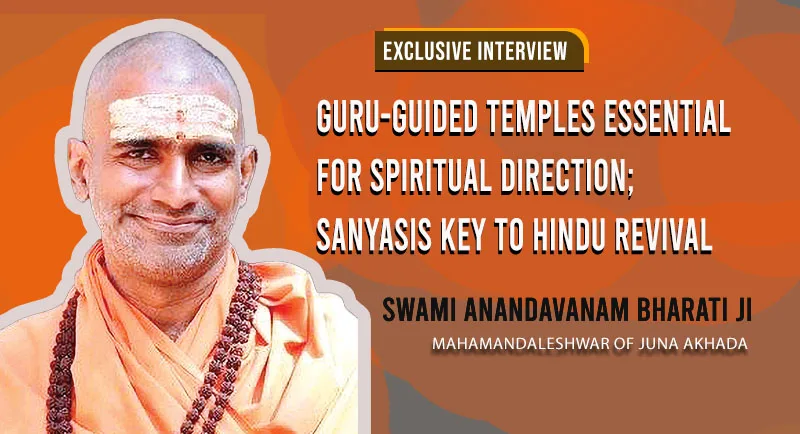
The Mahamagha Mahotsavam at Thirunnavaya has evoked renewed conversations around Hindu awakening, spiritual revival, and social unity in Kerala. Against this backdrop, T Satisan, Organiser Weekly’s Kerala Correspondent, spoke to revered Swami Anandavanam Bharati ji, Mahamandaleshwar of Juna Akhada. Reflecting on the scale and significance of the event, Swamiji spoke about the participation of various paramparas and sanyasi orders, as well as the expanding presence of Juna Akhada in Dakshin Bharat. In this detailed interaction, he also shares his views on temple administration, coordination among monastic
institutions, tribal empowerment, and the broader revival of Sanatan Dharma, offering insights drawn from his journey from poorvashram to monkhood. Excerpts:
We are witnessing what many describe as an unprecedented Hindu awakening in Kerala following the Mahamagha Mahotsavam. How do you assess this development?
Hindu jagaran, this great awakening, is the result of deergha tapas — a long spiritual pursuit sustained across generations. Such efforts bear fruit only at the destined time.
During the Mahamagha Mahotsavam, I met Sri Ananthan, a former Sangh Pracharak. He recalled visiting the Thirunnavaya temple decades ago with the late P Madhav ji, a senior Sangh Pracharak. Madhav ji had then remarked that the place would one day emerge as a centre of a major Hindu awakening. The organisers had initially planned to build the Mahotsavam into a large event over the next three years. Instead, it became a grand success within just three days. The venue is a small village in Muslim-majority Malappuram district. Earlier, there was no widespread awareness of any devata sanketam there. People traditionally visited the site to perform bali tarpan for the souls of their departed ancestors.
Yet devotees arrived from across the globe — from Canada, the US, Europe, the Middle East, and various parts of Asia. Thousands also came from other Dakshin Bharat states. According to police estimates, the total turnout touched nearly 40 lakh people.
Thousands of devotees from Tamil Nadu performed pooja at the source of the river near Anamalai in Tamil Nadu before proceeding to Thirunnavaya, the sacred venue of the Mahamagha Mahotsavam. They carried ornaments with them and offered them as part of the rituals there. The ceremony symbolically represented a girl’s family visiting her at her in-laws’ home and presenting her with ornaments, in keeping with traditional custom.
Despite limited cooperation from the state machinery, people across caste, religion, and party lines came together wholeheartedly. Why do you think the authorities remained hesitant while the public responded so enthusiastically?
During the initial phase of preparations, the district administration maintained a neutral stance — neither supportive nor opposed to the Mahotsavam. We wrote to the District Collector informing him of the possibility of large crowds. The response we received was, “Go ahead; we will see.”
By December, the momentum had gathered pace, and signs of a Hindu awakening were becoming visible. It was at this stage that a Stop Memo was issued. Many viewed this as an attempt to slow down the growing momentum. However, the development instead led to a stronger sense of unity among Hindus across the state. The spirit spread among all paramparas (traditions) of the Hindu society and sanyasins. Subsequently, the district administration approached the High Court, citing concerns about potential issues. The organisers began receiving notices on a daily basis. Apprehensions were raised regarding communal tensions, river pollution, stampedes, and other law-and-order challenges. At the same time, Deputy Superintendent of Police Johnson and Circle Inspector Vishnu extended their cooperation, ensuring that the arrangements proceeded smoothly. Devotees performed the holy dips in an orderly manner.
People and acharyas from the Kani tribe (Kanikkars) of Thiruvananthapuram to the Malaya parampara in Kasargod — spanning the southern and northern ends of the state — participated without any major disruptions. The district administration continued to move the court with petitions until the final day of the Mahotsavam.
How did members of other communities respond?
In Malappuram, where Muslims form the major non-Hindu community, their response was highly cooperative. Many opened their gates to provide parking space for vehicles. Women from their households offered tea and soft drinks to visitors at their doorsteps.
How significant was the contribution of Sewa Bharti volunteers on the ground during the event?
Sewa Bharti karyakartas worked round the clock throughout the Mahotsavam. The river and its banks remain as clean as they were before the event. Senior Sangh functionaries stayed present throughout to coordinate and oversee the seva activities.
How many ashrams and sanyasins come under the fold of your Akhada and what is the extent of its jurisdiction?
Akhada is a parampara with a worldwide presence. Juna Akhada has nearly three lakh ashrams across the world and around ten lakh sanyasins under its fold. It represents a long-standing tradition of warrior sanyasins.
What are the parameters for selecting a Mahamandaleshwar ?
The selection of a Mahamandaleshwar rests primarily on three foundational parameters: leadership, parampara, and vidyotita (enlightenment).
Is Kerala likely to witness an increased presence of Naga Sanyasins in the coming years?
Naga Sanyasins belong to the Juna Akhara and are traditionally regarded as warrior ascetics committed to the protection of Dharma. As and when the Juna Akhada expands its activities here, the presence of Naga Sanyasins is likely to increase. Notably, they participated in significant numbers during the Mahamagha Mahotsavam.
How do you evaluate the role of sanyasi mathas in Kerala?
The sanyasi mathas have several important roles to play. Swami Chinmayananda focused on the propagation of the Bhagavad Gita, which became a strong and articulate Hindu voice. Swami Chidananda Puri brought various mathas together and organised the Dharma Sandesh Yatra — the first initiative of its kind in Kerala.
Hindus are often on the receiving end in Kerala and that minority appeasement has become the norm, with Hindu concerns frequently viewed unfavourably. What factors, in your opinion, have contributed to this perception?
First and foremost, there is a lack of unity. Hindus often do not assert or express their collective strength when circumstances demand it. There is also a perceived erosion of self-respect, with many yielding to dominant narratives and adopting an apologetic stance.
For instance, it was widely alleged that the Mahamagha Mahotsavam would lead to river pollution, yet such fears did not materialise. At the same time, concerns over industrial discharge and slaughterhouse pollution have not received comparable attention.
Why, in your view, did Kerala move away from Sanatan Dharma? What factors or forces do you believe contributed to this shift?
We gradually distanced ourselves from our Paradevata and Kuladevata. The practice of Sandhya namajapam — family prayers at dusk — has largely faded. Decades ago, if an artist were asked to depict a typical Kerala home, he would paint a modest house with a traditional lamp lit in the verandah and the family gathered for evening prayers. Today, the image would more likely be a living room with a couple seated before a television while children are absorbed in their mobile phones.
What is the best method Kerala should follow to ensure that Sanatan Dharma is respected and revived in the state?
Rituals and outward observances alone are not sufficient. Temples should be guided by the presence of a Guru who can provide spiritual direction. Every village would benefit from having a sanyasi as a guide, someone who can help people understand and channel their collective strength in a constructive manner. Whether a temple or ashram is widely known or not, each represents a living parampara and embodies the continuity of tradition.
Will the recently concluded Magha Mahotsavam contribute to the revival of Hinduism, social renaissance, and greater Hindu unity in the state?
Certainly, the Magha Mahotsavam would certainly play a significant role in strengthening spiritual awareness, social harmony, and a sense of unity among Hindus in Kerala.
n We understand that you have undertaken “Dakshinamnayan” as a mission after assuming the position of Mahamandaleshwar. Could you explain what it entails?
“Dakshinamnayan” refers to a parampara traditionally led by a sanyasin. Over time, Kerala has seen a decline in this tradition, and many temples no longer have the systems in place to properly receive and support visiting sanyasins. In this context, the Mahamandaleshwar will lead the expansion of Juna Akhada activities across Southern Bharat, strengthening its spiritual and organisational presence in the region.
How do you plan to initiate better coordination among other sanyasi orders in Kerala?
The Akhada coordinated the Prayagraj Kumbh Mela, which itself is an exercise in large-scale coordination. Similarly, the Mahamagha Sammelan is another example of such collective coordination.
How do you view the alleged gold theft at Sabarimala?
The Yajman holds greater institutional responsibility than the Acharya. In earlier times, temples functioned under the patronage of a Yajman, often a ruling king. In Kerala, there were 64 Thambrakkals who fulfilled a similar role as custodial patrons. The absence of such a Yajman system can lead to administrative gaps and indiscipline in temple management.
What is your view on the revival of Hinduism at the national level? Do you see it as a tangible reality? What steps would you suggest to further strengthen and accelerate this process?
Social initiatives and the efforts of sanyasins play an important role. Society has not developed sufficiently to support the weaker sections, and this gap often creates conditions that lead to conversion and proselytisation. Conversions driven by inducements or threats should be discouraged. For instance, forest officers serve as the authorities in forest regions where vanavasi communities reside, yet they may not always have a deep understanding of vanavasi life and traditions. There is a need to promote serious study of forest ecosystems and indigenous ways of living. At the same time, the Mooppan — the traditional leader or head of a settlement — should be empowered to guide and support members of the community.
Has your proactive life in your poorvashram contributed to your grooming and formation
as a monk?
Yes. When issues and challenges arise, it becomes easier to understand and assess both sides of the situation.