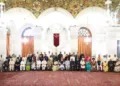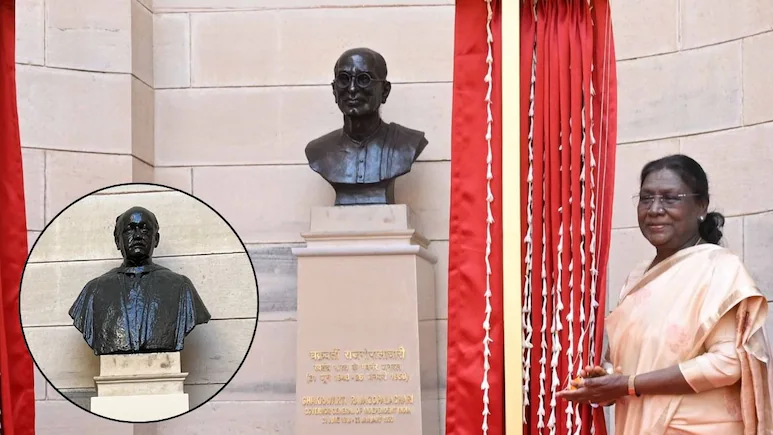
Honouring India’s constitutional and political history, a bust of C. Rajagopalachari, popularly known as Rajaji, has been installed at Rashtrapati Bhavan. The unveiling ceremony symbolised recognition of a statesman who served the nation in multiple capacities, freedom fighter, administrator, philosopher, and political reformer.
Rajagopalachari remains a singular figure in Indian history as the only Indian to have served as Governor-General after Independence. His tenure marked the final phase of India’s transition from British colonial administration to a fully sovereign republic.
The installation of his bust at Rashtrapati Bhavan highlights the enduring relevance of his contributions to governance and public life.
Born on December 10, 1878, in present-day Krishnagiri district of Tamil Nadu, Rajagopalachari came from a modest background but rose through education and intellectual brilliance. Trained as a lawyer, he soon earned a reputation for sharp legal reasoning and moral conviction.
Rajaji’s political journey began under the influence of Mahatma Gandhi, whose ideas on non-violence and national self-reliance deeply shaped his worldview. Over time, he emerged as one of Gandhi’s closest associates and trusted lieutenants during the freedom struggle.
Apart from politics, Rajagopalachari was also an accomplished writer and thinker who contributed to Indian philosophical and literary traditions.
Rajagopalachari holds a unique place in Indian constitutional history as the only Indian to serve as Governor-General.
After Independence in 1947, the position was initially held by Louis Mountbatten, who served as the first Governor-General of independent India. When Mountbatten stepped down in 1948, Rajagopalachari succeeded him, becoming the first and only Indian to occupy the post.
He served as Governor-General from 1948 to 1950, overseeing crucial administrative transitions before India formally became a republic on January 26, 1950.
With the adoption of the Constitution, the office of Governor-General was replaced by that of the President, ending the colonial-era structure of governance.
Rajagopalachari’s administrative career extended well beyond the Governor-Generalship.
Following the 1937 provincial elections under British rule, he became the Premier of Madras Presidency, a position equivalent to today’s Chief Minister. His tenure saw efforts toward administrative reform and educational initiatives.
After Independence, Rajagopalachari again returned to state politics. In the first general elections of 1952, he entered Parliament and later served as Chief Minister of Madras State.
His governance style was marked by fiscal discipline, strong administrative control, and emphasis on education and rural development.
Despite being a senior leader in the national movement, Rajagopalachari eventually developed differences with Prime Minister Jawaharlal Nehru.
Rajaji was critical of what he viewed as excessive state control and socialist economic policies promoted by the Congress leadership. He advocated free enterprise, decentralisation, and individual liberty.
These ideological differences ultimately led him to leave the Congress Party.
In 1959, Rajagopalachari founded the Swatantra Party, which became one of the earliest organised opposition parties in post-Independence India.
The party promoted market-oriented economic policies and limited government intervention at a time when socialist policies dominated Indian politics.
Although the Swatantra Party later declined, it played a significant role in shaping democratic debate and strengthening opposition politics.
Rajagopalachari’s legacy extends beyond the offices he held. He is remembered as a principled statesman who combined intellectual depth with political pragmatism.
Historians often describe him as one of the last representatives of the generation that led India from colonial rule to self-governance.
The unveiling of his bust at Rashtrapati Bhavan serves not only as a tribute to his achievements but also as a reminder of the diverse ideological traditions that shaped modern India.
More than seven decades after Independence, Rajagopalachari continues to stand as a symbol of constitutional governance, principled politics, and intellectual leadership.