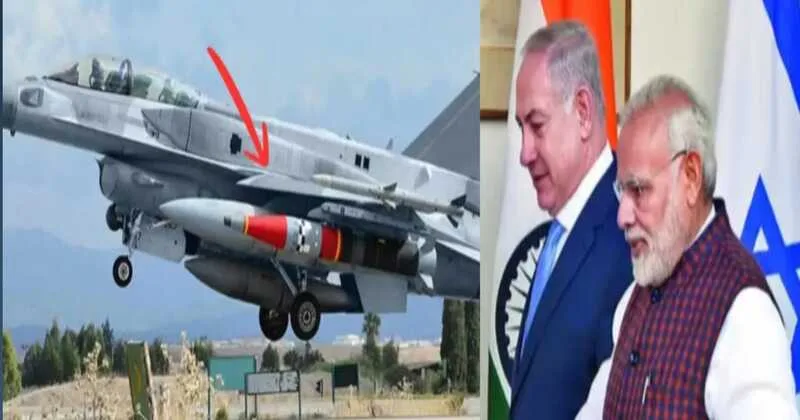
New Delhi: Ahead of Prime Minister Narendra Modi’s upcoming visit, Israel has reportedly offered India a powerful new strategic missile system known as Golden Horizon. The weapon is designed to penetrate underground bunkers, hardened military installations, and even nuclear facilities.
The Golden Horizon missile is believed to have a strike range of roughly 1,000 to 2,000 kilometres and can reach hypersonic speeds of Mach 5. At such velocity, intercepting the missile with existing air-defence systems becomes extremely difficult. This makes it significantly faster than India’s current BrahMos cruise missile, which travels at around Mach 3 and is widely regarded as the world’s fastest operational supersonic cruise missile.
According to defence sources, Golden Horizon is air-launched from fighter aircraft. If negotiations with Israel are finalised, the missile would likely be integrated onto the Indian Air Force’s Sukhoi-30 MKI jets. New Delhi is said to be seriously evaluating the proposal. Military analysts argue that induction of such an air-launched, long-range hypersonic weapon would provide India with a major strategic edge across South Asia.
Air-launched hypersonics could redefine India’s regional deterrence
Although India already fields indigenous ground-based ballistic missiles such as Agni-5, experts note that an air-launched system of this range dramatically expands operational flexibility. Fired from combat aircraft, Golden Horizon would allow deep-strike missions without crossing enemy airspace, substantially strengthening India’s deterrence posture. The missile’s deployment would also enhance the lethality of Indian air operations. Pakistan currently does not possess a comparable capability. China, however, is reported to operate an air-launched ballistic missile known as JL-1, believed to be adapted from the DF-21 hypersonic system and capable of striking targets up to 3,000 kilometres away. Beijing does not export this strategic asset.
However, defence analysts have claimed that defence systems supplied by China failed to perform effectively during India’s anti-terror Operation Sindoor, when Pakistan deployed Chinese-origin military equipment. The reported shortcomings during the operation have since been cited by defence analysts as evidence of vulnerabilities in Beijing’s military technology
Defence observers highlight another advantage for India that while China requires its H-6N bomber to deploy JL-1, Golden Horizon could be carried by India’s existing Sukhoi fleet, avoiding the need for specialised bombers. This significantly lowers operational and logistical barriers. Golden Horizon is said to be derived from Israel’s Silver Sparrow programme and offers greater range and impact than the LoRa (400 km) and Rampage (250 km) missiles currently used by India. With its speed, reach, and ability to bypass defences, the missile could markedly elevate India’s air-strike capabilities, if the deal moves forward.