
How US, UK and Other Countries Govern Classified Military Memoirs as India Considers 20-Year Ban Rule for Army Officers
June 6, 2026
  • Read Ecopy
  • Circulation
  • Advertise
  • Careers
  • About Us
  • Contact Us
Android AppiPhone AppArattai
Organiser
  • ‌
  • Bharat
    • Assam
    • Bihar
    • Chhattisgarh
    • Jharkhand
    • Maharashtra
    • View All States
  • World
    • Asia
    • Europe
    • North America
    • South America
    • Africa
    • Australia
  • Editorial
  • International
  • Opinion
  • RSS @ 100
  • More
    • Op Sindoor
    • Analysis
    • Sports
    • Defence
    • Politics
    • Business
    • Economy
    • Culture
    • Special Report
    • Sci & Tech
    • Entertainment
    • G20
    • Azadi Ka Amrit Mahotsav
    • Vocal4Local
    • Web Stories
    • Education
    • Employment
    • Books
    • Interviews
    • Travel
    • Law
    • Health
    • Obituary
  • Subscribe
    • Subscribe Print Edition
    • Subscribe Ecopy
    • Read Ecopy
  • ‌
  • Bharat
    • Assam
    • Bihar
    • Chhattisgarh
    • Jharkhand
    • Maharashtra
    • View All States
  • World
    • Asia
    • Europe
    • North America
    • South America
    • Africa
    • Australia
  • Editorial
  • International
  • Opinion
  • RSS @ 100
  • More
    • Op Sindoor
    • Analysis
    • Sports
    • Defence
    • Politics
    • Business
    • Economy
    • Culture
    • Special Report
    • Sci & Tech
    • Entertainment
    • G20
    • Azadi Ka Amrit Mahotsav
    • Vocal4Local
    • Web Stories
    • Education
    • Employment
    • Books
    • Interviews
    • Travel
    • Law
    • Health
    • Obituary
  • Subscribe
    • Subscribe Print Edition
    • Subscribe Ecopy
    • Read Ecopy
Organiser
  • Home
  • Bharat
  • World
  • Operation Sindoor
  • Editorial
  • Analysis
  • Opinion
  • Culture
  • Defence
  • International Edition
  • RSS @ 100
  • Magazine
  • Read Ecopy
Home World Europe

How US, UK and Other Countries Govern Classified Military Memoirs as India Considers 20-Year Ban Rule for Army Officers

Amid controversy over former Army Chief Naravane’s unpublished memoir, the Centre is considering a 20-year cooling-off period for armed forces officers’ writings, as global norms on restricting sensitive military publications come under scrutiny. Here's a closer look at how different countries regulate such memoirs

Lakshmi RanjithLakshmi Ranjith
Feb 20, 2026, 10:00 pm IST
in Europe, Bharat, World, Defence, Law
Follow on Google News
How US, UK and Other Countries Govern Classified Military Memoirs as India Considers 20-Year Ban Rule for Army Officers

Many countries control what retired military officers can write to protect sensitive information

FacebookTwitterWhatsAppTelegramEmail

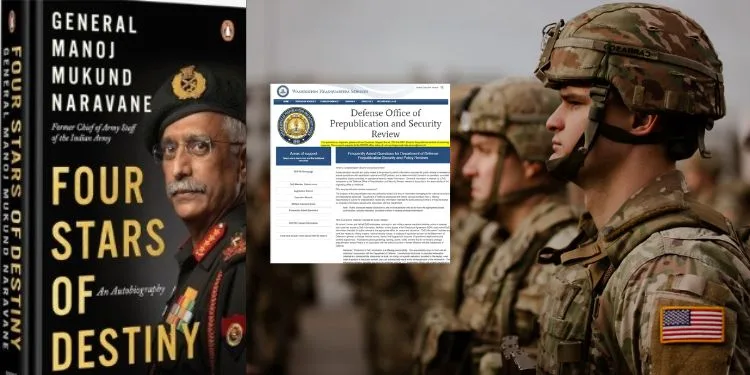
The Centre is reportedly considering a 20-year cooling-off period that would restrict senior serving and retired armed-forces officers from publishing books or memoirs about sensitive subjects for two decades after leaving service. The move follows controversy over a retired Army chief Naravane’s unpublished memoir and aims to close a legal “grey area” governing retirees’ publication. The proposal is said to apply to senior military and government officials and be formalised into rules affecting book publication post-service.

What are the Current Legal Provisions?

Retired officers are not automatically banned from writing books. However, the Official Secrets Act still applies to them even after retirement. Sharing confidential or sensitive information remains a criminal offence. The Official Secrets Act, 1923 already makes it illegal to reveal defence secrets, even after retirement. The Act covers all government employees, including armed forces personnel. Senior officers have access to large amounts of sensitive information.

Serving officers must take official permission before publishing anything. Now, the government is considering whether retired officers should also wait for a fixed period before publishing, to avoid any risk to national security or diplomatic relations.

Now, the government is considering whether retired officers should also wait for a fixed period before publishing, to avoid any risk to national security or diplomatic relations.

India does not have a clear and time-bound system for declassifying military records. In many cases, war records and operational files remain classified for decades.

In 2019, a policy suggested that records older than 25 years should be reviewed before being sent to the National Archives. This shows that official information is often treated as sensitive for a long time.

What is being proposed?

According to reports, the government is examining a framework that would prevent retired senior officers from publishing books or memoirs concerning sensitive operational, strategic or policy matters for up to two decades after demitting office. While serving officers already require prior permission to publish and remain bound by the Official Secrets Act even after retirement, the proposal would formalise a time-bound restriction.

Supporters argue the proposal plugs gaps in the current system. Critics argue it introduces an unprecedented blanket delay.

How other countries handle publications by former military personnel

Many countries control what retired military officers can write to protect sensitive information. They usually do this by asking former officers to submit their books for review before publishing. They may also require lifelong secrecy promises. If someone reveals classified information, they can face punishment under official secrets or espionage laws. Authoritarian countries are generally stricter and place heavier restrictions on such writings.

United States of America

According to the US Department of Defense’s official website for the Defense Office of Prepublication and Security Review (DOPSR), there is no general ban. However, former service members are subject to lifelong prohibitions on revealing classified information. All current, former, and retired DoD employees, contractors, and military service members (whether active or reserve) who have had access to DoD information, facilities, or who signed a Non-Disclosure Agreement (NDA) must submit DoD information intended for public release to the appropriate office for review and clearance.

The Department of Defense runs a pre-publication security review process for manuscripts by current and former personnel; criminal statutes (including sections of the Espionage Act and 18 U.S.C. §798) can apply if classified material is disclosed. Authors must often submit drafts for review; disputes over the scope of review have reached U.S. courts.

United Kingdom

As per the UK Parliament research briefing published on the official Parliament website. The Official Secrets Acts create criminal offences for unlawful disclosure by present and former government employees. Retired military personnel must follow the Official Secrets Act 1989. This law bans them from sharing sensitive information without permission. The rule applies for life. It covers matters related to national security, defence and international relations.

Some personnel, such as those in special forces, may have signed extra agreements. These can require approval from the Ministry of Defence before publishing certain material.

They are free to write on non-sensitive topics. However, books or articles dealing with security matters are usually checked before publication. The UK does not use a blanket post-service publishing ban, but legal obligations and possible prosecution for disclosing protected information act as strong constraints.

Australia

Similar to the UK, restrictions stem from the Crimes Act and Defence-specific rules requiring pre-approval for publications containing classified info. Retired personnel submit materials to Defence for review if sensitive. No long cooling-off period; emphasis is on redaction and clearance for non-sensitive content. Recent laws (e.g., 2023 amendments) focus more on foreign work restrictions than publications.

France

French retired military personnel are bound by the “duty of reserve” under the Code of Defense, prohibiting public expressions that could undermine neutrality or disclose sensitive info. Publications may require Ministry approval if related to military matters.

Conclusion

The debate also comes at a time when India’s strategic footprint is expanding. Greater international engagement, defence partnerships and joint operations increase the sensitivity of certain disclosures.

Some security analysts argue that a structured cooling-off period may help align India’s disclosure regime with emerging global security risks.

At its core, the issue is about protecting sensitive military information, which is unquestionably essential. Military plans, intelligence inputs, operational details, and strategic assessments are not ordinary information. If such details are disclosed, even unintentionally, they can compromise national security, endanger personnel, weaken defence preparedness, and provide adversaries with critical insights.


Topics: Former Army Chief NaravaneIndiaUnited KingdomUnited States
Lakshmi Ranjith
Lakshmi Ranjith
A digital journalist with over 18 years of experience in mainstream media, she began her career in television news before expanding into print, social media, and digital platforms. She has travelled extensively across India to cover elections, political developments, and major business events, reporting on issues ranging from politics and governance to business and social affairs. Her key strengths include sharp analysis of national and state politics, as well as international relations. Over the years, she has worked with The Times of India, Google, News24 Digital, MMTV, TV News, and the Ministry of Information & Broadcasting. She currently serves as Assistant News Editor at Organiser, overseeing digital platforms. She is Committed to continuous learning; she maintains high editorial standards and a strong commitment to ethical journalism in a rapidly evolving media landscape. [Read more]
ShareTweetSendShareSend
✮ Subscribe Organiser YouTube Channel. ✮
✮ Join Organiser's WhatsApp channel for Nationalist views beyond the news. ✮
Previous News

US Supreme Court rules Trump lacked authority under IEEPA to impose sweeping tariff

Next News

Deepfakes pose serious risk to democratic discourse: Lok Sabha Speaker OM Birla

Related News

Union Home Minister Amit Shah addressing BSF personnel at the Lankamura Border Outpost along the India-Bangladesh border in West Tripura district on June 5, 2026

Amit Shah at Bangladesh Border: “India will have an impregnable security grid soon”

India slams Pakistan’s bid to hold elections in Gilgit-Baltistan, demands end to illegal occupation

India seals robust 7.7% GDP Growth in FY26: Reflects economic resilience amid West Asia crisis & other global headwinds

MEA spokesperson Randhir Jaiswal highlights India's resolve to deport illegal Bangladeshi migrants via bilateral mechanisms

India reiterates strong resolve to deport illegal Bangladeshis; Flags delay of bilateral procedures from Dhaka

Russia pitches for the co-production of Fifth Generation Su-57 with India

Russian President Putin renews Su-57 offer to India; Signals full access to 5th gen stealth fighter jet technology

As fuel shortages rippled across Asia, New Delhi expanded supplies to its neighbours while Beijing sought to turn energy security into strategic influence.

The Hormuz Test: How India’s energy assistance outshines China’s conditional approach

Load More

Latest News

Jameer Khan and Alla Bhakshu arrested in Pakistan-linked terror probe

Karnataka: Digital jihad trail exposed: Jameer Khan and Alla Bhakshu arrested, links traced to Pakistan

Union Home Minister Amit Shah addressing BSF personnel at the Lankamura Border Outpost along the India-Bangladesh border in West Tripura district on June 5, 2026

Amit Shah at Bangladesh Border: “India will have an impregnable security grid soon”

India slams Pakistan’s bid to hold elections in Gilgit-Baltistan, demands end to illegal occupation

Maharashtra government approves central wage structure for Pune Metro Contract Workers; Major victory for BMS

India seals robust 7.7% GDP Growth in FY26: Reflects economic resilience amid West Asia crisis & other global headwinds

A representative image

After TCS, Corporate Jihad allegations reach SBI: Married Hindu employee conversion claims trigger FIR in Mumbai

MEA spokesperson Randhir Jaiswal highlights India's resolve to deport illegal Bangladeshi migrants via bilateral mechanisms

India reiterates strong resolve to deport illegal Bangladeshis; Flags delay of bilateral procedures from Dhaka

Kerala HC rejects CMRL appeal, clears way for ED probe against Pinarayi Vijayan’s daughter in money laundering case

Uttar Pradesh leads in Bharat's green transformation

World Environment Day 2026: On his birthday, Yogi Adityanath’s green vision powers Uttar Pradesh’s transformation

As Khalistani networks seek new platforms beyond the West, Azerbaijan has emerged as a key venue for conferences, campaigns and narratives aligned with the Pakistan-Turkey axis against India.

Khalistan’s New Grazing Ground: Azerbaijan emerges as new hub for Turkey-Pakistan backed anti-India networks

Load More
  • Privacy
  • Terms
  • Cookie Policy
  • Refund and Cancellation
  • Delivery and Shipping

© Bharat Prakashan (Delhi) Limited.
Tech-enabled by Ananthapuri Technologies

  • Home
  • Search Organiser
  • Bharat
    • Assam
    • Bihar
    • Chhattisgarh
    • Jharkhand
    • Maharashtra
    • View All States
  • World
    • Asia
    • Africa
    • North America
    • South America
    • Europe
    • Australia
  • Editorial
  • Operation Sindoor
  • Opinion
  • Analysis
  • Defence
  • Culture
  • Sports
  • Business
  • RSS @ 100
  • Entertainment
  • More ..
    • Sci & Tech
    • Vocal4Local
    • Special Report
    • Education
    • Employment
    • Books
    • Interviews
    • Travel
    • Health
    • Politics
    • Law
    • Economy
    • Obituary
  • Subscribe Magazine
  • Read Ecopy
  • Advertise
  • Circulation
  • Careers
  • About Us
  • Contact Us
  • Policies & Terms
    • Privacy Policy
    • Cookie Policy
    • Refund and Cancellation
    • Terms of Use

© Bharat Prakashan (Delhi) Limited.
Tech-enabled by Ananthapuri Technologies