J&K: Cutting of willow trees in catchment of Wullar lake undertaken
September 14, 2026
  • Read Ecopy
  • Circulation
  • Advertise
  • Careers
  • About Us
  • Contact Us
Android AppiPhone AppArattai
Organiser
  • ‌
  • Bharat
    • Assam
    • Bihar
    • Chhattisgarh
    • Jharkhand
    • Maharashtra
    • View All States
  • World
    • Asia
    • Europe
    • North America
    • South America
    • Africa
    • Australia
  • Editorial
  • International
  • Opinion
  • RSS @ 100
  • More
    • World Hindu Congress 2026
    • Op Sindoor
    • Analysis
    • Sports
    • Defence
    • Politics
    • Business
    • Economy
    • Culture
    • Special Report
    • Sci & Tech
    • Entertainment
    • G20
    • Azadi Ka Amrit Mahotsav
    • Vocal4Local
    • Web Stories
    • Education
    • Employment
    • Books
    • Interviews
    • Travel
    • Law
    • Health
    • Obituary
  • Subscribe
    • Subscribe Print Edition
    • Subscribe Ecopy
    • Read Ecopy
  • ‌
  • Bharat
    • Assam
    • Bihar
    • Chhattisgarh
    • Jharkhand
    • Maharashtra
    • View All States
  • World
    • Asia
    • Europe
    • North America
    • South America
    • Africa
    • Australia
  • Editorial
  • International
  • Opinion
  • RSS @ 100
  • More
    • World Hindu Congress 2026
    • Op Sindoor
    • Analysis
    • Sports
    • Defence
    • Politics
    • Business
    • Economy
    • Culture
    • Special Report
    • Sci & Tech
    • Entertainment
    • G20
    • Azadi Ka Amrit Mahotsav
    • Vocal4Local
    • Web Stories
    • Education
    • Employment
    • Books
    • Interviews
    • Travel
    • Law
    • Health
    • Obituary
  • Subscribe
    • Subscribe Print Edition
    • Subscribe Ecopy
    • Read Ecopy
Organiser
  • Home
  • Bharat
  • World
  • Operation Sindoor
  • Editorial
  • Analysis
  • Opinion
  • Culture
  • Defence
  • International Edition
  • RSS @ 100
  • Magazine
  • Read Ecopy
Home Bharat

J&K: Cutting of willow trees in catchment of Wullar lake undertaken in phased manner to improve water holding capacity

Willow trees which the government introduced in the catchment area of Wullar lake around 1960 have harmed it immensely and are now being removed in a phased manner. However, the pace of work leaves much to be desired as the water holding capacity of the lake has reduced signficantly and this trend needs to be reversed

Sant Kumar SharmaSant Kumar Sharma
Feb 19, 2026, 08:30 pm IST
inBharat, Analysis, Jammu and Kashmir
Follow on Google News
Wullar Lake

Wullar Lake

Facebook
Twitter
WhatsAppTelegramEmail

Jammu: The government informed the Legislative Assembly on February 19, Thursday that around 1.35 lakh willow trees have been felled in and around Wullar Lake under a phased restoration plan. On the other hand, over 19 lakh plants have been raised in the catchment area to mitigate the ecological impact since 2012.

In response to MLA Irshad Rasool Kar’s query, the government said that 1.91 lakh willow trees were identified for removal in the first phase under the Comprehensive Management Action Plan for Wullar Lake. Of these, nearly 1.35 lakh trees have already been removed. The government said the exercise is not deforestation but a habitat management measure aimed at restoring the lake’s natural wetland character.

Incidentally, the growth of these willow trees has harmed the aquatic character of the lake and the habitat space for both birds and fish species has shrunk. As such, the trees are not a positive attribute but impact the lake negatively and detrimental to its ecosystem.

Conservation efforts

The government also said the plan does not provide for blanket removal and instead prescribes selective and need-based cutting aligned with ecological goals. The Minister further informed the House that total estimated number of willow trees in and around the lake stands between 19 and 21 lakh. The removal is being carried out in a phased and strategic manner based on management requirements.

The government also disclosed that the tree removal has generated approximately Rs 31.95 crore in revenue so far. The entire amount has been deposited under government receipts in accordance with financial rules. On compensatory measures, the government said, more than 19 lakh plants have been raised in the Wullar catchment since the establishment of the Wullar Conservation and Management Authority(WUCMA) in 2012.

In the Bandipora catchment alone, over 2,900 hectares have been treated through afforestation, plantation and soil conservation works. These measures, they said, aim to stabilise slopes, control erosion and reduce sediment flow into the lake as part of the larger restoration effort. To restore Wullar Lake to health, the government has identified between 19 and 21 lakh (1.9 to 2.1 million) willow trees for removal from its bed. These trees, planted over decades, have encroached upon the lake’s area, causing severe siltation and reducing its water-holding capacity. On removal of all the identified trees, the holding capacity of the lake is expected to improve significantly.

Cutting Willows

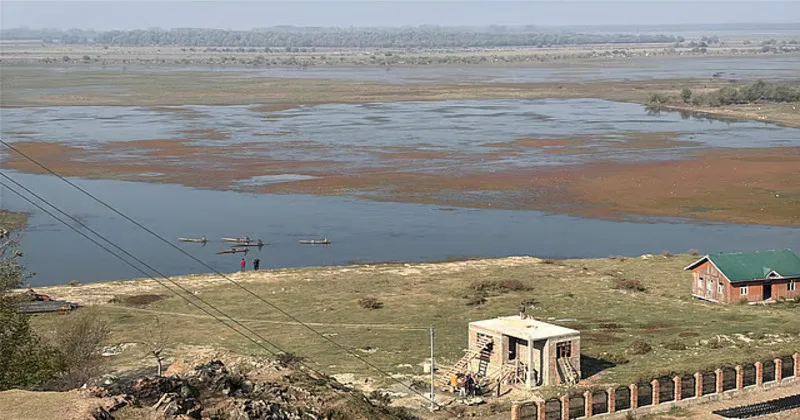
The willow plantation, covering around 27 sq km, has significantly reduced the lake’s water-holding capacity, turning marshlands into terrestrial areas, changing it from an aquatic ecosystem. The removal of these trees and over 2 crore cubic metres of silt is crucial for enhancing the lake’s ecological health. The removal of silt through dredgers was taken up but interrupted by raising a bogey of it constituting a violation of the Indus Waters Treaty(IWT) now in abeyance.

The project, if undertaken on priority in the coming summer, can help restore the lake’s original, larger water-spread area. According to some estimates, the large water body has shrunk by over 45 per cent over the past century. Encroachments by land sharks, dumping of municipal waste into this pristine water body and a host of other factors has led to this sorry state of affairs.

The work for removal of the trees is going on at a slow pace but needs to be speeded up. If the holding capacity of the lake shrinks and is reduced, the major gainer is Pakistan located downstream as all water runs off via Jhelum river to Mangla dam. If a targeted approach focused on removing trees in areas with high siltation is taken up, the natural wetland character of the lake can be restored.

Area reduction

It was in December 2018 that a study was undertaken which put the lake area having reduced very much in the last century. The lake has dwindled from 157.74 sq km in 1911 to 86.71 sq km in 2007. In lean winter months, when the water flow in Jhelum and many of its tributaries dwindles, the lake area can be reduced to as little as to 24 sq km, about one-fifth of its original size.

At least 27 square kilometre area out of a stretch of 130 sq km classified as the lake area by the Revenue Department was converted into willow plantation sites. These plantations are now identified as a major cause of siltation and filling up of the lake artificially. This has happened at the cost of the natural habitat of migratory birds, fish and plant species. The need is to reverse this harmful trend which affects both flora and fauna.

Due to the decline in water levels and deteriorating water quality, the Wullar lake and its surrounding areas have seen a reduction in bird and fish population over the past few years. One very significant reason why the Wullar lake needs to be revived, restored to its original size is that it acts as a natural sponge. That means its vastness absorbs and accommodates water when it flows in excess. Then oozes it out during lean winter months helping maintain humidity in the Valley.

Also Read: IFR 2026: Indigenous naval prowess echoes the resolve for secure maritime corridors & shared spirit for ocean diplomacy

Navigation project

It needs to be mentioned here that Tulbul Navigation project, which has been pending for the past few decades, is also likely to be completed in the next few years. The Wullar lake is central to this project aimed at make the Jhelum river navigable. For this, at the mouth of the lake towards its outfall where the Jhelum exits the Wullar, a navigation structure has been planned. Earlier, Pakistan repeatedly stalled this project by raising objections under the Indus Waters Treaty. However, with the treaty in abeyance, its objections are not being entertained and the river will be made navigable by building the necessary structures.

Since navigation constitutes a non-consumptive use of water, only regulating its flow and not putting it to use otherwise, India has always held that Pakistan should cooperate, instead of confronting on every minor technical detail. In fact, regulating the flow of water downstream of Wullar can only lead to better flows in the Jhelum during winter months when the river becomes non navigable.


Topics: Indus Waters TreatyWullar LakeTulbul Navigation Projectwillow treesPakistanJ&K
Share
Tweet
SendShareSend
✮ Subscribe Organiser YouTube Channel. ✮
✮ Join Organiser's WhatsApp channel for Nationalist views beyond the news. ✮
Previous News

Kerala: SC priest resigns from CPM-controlled Tiruvitamcoor Devaswom Board alleging harassment by members, unions

Next News

Reclaiming Civilizational Time: Why Vikrama Samvat should replace the Saka Samvat in Bharat’s National Calendar

Related News

AI Generated Representative Image

“Let Go” — But only when it suits you? Exposing the double standards of Kashmir’s political leadership

Chinese President Xi Jinping and Prime Minister Modi at BRICS Summit, 2026

BRICS Summit: China inks declaration on Pahalgam attack & counter-terrorism; India’s win amid Beijing-Islamabad ties

‘Samuel Could Never Do This’: Mother Rejects Blasphemy Allegations Against Son in Lahore

Pakistan Blasphemy Case: Mother of Christian man Samuel Arif claims false implication, seeks justice

UN Experts Flag Balochistan ‘Pattern’ of Alleged Disappearances and Extrajudicial Killings

Balochistan Under UN Lens: Experts raise alarm over alleged disappearances, torture and killings

The Map of India shown in Afghanistan Cricket Board's promotional video

Afghanistan cricket promo irks occupying Pakistan; Kabul highlights PoJK, Gilgit-Baltistan as Indian territories

MEA backs UNGA resolution on cartographic representation

MEA backs UNGA resolution on cartographic depiction; Reaffirms India’s non-negotiable sovereignty over J&K and Ladakh

Load More

Latest News

RSS Akhil Bharatiya Sah-Bauddhik Shikshan Pramukh Deepak Vispute addressing the gathering

‘Nation First’ should be the guiding principle for every individual, regardless of their Field: Deepak Vispute

‘India was not poor; it was made poor’: The truth re-emerges through Jema Ferrer’s perspective

Six years after talent manager Disha Salian was found dead, her father Satish Salian on September 11 recorded a detailed statement with the Central Bureau of Investigation (CBI), naming Shiv Sena (UBT) leader Aaditya Thackeray, actors Dino Morea and Sooraj Pancholi, and others.

Disha Salian Murder Case: Father names Aaditya Thackeray in CBI statement; Lawyer claims gang rape, murder cover-up

Release of a book at Vishwa Bandhutva Diwas programme that was organised in Ujjain

Bharat’s youth rooted in sacrifice, service & discipline can give new direction to World: Parag Abhyankar

AI Generated Representative Image

“Let Go” — But only when it suits you? Exposing the double standards of Kashmir’s political leadership

Bharatiya Kisan Sangh distributed free school uniforms, notebooks, pen bundles, bags to 7,000 students in flood-affected areas of Assam

Assam: Bharatiya Kisan Sangh distributes free school uniforms, notebooks & bags to 7,000 flood-affected students

Chinmoy Prabhu

When a Bengali Hindu suffers in Bangladesh, where does ‘Bangali-Prem’ go?

AI Generated Representative Image

BRICS Summit: Not de-dollarisation, but derisking from dollar; India scripts pragmatic shield against external shocks

RSS Sarsanghchalak Dr Mohan Bhagwat, attended the 37th annual prize distribution ceremony ‘Swaraj’ at L.K. Singhania Education Centre

Education must go beyond livelihood and focus on holistic human development: Dr Mohan Bhagwat

(Left) Prime Minister Narendra Modi and Russian President Vladimir Putin (Right) Prime Minister Narendra Modi and Chinese President Xi Jinping in the backdrop of the Rameshwaram temple corridor in the backdrop of the BRICS 2026 summit

Bharat’s civilisational pride at BRICS 2026: Rameswaram temple corridor frames world leaders

Load More
  • Privacy
  • Terms
  • Cookie Policy
  • Refund and Cancellation
  • Delivery and Shipping

© Bharat Prakashan (Delhi) Limited.
Tech-enabled by Ananthapuri Technologies

  • Home
  • Search Organiser
  • Bharat
    • Assam
    • Bihar
    • Chhattisgarh
    • Jharkhand
    • Maharashtra
    • View All States
  • World
    • Asia
    • Africa
    • North America
    • South America
    • Europe
    • Australia
  • Editorial
  • Operation Sindoor
  • Opinion
  • Analysis
  • Defence
  • Culture
  • Sports
  • Business
  • RSS @ 100
  • Entertainment
  • More ..
    • Sci & Tech
    • Vocal4Local
    • Special Report
    • Education
    • Employment
    • Books
    • Interviews
    • Travel
    • Health
    • Politics
    • Law
    • Economy
    • Obituary
  • Subscribe Magazine
  • Read Ecopy
  • Advertise
  • Circulation
  • Careers
  • About Us
  • Contact Us
  • Policies & Terms
    • Privacy Policy
    • Cookie Policy
    • Refund and Cancellation
    • Terms of Use

© Bharat Prakashan (Delhi) Limited.
Tech-enabled by Ananthapuri Technologies