J&K: Cutting of willow trees in catchment of Wullar lake undertaken
June 23, 2026
  • Read Ecopy
  • Circulation
  • Advertise
  • Careers
  • About Us
  • Contact Us
Android AppiPhone AppArattai
Organiser
  • ‌
  • Bharat
    • Assam
    • Bihar
    • Chhattisgarh
    • Jharkhand
    • Maharashtra
    • View All States
  • World
    • Asia
    • Europe
    • North America
    • South America
    • Africa
    • Australia
  • Editorial
  • International
  • Opinion
  • RSS @ 100
  • More
    • Op Sindoor
    • Analysis
    • Sports
    • Defence
    • Politics
    • Business
    • Economy
    • Culture
    • Special Report
    • Sci & Tech
    • Entertainment
    • G20
    • Azadi Ka Amrit Mahotsav
    • Vocal4Local
    • Web Stories
    • Education
    • Employment
    • Books
    • Interviews
    • Travel
    • Law
    • Health
    • Obituary
  • Subscribe
    • Subscribe Print Edition
    • Subscribe Ecopy
    • Read Ecopy
  • ‌
  • Bharat
    • Assam
    • Bihar
    • Chhattisgarh
    • Jharkhand
    • Maharashtra
    • View All States
  • World
    • Asia
    • Europe
    • North America
    • South America
    • Africa
    • Australia
  • Editorial
  • International
  • Opinion
  • RSS @ 100
  • More
    • Op Sindoor
    • Analysis
    • Sports
    • Defence
    • Politics
    • Business
    • Economy
    • Culture
    • Special Report
    • Sci & Tech
    • Entertainment
    • G20
    • Azadi Ka Amrit Mahotsav
    • Vocal4Local
    • Web Stories
    • Education
    • Employment
    • Books
    • Interviews
    • Travel
    • Law
    • Health
    • Obituary
  • Subscribe
    • Subscribe Print Edition
    • Subscribe Ecopy
    • Read Ecopy
Organiser
  • Home
  • Bharat
  • World
  • Operation Sindoor
  • Editorial
  • Analysis
  • Opinion
  • Culture
  • Defence
  • International Edition
  • RSS @ 100
  • Magazine
  • Read Ecopy
Home Bharat

J&K: Cutting of willow trees in catchment of Wullar lake undertaken in phased manner to improve water holding capacity

Willow trees which the government introduced in the catchment area of Wullar lake around 1960 have harmed it immensely and are now being removed in a phased manner. However, the pace of work leaves much to be desired as the water holding capacity of the lake has reduced signficantly and this trend needs to be reversed

Sant Kumar SharmaSant Kumar Sharma
Feb 19, 2026, 08:30 pm IST
in Bharat, Analysis, Jammu and Kashmir
Follow on Google News
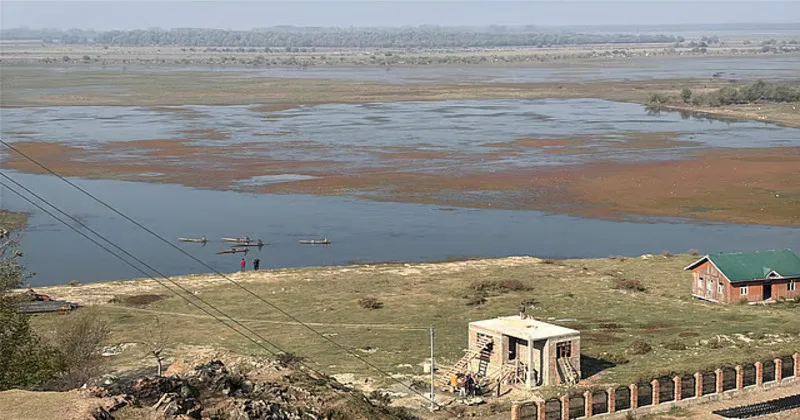
Wullar Lake

Wullar Lake

FacebookTwitterWhatsAppTelegramEmail

Jammu: The government informed the Legislative Assembly on February 19, Thursday that around 1.35 lakh willow trees have been felled in and around Wullar Lake under a phased restoration plan. On the other hand, over 19 lakh plants have been raised in the catchment area to mitigate the ecological impact since 2012.

In response to MLA Irshad Rasool Kar’s query, the government said that 1.91 lakh willow trees were identified for removal in the first phase under the Comprehensive Management Action Plan for Wullar Lake. Of these, nearly 1.35 lakh trees have already been removed. The government said the exercise is not deforestation but a habitat management measure aimed at restoring the lake’s natural wetland character.

Incidentally, the growth of these willow trees has harmed the aquatic character of the lake and the habitat space for both birds and fish species has shrunk. As such, the trees are not a positive attribute but impact the lake negatively and detrimental to its ecosystem.

Conservation efforts

The government also said the plan does not provide for blanket removal and instead prescribes selective and need-based cutting aligned with ecological goals. The Minister further informed the House that total estimated number of willow trees in and around the lake stands between 19 and 21 lakh. The removal is being carried out in a phased and strategic manner based on management requirements.

The government also disclosed that the tree removal has generated approximately Rs 31.95 crore in revenue so far. The entire amount has been deposited under government receipts in accordance with financial rules. On compensatory measures, the government said, more than 19 lakh plants have been raised in the Wullar catchment since the establishment of the Wullar Conservation and Management Authority(WUCMA) in 2012.

In the Bandipora catchment alone, over 2,900 hectares have been treated through afforestation, plantation and soil conservation works. These measures, they said, aim to stabilise slopes, control erosion and reduce sediment flow into the lake as part of the larger restoration effort. To restore Wullar Lake to health, the government has identified between 19 and 21 lakh (1.9 to 2.1 million) willow trees for removal from its bed. These trees, planted over decades, have encroached upon the lake’s area, causing severe siltation and reducing its water-holding capacity. On removal of all the identified trees, the holding capacity of the lake is expected to improve significantly.

Cutting Willows

The willow plantation, covering around 27 sq km, has significantly reduced the lake’s water-holding capacity, turning marshlands into terrestrial areas, changing it from an aquatic ecosystem. The removal of these trees and over 2 crore cubic metres of silt is crucial for enhancing the lake’s ecological health. The removal of silt through dredgers was taken up but interrupted by raising a bogey of it constituting a violation of the Indus Waters Treaty(IWT) now in abeyance.

The project, if undertaken on priority in the coming summer, can help restore the lake’s original, larger water-spread area. According to some estimates, the large water body has shrunk by over 45 per cent over the past century. Encroachments by land sharks, dumping of municipal waste into this pristine water body and a host of other factors has led to this sorry state of affairs.

The work for removal of the trees is going on at a slow pace but needs to be speeded up. If the holding capacity of the lake shrinks and is reduced, the major gainer is Pakistan located downstream as all water runs off via Jhelum river to Mangla dam. If a targeted approach focused on removing trees in areas with high siltation is taken up, the natural wetland character of the lake can be restored.

Area reduction

It was in December 2018 that a study was undertaken which put the lake area having reduced very much in the last century. The lake has dwindled from 157.74 sq km in 1911 to 86.71 sq km in 2007. In lean winter months, when the water flow in Jhelum and many of its tributaries dwindles, the lake area can be reduced to as little as to 24 sq km, about one-fifth of its original size.

At least 27 square kilometre area out of a stretch of 130 sq km classified as the lake area by the Revenue Department was converted into willow plantation sites. These plantations are now identified as a major cause of siltation and filling up of the lake artificially. This has happened at the cost of the natural habitat of migratory birds, fish and plant species. The need is to reverse this harmful trend which affects both flora and fauna.

Due to the decline in water levels and deteriorating water quality, the Wullar lake and its surrounding areas have seen a reduction in bird and fish population over the past few years. One very significant reason why the Wullar lake needs to be revived, restored to its original size is that it acts as a natural sponge. That means its vastness absorbs and accommodates water when it flows in excess. Then oozes it out during lean winter months helping maintain humidity in the Valley.

Also Read: IFR 2026: Indigenous naval prowess echoes the resolve for secure maritime corridors & shared spirit for ocean diplomacy

Navigation project

It needs to be mentioned here that Tulbul Navigation project, which has been pending for the past few decades, is also likely to be completed in the next few years. The Wullar lake is central to this project aimed at make the Jhelum river navigable. For this, at the mouth of the lake towards its outfall where the Jhelum exits the Wullar, a navigation structure has been planned. Earlier, Pakistan repeatedly stalled this project by raising objections under the Indus Waters Treaty. However, with the treaty in abeyance, its objections are not being entertained and the river will be made navigable by building the necessary structures.

Since navigation constitutes a non-consumptive use of water, only regulating its flow and not putting it to use otherwise, India has always held that Pakistan should cooperate, instead of confronting on every minor technical detail. In fact, regulating the flow of water downstream of Wullar can only lead to better flows in the Jhelum during winter months when the river becomes non navigable.


Topics: Tulbul Navigation Projectwillow treesPakistanJ&KIndus Waters TreatyWullar Lake
ShareTweetSendShareSend
✮ Subscribe Organiser YouTube Channel. ✮
✮ Join Organiser's WhatsApp channel for Nationalist views beyond the news. ✮
Previous News

Kerala: SC priest resigns from CPM-controlled Tiruvitamcoor Devaswom Board alleging harassment by members, unions

Next News

Reclaiming Civilizational Time: Why Vikrama Samvat should replace the Saka Samvat in Bharat’s National Calendar

Related News

Illegally constructed mosque in Japan

The Threat of Islamisation: A Japanese case study

7 killed and 3 injured in a twin blast at Khyber Pakhtunkhwa

Pakistan: 7 killed, 3 injured in twin blasts in Wazir sub-division of Khyber Pakhtunkhwa

Government employess of Balochistan begin indefinite strike against Pakistan

Balochistan on Boil: Govt employees start indefinite strike against Pakistan; 400 LPG bowsers stranded in Tuftan

India calls Indus Waters Treaty outdated at UNHRC, says Pakistan cannot seek cooperation while exporting terror

“Indus Waters Treaty outdated”: India slams Pakistan at UN for “exporting terror”

Prestige Denim Mills' $20 million project marks India's industrial entry into one of Africa's fastest-growing textile hubs

India enters Egypt’s textile battlefield, challenging Chinese, Turkish and Pakistani dominance in Africa

Elderly caretaker Sikh couple killed inside the Gurdwara in pakistan

Pakistan: Elderly caretaker Sikh couple shot dead inside gurdwara at Mardan in Khyber Pakhtunkhwa province

Load More

Latest News

Prime Minister Narendra Modi

‘Maoism is breathing its last’: PM Modi highlights crackdown on red terror in last 12 years and growth in tribal areas

(Left) Dr Shyama Prasad Mookerjee (Right) West Bengal CM Suvendu Adhikari

Syama Prasad Mookerjee was instrumental in creation of West Bengal’: CM Suvendu Adhikari

Female recruitment in Jihadist networks emerges as major security concern

Khadija Terror Case: Female recruitment, online radicalisation in Jihadi networks poses major security concern

Outcry grows after Dalits in Theeyathur village carry deceased woman across paddy fields due to lack of burial access

Tamil Nadu: Dalits forced to carry deceased woman through paddy fields as Pudukkottai village lacks road access

ASI transfers Rakhigarhi skeletal remains to Anthropological Survey of India for detailed examination

Rakhigarhi’s ancient secrets to be unveiled as human skeletal remains reach AnSI for advanced scientific analysis

Dr Syama Prasad Mookerjee: A Life That Still Guides Bharat’s National Resolve

(Left) Maoist Arms seized (Right) Security personnel with the seized arms of Maoists

Odisha: Major Maoist arms cache recovered in Koraput, sixth such seizure within two weeks

Delhi Chief Minister Rekha Gupta paid tribute to Bharatiya Jana Sangh founder Syama Prasad Mookerjee on his death anniversary

Article 370 abrogation was the greatest tribute to Syama Prasad Mookerjee: Delhi CM Rekha Gupta

Prime Minister Narendra Modi

Viksit Bharat: PM Modi slams Congress — ‘Blocks development, claims credit’

(Left) Petrol bomb hurled at BJP leader’s clinic opposite newly inaugurated RSS office in Bhatinda (Right) BJP leader Dr Tarsem Garg

Punjab: Petrol bomb hurled at BJP leader’s clinic opposite newly inaugurated RSS office in Bhatinda

Load More
  • Privacy
  • Terms
  • Cookie Policy
  • Refund and Cancellation
  • Delivery and Shipping

© Bharat Prakashan (Delhi) Limited.
Tech-enabled by Ananthapuri Technologies

  • Home
  • Search Organiser
  • Bharat
    • Assam
    • Bihar
    • Chhattisgarh
    • Jharkhand
    • Maharashtra
    • View All States
  • World
    • Asia
    • Africa
    • North America
    • South America
    • Europe
    • Australia
  • Editorial
  • Operation Sindoor
  • Opinion
  • Analysis
  • Defence
  • Culture
  • Sports
  • Business
  • RSS @ 100
  • Entertainment
  • More ..
    • Sci & Tech
    • Vocal4Local
    • Special Report
    • Education
    • Employment
    • Books
    • Interviews
    • Travel
    • Health
    • Politics
    • Law
    • Economy
    • Obituary
  • Subscribe Magazine
  • Read Ecopy
  • Advertise
  • Circulation
  • Careers
  • About Us
  • Contact Us
  • Policies & Terms
    • Privacy Policy
    • Cookie Policy
    • Refund and Cancellation
    • Terms of Use

© Bharat Prakashan (Delhi) Limited.
Tech-enabled by Ananthapuri Technologies