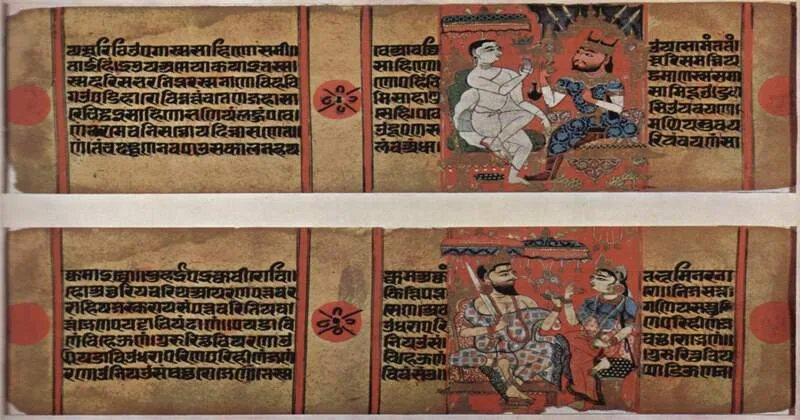
A national calendar is not merely a technical instrument for counting days; it is a declaration of historical consciousness. The choice of a national calendar is not an administrative triviality; it reflects how a nation understands its past, asserts its continuity, and projects its identity into the future. The adoption of the Saka Era as India’s National Calendar in 1957, alongside the Gregorian calendar, was the outcome of administrative reform and astronomical standardisation. However, seven decades later, it is legitimate to ask whether that choice truly reflects India’s civilizational continuity and the historical practice of its people.
The Case for Civil Prevalence
The Committee’s own findings acknowledged that the Vikrama Samvat was widely prevalent in large parts of India. It had been used in civil, commercial, and religious records for centuries. Unlike the Saka Era, whose primary association was with astronomical calculations and almanacks, Vikrama Samvat evolved into a living civil calendar, with embedded astronomical calculations woven into the daily life of the people.
A civil national calendar must reflect civil usage. Astronomical precision is not the sole purpose of a national calendar. Government notifications, gazettes, public communications, and official symbolism are meant for citizens, not observatories. The question, therefore, is not which era is computationally convenient, but which era historically served as the people’s chronological framework.
Historical and Indigenous Legitimacy
Vikrama Samvat was not confined to ritual usage. It appears in inscriptions, literary works, land grants, commercial records, and community documentation across large parts of Bharat. Its longevity was not the product of state coercion but of organic continuity. Over the centuries, it became embedded in civil life through the marking of contracts, festivals, social events, and historical memory.
The primary argument advanced by the Calendar Reform Committee (1955) in rejecting Vikrama Samvat was the alleged lack of historical evidence regarding King Vikramaditya. This view has been effectively refuted by modern scholarship, most notably through the rigorous research of Dr Bhagwatilal Rajpurohit, a Padma Shri awardee and distinguished scholar.

Excerpt from the REPORT OF THE CALENDAR REFORM COMMITTEE, 1955
By contrast, the Saka Era, though historically rooted, does not carry the same degree of popular civil resonance. Its adoption in 1957 was based primarily on considerations of astronomical standardisation rather than comparative cultural prevalence. Administrative convenience, while important, cannot be the sole determinant of national symbolism.
Pan-Indian Resonance
While sometimes described as “the great era of the North,” its influence is not narrow down to the regional identity. Over centuries, it permeated civil records, temple inscriptions, commercial transactions, and literary compositions across multiple regions of Bharat. Its endurance across political regimes demonstrates that it functioned as a civilizational era rather than a merely regional one. A national calendar should ideally emerge from such organic continuity. The strength of Vikrama Samvat lies precisely in its bottom-up acceptance rather than top-down imposition.
Cultural Continuity in a Constitutional Republic
India’s Constitution recognises the value of cultural continuity and civilizational heritage. The republic did not begin in 1950; it rests upon millennia of intellectual, spiritual, and social evolution. Reconsidering the national calendar is therefore not an act of regression, but one of restoration—aligning state symbolism with historical consciousness.
Replacing the Saka Era with Vikrama Samvat for official civil purposes would not disrupt scientific precision. Astronomical calculations can continue independently. Modern calendrical systems are capable of harmonisation, just as India already uses both the Gregorian and national calendar simultaneously.
Recognition of Vikrama Samvat
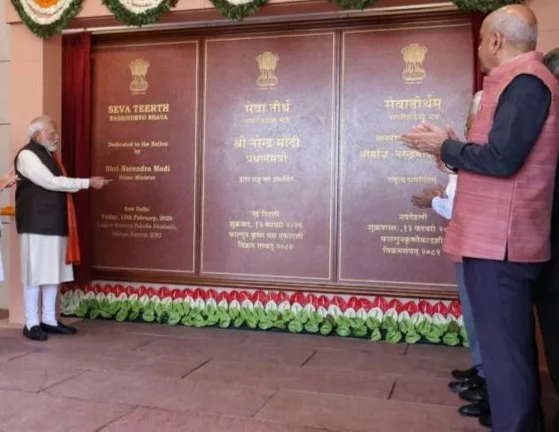
The inauguration of the Seva Teerth Complex marks a significant civilizational gesture, not merely an administrative development. The inscription of the name in Devanagari script, accompanied by the motto “Nagrik Devo Bhava,” reflects a conscious alignment of governance with cultural ethos. Notably, the presence of Vikrama Samvat 2082 engraved on the commemorative shila is symbolically powerful. It demonstrates that, even at the highest seat of executive authority, the official commemorative architecture acknowledges an indigenous civilizational era.
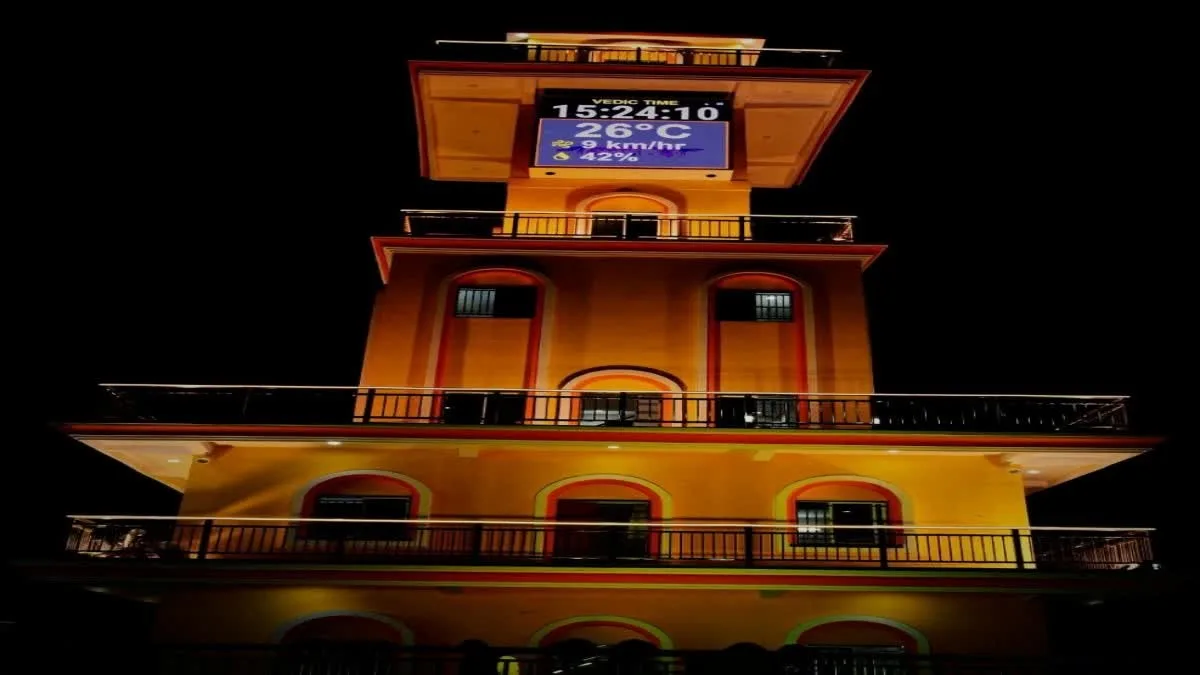
Another instance, the installation of the Vikramaditya Vaidik Ghadi (Vedic Clock) in Ujjain, inaugurated by the Hon’ble Prime Minister Shri Narendra Modi on February 29, 2024, demonstrates the scientific robustness of the Vikramaditya tradition.
The Question Before Us
The essential question is this: Should a national calendar prioritise technical standardisation, or should it reflect civilizational continuity and societal usage? Bharat has progressively revisited colonial-era narratives, restored indigenous place names, and revived civilizational symbols. Aligning the National Calendar with Vikrama Samvat would be a natural extension of this process, a reaffirmation that the Republic stands upon a much older civilizational foundation.
Timekeeping reflects identity. A civilization that has measured time in yugas, samvatsaras, and eras rooted in its own intellectual traditions need not remain bound to a system chosen primarily for mid-twentieth-century administrative convenience. Reconsidering the national calendar is not an act of exclusion or regression. It is an act of restoration, aligning state symbolism with historical continuity.
The Republic must ask itself: should its official era reflect technical standardisation alone, or the lived chronology of its people? In choosing Vikrama Samvat as the National Calendar, India would not merely alter a date format. It would restore civilizational time to the heart of the state.