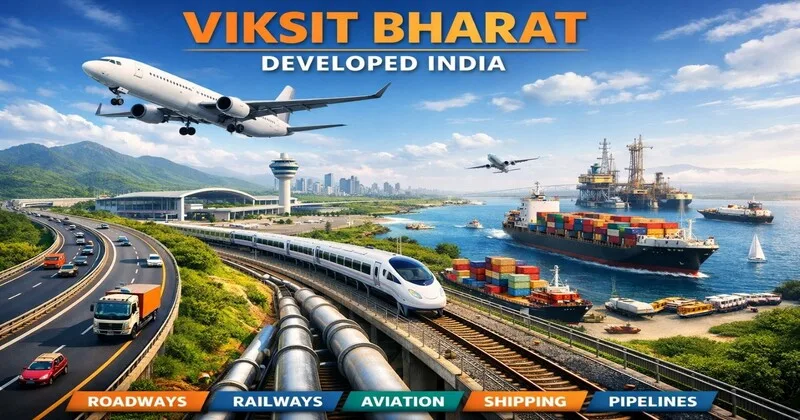
India, with an ambition to become a developed nation by 2047, Viksit Bharat is driven by mobility. The transport sector, comprising roads, railways, ports, aviation and pipelines, is the lifeline of the country’s development. In recognition of the importance of this sector, the NITI Aayog report states that it provides a comprehensive blueprint for transforming India’s transport system to support the country’s economic ambitions and achieve Net Zero emissions by 2070.
This report highlights that mobility is not just about movement; it is about opportunity. Well-connected transport systems link farmers to markets, workers to jobs, industries to ports and the countryside to development corridors. With the growing Indian economy and the increasing pace of urbanisation, the transport sector must serve as both the engine of growth and the challenge of sustainability transformation.
Transport as the Backbone of India’s Economic Rise
The transport sector is a major contributor to India’s growth. According to recent estimates, the transport sector accounts for about 4.5 per cent of India’s Gross Value Added. The demand for mobility in India has been steadily increasing with rising incomes and urbanisation. The per capita distance travelled in India has grown from 3,483 kilometres in 2000 to 4,273 kilometres in 2023. If one compares this with the per capita distance travelled in developed countries like Germany or Japan, where distances exceed 11,000 kilometres, there is immense scope for growth in India’s mobility sector.
Transportation also plays a strategic role in the country’s productivity. This is because a well-organised logistics system reduces industry costs, makes exports more competitive, and enables the integration of regional economies. The Indian automobile industry, for instance, accounts for 7.1 per cent of the country’s GDP and almost half of manufacturing GDP, thus underlining the symbiotic relationship between transport infrastructure and economic development. The need for a transport infrastructure overhaul becomes a key national priority for achieving the country’s dual objectives of economic development and environmental sustainability.
A Decade of Infrastructure Expansion and Connectivity Revolution
The last decade has been one of unexpeccted growth in Indian transport infrastructure and this provides a strong foundation for a future-ready transport ecosystem.
Roadways: Connecting Bharat at Scale
The transport infrastructure in India has improved, with the National Highways increasing by almost 60 % from 91,287 kilometres in 2014 to 146,145 kilometres by 2023. This pace of construction accelerated to 28.3 kilometres per day, showing government emphasis on infrastructure development through the Bharatmala Pariyojana scheme.
The infrastructure development improved freight services, last-mile connectivity and rural economic development. Schemes such as Pradhan Mantri Gram Sadak Yojana have connected over 1,63,000 rural habitations, providing better access to markets, healthcare facilities, and educational institutions.
Railways: Modernisation and Freight Efficiency
The Indian Railways have seen modernisation in the last decade, with over 31,000 kilometres of new lines laid and 45,000 route kilometres of Dedicated Freight Corridors (DFCs) electrified, which are nearly 90% operational, thus reducing transit times by as much as 40%.
Passenger services have also been improved with the introduction of Vande Bharat trains and the upgrading of Amrit Stations. These initiatives signal the start of faster, cleaner and more efficient rail mobility.
Ports and Shipping: Enhancing India Maritime Strength
Through the Sagarmala project, the handling of cargo has been enhanced from 581 million metric tonnes to 855 million metric tonnes and the number of containers has risen from 7.9 million to 13.5 million TEUs. The revenues of the major ports have doubled, symbolising greater efficiency and trade capacity. Projects such as Vadhvan Port and Eastern Waterways Grid will help reduce logistics costs and provide new avenues for growth in India.
Aviation: Lifeline of Air Transport
The Indian aviation sector has witnessed remarkable growth, with passenger traffic rising from 10.4 crore to 22 crore annually. The UDAN scheme has operationalised 619 routes and has reached the remotest areas, making air transport accessible to the common man. This aviation democratisation marks the entry of India among the fastest-growing aviation countries in the world.
Pipeline Infrastructure: Energy Security Backbone
The pipeline networks have also grown, with natural gas pipelines extending to 25,000 kilometres and petroleum product pipelines extending to 24,000 kilometres. These pipelines are essential for the efficient and safe transfer of energy in the country.
Structural Challenges: Road Dominance and Energy Dependence
There are a few problems in the transport sector in India, including the reliance on Road transportation. Currently, road transport is the primary mode, accounting for 78 per cent of passenger traffic and 66 per cent of freight traffic. Railways account for 17 per cent of passenger traffic and 22 per cent of freight traffic, while waterways and pipelines account for a smaller proportion of traffic, nearly 1 per cent.
The transport sector also accounts for around 20 per cent of final energy use in India and around 10 per cent of total greenhouse gas emissions. Of this, road transport accounts for around 90% of transport-related emissions, underlining the need for cleaner transport technologies. Indian dependence on imported oil which currently stands at over 87 per cent, also poses a strategic risk thus there is the need for decarbonization of the transport sector not only an environmental concern but also an energy security concern.
Strategic Pathways: Modelling India’s Transport Future
To overcome these issues, NITI Aayog has developed two future scenarios using advanced models, including the Activity-Structure-Intensity-Fuel (ASIF) models and the India Energy Security Scenarios tool. These two future scenarios have been designed in the following ways:
Current Policy Scenario (CPS)
In this scenario, India will follow its current policies, leading to some improvement but still being dependent on fossil fuels and road transport.
Net Zero Scenario (NZS)
In this scenario, India will meet its Net Zero goal and will see a transformation in the following areas:
• Adoption of Zero-Emission Vehicles on a large scale
• Development of public and shared transport systems
• Increase in the transport of goods through rail and water transport
• Increased use of clean fuels like electricity, biofuels and hydrogen
In the Net Zero Scenario, the overall energy demand in the transport sector will reduce substantially from 336 million tonnes of oil equivalent under the current policies to 200 million tonnes of oil equivalent by 2070. The fuel mix will also change and petroleum will account for only 21 per cent of the fuel mix, while electricity, biofuels and hydrogen will become the dominant fuel sources.
Zero-Emission Vehicles and Clean Fuels: The Core of Future Mobility
The move to Zero Emission Vehicles (ZEVs) is the central theme of the transport transformation plan in India.
This includes:
Electric vehicles with batteries
• Hydrogen-based vehicles for heavy transport
• Biofuel-powered vehicles using ethanol and compressed biogas
The plan for the future aims to electrify buses, taxis, and logistics vehicles, which have the greatest potential to reduce emissions due to their lower pollution rates. The establishment of charging infrastructure, the development of local battery manufacturing and the harnessing of the renewable energy sources are crucial for this transition.
The future of the transport system in India will see an increasing emphasis on multimodal integration, with road, rail, water, and pipeline transport integrated to achieve maximum efficiency. Plans such as PM Gati Shakti and multimodal logistics parks are being developed to integrate various modes of transport and reduce logistics costs to global standards. Rail and water transport, which are more energy-efficient and environmentally friendly, will see increased use for freight transport. This will help to remove congestion, lower emissions and improve economic competitiveness.
Investment, Innovation and Strategic Opportunity
To reach Net Zero transport, cumulative investments of around USD 4.3 trillion are needed by 2070, which is a further 25 per cent above the current policy scenario. This investment is an opportunity.
It will provide the following benefits:
•Lower oil import dependence
•Improved air quality and health
• Development of new sectors in electric mobility, hydrogen and batteries
• Job creation in manufacturing and service sectors
The transformation in the transport sector should also ensure equity in access. Initiatives such as UDAN and the development of rural roads have already ensured that rural areas are connected. Future initiatives will be based on the idea of inclusive mobility, which will ensure that rural areas, women and the disadvantaged have access to transport. This is in keeping with the overall idea of Viksit Bharat, where development is inclusive and for every citizen.
The transport transformation in India is more than an infrastructure. It is a face of nation-building. The next two decades will determine whether India can build a transport system that is efficient, sustainable, inclusive and globally competitive.
With the right investments, innovation in technology and collective policy actions, India is ready to create a mobility ecosystem which will catalyse economic growth, ensure energy security and protect the environment.
As the NITI Aayog report makes clear, the transport sector is more than just the movement of people and goods. It is the movement of India towards realising its vision of becoming a developed, self-dependent and sustainable nation.