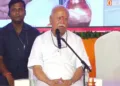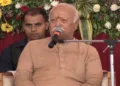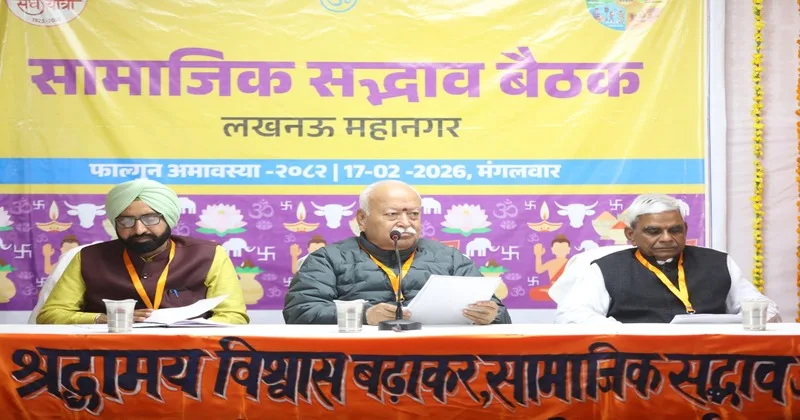
LUCKNOW: “Hindu society must be organised and empowered. We are not under threat from anyone, but we must remain vigilant, ” said Rashtriya Swayamsevak Sangh Sarsanghchalak Dr Mohan Bhagwat while addressing a Samajik Samrasta Baithak at Saraswati Shishu Mandir in Nirala Nagar, Lucknow.
Expressing concern over the declining Hindu population, he emphasised the need to curb conversions carried out through inducement or coercion. He stated that efforts toward “ghar wapsi” should be intensified and that those returning to Hindu Dharma must be supported. Raising concerns over illegal infiltration, he remarked that infiltrators must be “detected and deported,” and should not be provided employment.
Referring to demographic trends, Dr Bhagwat said that Hindu families should aim to have at least three children. Citing scientific assessments, he noted that societies with an average fertility rate below three eventually face demographic decline. “This understanding should be communicated to newly married couples,” he said. He added that the purpose of marriage should be the continuation of creation, not mere gratification, and that such a sense of duty strengthens society.
Dr Bhagwat also emphasised that the absence of harmony leads to discrimination. “We are all children of one nation and one motherland. As human beings, we are one,” he said. Over time, divisions crept into society and became habitual; these must now be consciously removed.
He asserted that Sanatan thought is inherently a philosophy of harmony. “We do not believe in eliminating opponents. Truth is one and present everywhere. When this philosophy is understood and practised, discrimination ends,” he stated.
Highlighting the role of women, he said that the foundation of the family rests upon Matrishakti. Traditionally, while men earned, women decided how resources were utilised. “After marriage, a woman enters a new household and binds everyone together,” he observed.
He stressed that women should not be viewed as weak but as embodiments of strength. In Bharatiya thought, woman and nature are envisioned as powerful forces. Women should receive self-defence training, he said. “In the West, a woman’s identity is often seen as that of a wife; in our tradition, she is revered as a mother. Her value lies not in beauty but in compassion and nurturing,” he added.
Responding to a question regarding UGC guidelines, Dr Bhagwat stated that laws must be followed by all. If a law is flawed, there are constitutional means to amend it. He cautioned against allowing caste divisions to become causes of conflict. “If society is guided by a sense of belonging, such issues will not arise. Those who have fallen behind must be lifted with humility. All are ours,” he said.
Dr Bhagwat expressed confidence that Bharat will guide the world in the near future, stating that solutions to many global challenges lie within Bharat’s civilisational wisdom.
Calling upon the constructive forces of society, he suggested that samajik samarasta baithak should be held regularly at the locality level. “When we meet and interact, misunderstandings fade. Such gatherings should also discuss freedom from regressive customs and address emerging challenges. The weak must be supported,” he said.
He cautioned that certain elements based in countries like the United States and China are working against Bharat’s social harmony. Society must remain vigilant and eliminate mutual distrust, he said, emphasising participation in each other’s joys and sorrows.
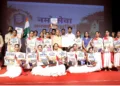
Representatives from Sikh, Buddhist and Jain communities participated in the programme, along with members from organisations such as Ramakrishna Mission, International Society for Krishna Consciousness (ISKCON), Arya Samaj, Art of Living Foundation, Sant Nirankari Mission and several other social and spiritual institutions.