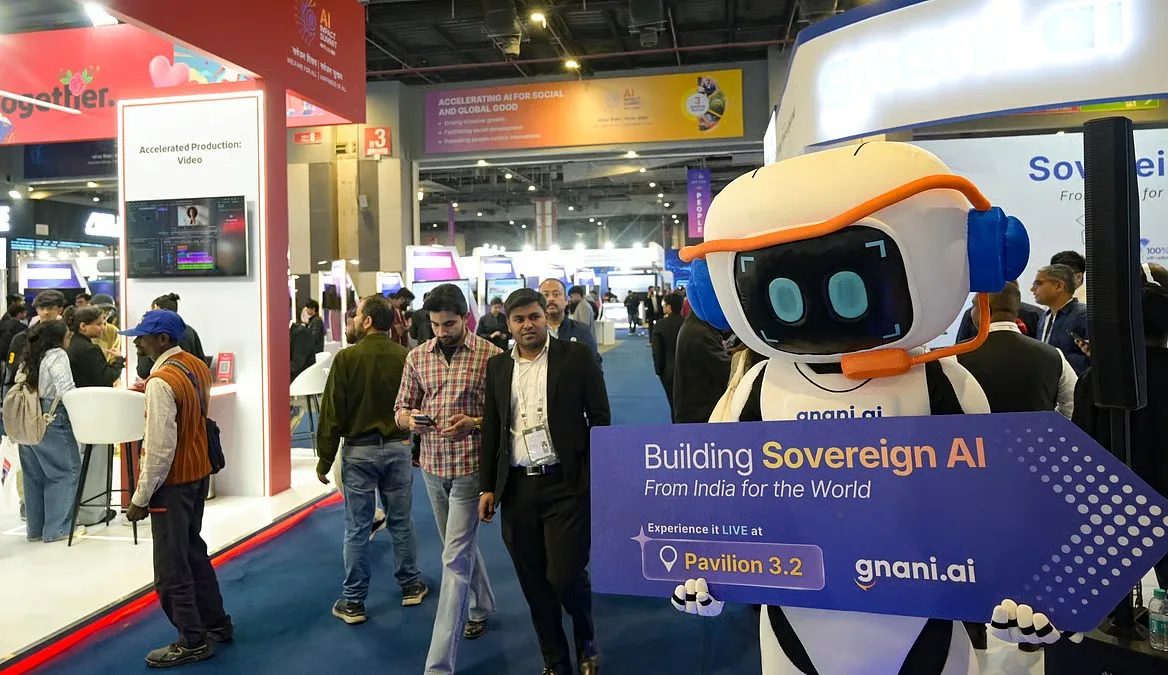
New Delhi: The exhibition at the India AI Impact Summit 2026 has emerged as a major global platform, bringing together over 300 exhibitors from India and more than 30 countries to demonstrate how Artificial Intelligence is transitioning from research labs to real-world applications.
With ten thematic pavilions and high public footfall, the Expo reflects India’s expanding capabilities in AI infrastructure, robotics, healthcare, education, fintech and scientific research.
The Summit has drawn leading technology companies, academic institutions, start-ups, industry bodies and international partners, collectively presenting how AI is powering scientific advancement, industrial resilience, innovation and the democratisation of digital resources. From sovereign AI models and supercomputing systems to multilingual platforms and humanoid robotics, the exhibition showcases a comprehensive ecosystem that positions India as a key player in global AI development.
In the robotics and intelligent manufacturing segment, advanced platforms designed for logistics, manufacturing, retail and smart agriculture have attracted significant attention. These systems are aimed at enhancing productivity, lowering operational costs and addressing workforce shortages in high-demand sectors. Deployment-ready humanoid systems and robotics processors highlight how physical AI is rapidly moving from experimental prototypes to industrial implementation.
The AI for Science and Research pavilion features Indian and international institutions demonstrating breakthroughs in AI-driven protein engineering and drug discovery, neuroscience and cognitive systems research, and the use of advanced computing and quantum-centric approaches for analysing large-scale biological and clinical data. Generative AI and Large Language Models designed for multilingual and secure applications underline how AI is reshaping biomedical research, diagnostics and data-driven healthcare systems.
AI-ready infrastructure designed for high-performance computing and data-intensive workloads has emerged as another key highlight. Exhibitors are presenting next-generation data architectures capable of supporting large-scale AI deployments, reinforcing the importance of resilience and scalability in national AI strategy.
In the education and upskilling segment, leading academic institutions are showcasing AI-enabled education frameworks tailored for students as well as working professionals. With tens of thousands already enrolled in AI and Machine Learning programmes, the Expo underscores India’s commitment to building a future-ready workforce while democratising access to advanced technological learning.
The finance and cybersecurity pavilion demonstrates AI-powered tools for faster audits, enhanced fraud detection, improved compliance and operational efficiency. These solutions highlight AI’s growing role in strengthening fintech ecosystems and securing digital transactions in an increasingly connected economy.
A strong focus on democratisation and inclusion runs across the exhibition. Multilingual AI content generation tools, AI solutions for small businesses and professional firms, modular AI infrastructure adaptable to both urban and remote environments, and AI-driven public service applications such as smart waste management and agricultural robotics illustrate how AI resources are being made accessible across diverse socio-economic contexts.
The exhibition venues at the India AI Impact Summit 2026 have witnessed strong participation from industry leaders, start-ups, researchers, students, policymakers and global delegates. The overwhelming response reflects a clear shift: AI is no longer confined to theoretical innovation but is actively shaping sectors ranging from healthcare and manufacturing to education and finance. The Expo reinforces the message that AI is emerging as a strategic enabler for scientific progress, economic resilience, innovation and inclusive growth.