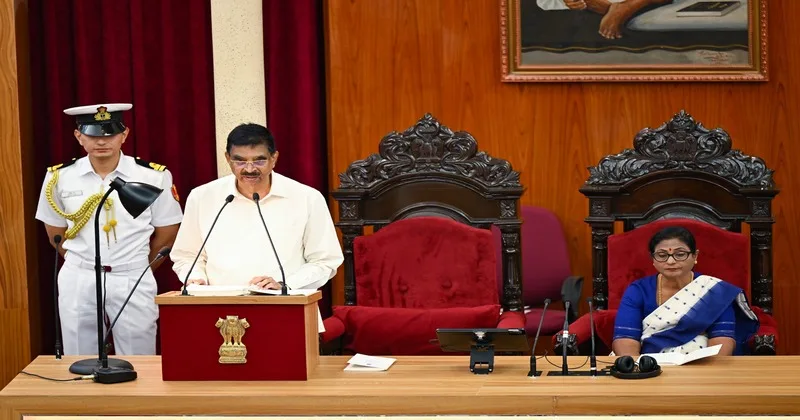
BHUBANESWAR: The Budget Session of the Odisha Legislative Assembly commenced on February 17 with Governor Haribabu Kambhampati addressing the House and outlining an expansive roadmap for the state’s economic, social and industrial transformation. Beginning his address with the invocation “Jai Jagannath,” the Governor struck a culturally resonant tone as he presented a long-term vision for the state’s development trajectory.
The Governor said Odisha is poised to emerge as the “growth engine” of a developed India and will play a decisive role in achieving the national goal of Viksit Bharat. He noted that the state will complete 100 years of its formation in 2036 and affirmed the government’s commitment to building a prosperous and empowered Odisha by that milestone year.
According to the vision document, Odisha aims to transform into a $500 billion economy by 2036 and a $1.5 trillion economy by 2047. The state also plans to raise its contribution to the national GDP from 3 per cent to 5 per cent and increase the average annual growth rate from 7 per cent to 9.5 per cent through improved investment execution and greater use of technology.
The Governor further said the state intends to increase per capita income from Rs 1.8 lakh to Rs 32 lakh by 2047, reduce multidimensional poverty to below 5 per cent, raise women’s workforce participation to 70 per cent and extend life expectancy beyond 80 years.
Addressed the Odisha Legislative Assembly at the commencement of the Budget Session today. Reaffirmed our commitment to inclusive development, good governance and the welfare of every citizen of the State.
I am confident that this session will pave the way for meaningful… pic.twitter.com/kAe5bHgujO
— Dr. Hari Babu Kambhampati (@DrHariBabuK) February 17, 2026
Highlighting cooperation with the Centre under Prime Minister Narendra Modi, the Governor stated that Odisha has been receiving major infrastructure and development projects that will accelerate economic expansion. Referring to the vision of Atmanirbhar Bharat, he announced that the state would emerge as a semiconductor hub — a step expected to boost technological capacity and industrial growth.
Infrastructure and Urban Connectivity
Infrastructure development formed a major component of the address. The Governor informed the House that large-scale road modernisation is underway across the state to improve connectivity and economic activity.
Among key urban projects, a flyover will soon be constructed on the busy Jaydev Vihar–Nandankanan Road in Bhubaneswar to ease traffic congestion. Additionally, a ring road connecting Bhubaneswar, Khordha and Cuttack is under construction to enhance regional mobility and reduce traffic pressure across the capital region.
The government also plans to construct 648 roads covering 2,711 km this year, while several mega drinking water projects are nearing completion.
Renewable Energy and Industrial Expansion
Emphasising climate responsibility, the Governor said Odisha aims to install 10 GW of renewable energy capacity by 2030, through solar, wind, and advanced storage technologies, to move toward net-zero goals.
In 2025 alone, 85 industrial projects were inaugurated or grounded, generating about 1.65 lakh jobs. Another 343 large industrial projects approved during the year have the potential to create approximately 4.65 lakh employment opportunities.
The state’s steel sector continues to expand rapidly. Odisha currently has 55 steel plants with a combined annual capacity of nearly 45 million tonnes — about 23 per cent of India’s total production. The government aims to scale this capacity to 100 million tonnes by 2030.
Governance reforms in the minor minerals sector have also improved transparency and revenue generation. Revenue rose from Rs 1,195 crore in 2022–23 to Rs 1,776 crore in 2024–25 following policy reforms.
Under the Make in Odisha initiative, foundation stones have been laid for 85 projects involving investments worth Rs 2 lakh crore, expected to generate employment for about 1.65 lakh people. Overall, development initiatives across sectors are projected to create nearly 4.65 lakh jobs.
Education and School Infrastructure
The Governor announced the launch of the Aspirational Godabarish Adarsha Primary School Scheme, under which Rs 12,000 crore will be spent over four years to upgrade 2,200 schools with modern classrooms, digital learning tools and sports infrastructure.
Under the National Education Policy, the admission age for Class I has been fixed at 6+ years. More than 45,000 pre-primary Shishu Batika classes have been introduced, enrolling nearly 3.2 lakh children aged five to six years.
The state adopted the National Curriculum Framework with local contextualisation in January 2025, and revised textbooks will be implemented for Classes I to VIII from the 2026–27 academic year.
Women Empowerment and Social Welfare
The Governor highlighted significant progress in women empowerment. Over 16.42 lakh ‘Lakhpati Didis’ have been created through self-help groups, strengthening rural livelihoods.
Under the Subhadra scheme, more than Rs 1,500 crore has been disbursed to over one crore women beneficiaries. The Mamata scheme has transferred Rs 3,767 crore directly to 68.42 lakh pregnant and lactating women and will be integrated with the PM Matru Vandana Yojana from April 1, 2025.
Scholarship support has also expanded. In 2025–26, Rs 760 crore has been sanctioned for pre-matric scholarships and Rs 532 crore for post-matric scholarships for SC, ST, OBC and EBC students.
Agriculture and Rural Development
Farm incomes have increased through schemes such as Samruddha Krushak Yojana and CM Kisan, with over Rs 8,000 crore spent on income support. Crop production reached a record 150.48 lakh metric tonnes in 2024–25 — nearly three times higher than in 2000–01.
Food security coverage has expanded with more than 6.40 lakh new beneficiaries added to welfare schemes. The state continues to distribute rice to over 12.36 lakh families under the Antyodaya Anna Yojana.
Law and Order and Governance
The Governor reported a steady decline in Maoist activity over the last five years, with 48 Maoists neutralised, 78 arrested and 82 surrendering. Crackdowns on illicit liquor and narcotics have led to thousands of arrests.
The Chief Minister’s grievance cell resolved 94 per cent of complaints received between June 2024 and December 2025, indicating improvements in administrative responsiveness.
Concluding his address, the Governor reiterated the government’s commitment to building a prosperous, self-reliant, and industrially strong Odisha by the state’s centenary year in 2036, asserting that Odisha will significantly contribute to India’s overall development journey in the coming decades.