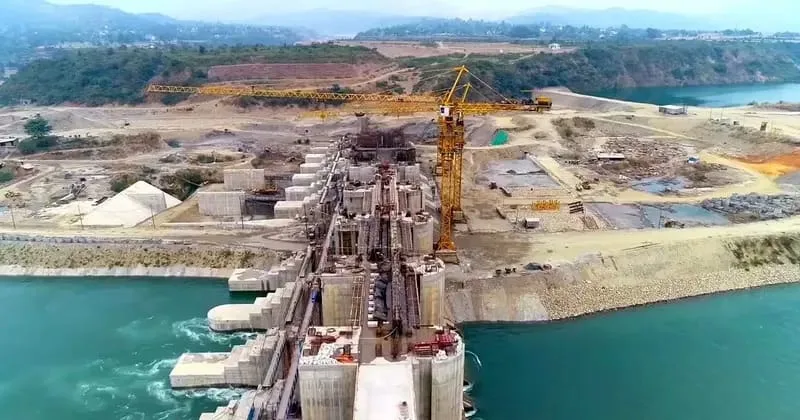
The completion of the Shahpur Kandi dam project on the Ravi River in the near future, as per schedule, will provide irrigation facilities to farmers in an area of around 37,000 hectares. Of this, around 32,000 hectares will be located in the Union Territory (UT) of J&K. One significant point is that it will also help India stop the water that flows into Pakistan downstream of the Ranjit Sagar dam.
This project has been in limbo for the last 45 years, as the agreement between Punjab and J&K was signed in January 1979. On behalf of Punjab, the agreement was signed by then Chief Minister Prakash Singh Badal and for J&K by Chief Minister Sheikh Mohammad Abdullah.
This project was meant to stop the water downstream of Ranjit Sagar Dam, which was built by Punjab on the Ravi, one of the Eastern Rivers, allotted to India under the Indus Waters Treaty (IWT) 1960. The Shahpur Kandi Dam project is located in Pathankot area of Punjab on the eastern bank of Ravi. This was to provide additional irrigation facilities to both neighbouring states. From the Ranjit Sagar Dam project, Punjab produces 600 MW of power and 20 per cent of this was to be given to J&K. However, Punjab reneged on this years later and has not supplied any electricity to J&K produced from Ranjit Sagar Dam.
Shahpur Kandi Dam was a part of that agreement, which has festered like a wound as the water continued to flow to Pakistan, instead of getting diverted fo the benefits of Indian farmers living in Punjab (Pathankot and Gurdaspur), as also J&K (Kathua and Samba districts mainly). Due to unresolved issues between these two neighbours, the beneficiary has been Pakistan.
This reservoir is essential for exercising control of water flowing downstream and running off to Pakistan. This project is located around 11 km downstream of the Ranjit Sagar dam, which produces 600 MW of electricity. The Shahpur Kandi dam project is multipurpose and includes two hydel projects with an installed capacity of 206 MW. It will partially check the uncontrolled water flow to Pakistan, utilising it for the benefit of the Indian farmers.
It will supply 1,150 cusecs of water for irrigating 32,173 hectares in the Kandi belt of Kathua and Samba through the Main Ravi Canal, presently lying in a state of disrepair and neglect. As such, the Rawi Tawi canal may not be in a position to utilise all the water that may become available once the Shahpur Kandi project is completed.
Earlier, keeping this canal fed entailed lifting water but henceforth, gravity feeding will become possible. The regulated water supply in the canals criss-crossing mostly border areas will help the defence potential of the Kathua-Hirnagar-Samba corridor, infamous for infiltration by Pakistani terrorists. Besides irrigation water, J&K will also get a 20 per cent share of power, which comes to around 41.2 MW. Besides getting 80 per cent of the power produced, Punjab will draw water to irrigate an additional 5,000 hectares.
Post Pulwama Progress
Incidentally, after last year’s terrorist attack on tourists in Pahalgam, the Indus Waters Treaty was put in abeyance. However, the Shahpur Kandi project has nothing to do with post-Pahalgam developments between the two nations. It is an older, 45-year-old project as pointed out earlier. However, after the Pulwama attack of February 14, 2019, carried out by Jaish-e-Mohammad suicide bomber Adil Dar, the Shahpur Kandi dam project was put on a fast track.
“Yes, excess water (from Ravi river) to Pakistan will be stopped. It has to be stopped,” Rana told a TV channel in Jammu. “Kathua and Samba districts are drought-hit areas; and this project, which is our priority, is being constructed for the Kandi area,” he added. However, over the last six years, after the Pulwama blast, the project has remained a national project with the Centre taking over its completion as a priority. The money and material has been poured into this barrage project by the Modi government, with both Punjab and J&K remaining bare bystanders.
Incidentally, Prime Minister Narendra Modi had speeded up the hydroelectric projects in the Jammu region, mainly on the Chenab river, after the Pahalgam killings to ensure optimal use of its waters. The completion of the Shahpur Kandi barrage, designated a national project, was revised after four decades following the PM’s intervention. However, it needs to be stressed here that this project conformed to all IWT regulations. Being located on one of the Eastern Rivers Ravi, Pakistan has no say in utilisation of its water as its full and absolute control has been ceded to India.
Pahalgam Punishment
Since the terror attack in Baisaran valley in Pahalgam last year, India made steady progress on four ongoing hydel power projects in Jammu and Kashmir over the Chenab river, and they are likely to be commissioned in 2027-28. The 1,000 MW Pakal Dul project in Kishtwar, which uses a small storage of around 88,000 acre feet, is likely to be completed in the next financial year. If all goes well, and according to plans, trial production, if not at a commercial scale, of electricity may start within this calander year itself.
Under the flawed IWT, facilitated and brokered by the World Bank, six Indus system rivers were divided between India and Pakistan. The Eastern Rivers (Ravi, Beas and Sutlej) were given to India, and the three Western Rivers (Indus, Jhelum and Chenab) were given to Pakistan, with India permitted non-consumptive use of the latter, like navigation and its use for hydropower generation.
Beyond the number of both countries being given three rivers each, it is important to understand that the Western Rivers have an annual flow of around 135 Million Acre Feet (MAF) of water and the Eastern Rivers only 32.7 MAF. This means Pakistan was given over 80 per cent of the water in the Indus system, with India getting less than 20 per cent. This unequal division of water has been a sore point between the two countries ever since the signing of the treaty in September 1960.
The 850 MW Ratle project at Drabshala in Kishtwar is a project that got stalled because of Pakistan’s intrasigence. With the treaty in abeyance, India has hastened the work on the project, with Union Power Minister Manohar Lal Khattar visiting it recently.