Vadodara Hindus oppose alleged Act violation in property deals
October 5, 2026
  • Read Ecopy
  • Circulation
  • Advertise
  • Careers
  • About Us
  • Contact Us
Android AppiPhone AppArattai
Organiser
  • ‌
  • Bharat
    • Assam
    • Bihar
    • Chhattisgarh
    • Jharkhand
    • Maharashtra
    • View All States
  • World
    • Asia
    • Europe
    • North America
    • South America
    • Africa
    • Australia
  • Editorial
  • International
  • Opinion
  • RSS @ 100
  • More
    • World Hindu Congress 2026
    • Op Sindoor
    • Analysis
    • Sports
    • Defence
    • Politics
    • Business
    • Economy
    • Culture
    • Special Report
    • Sci & Tech
    • Entertainment
    • G20
    • Azadi Ka Amrit Mahotsav
    • Vocal4Local
    • Web Stories
    • Education
    • Employment
    • Books
    • Interviews
    • Travel
    • Law
    • Health
    • Obituary
  • Subscribe
    • Subscribe Print Edition
    • Subscribe Ecopy
    • Read Ecopy
  • ‌
  • Bharat
    • Assam
    • Bihar
    • Chhattisgarh
    • Jharkhand
    • Maharashtra
    • View All States
  • World
    • Asia
    • Europe
    • North America
    • South America
    • Africa
    • Australia
  • Editorial
  • International
  • Opinion
  • RSS @ 100
  • More
    • World Hindu Congress 2026
    • Op Sindoor
    • Analysis
    • Sports
    • Defence
    • Politics
    • Business
    • Economy
    • Culture
    • Special Report
    • Sci & Tech
    • Entertainment
    • G20
    • Azadi Ka Amrit Mahotsav
    • Vocal4Local
    • Web Stories
    • Education
    • Employment
    • Books
    • Interviews
    • Travel
    • Law
    • Health
    • Obituary
  • Subscribe
    • Subscribe Print Edition
    • Subscribe Ecopy
    • Read Ecopy
Organiser
  • Home
  • Bharat
  • World
  • Operation Sindoor
  • Editorial
  • Analysis
  • Opinion
  • Culture
  • Defence
  • International Edition
  • RSS @ 100
  • Magazine
  • Read Ecopy
Home Bharat

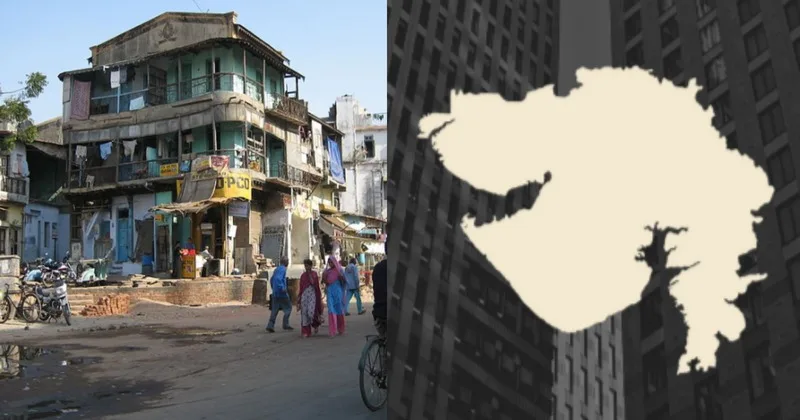
Gujarat: Protest erupts over alleged property sales in Hindu-majority area in violation of Disturbed Areas Act

The Gujarat Disturbed Areas Act regulates property transactions in communally sensitive localities by mandating prior approval from the District Magistrate. Enacted in 1991, the law aims to prevent coercive sales and maintain public order in notified areas across Gujarat

WEBDESKWEBDESK
Feb 16, 2026, 03:00 pm IST
inBharat, Gujarat
Follow on Google News
Representative image

Representative image

Facebook
Twitter
WhatsAppTelegramEmail

Vadodara: Protests broke out in the Gayatrinagar society in the Gorwa area of Vadodara district, Gujarat, on February 13 after two houses in the predominantly Hindu locality were allegedly sold to non-Hindus in violation of the Disturbed Areas Act, 1991.

Members of local Hindu organisations and a Sangharsh Samiti staged a demonstration and marched to the District Magistrate’s office, where they submitted a memorandum seeking strict enforcement of the Act. Protesters claimed that although the property owners initially stated the houses had been rented out, residents suspected that the properties had in fact been sold. They demanded a probe into the transactions and appropriate legal action if any violations were found. Residents also alleged that despite approaching the Municipal Commissioner earlier, no action had been taken.

What is the Disturbed Areas Act?

The Gujarat Prohibition of Transfer of Immovable Property and Provision for Protection of Tenants from Eviction from Premises in Disturbed Areas Act, 1991, commonly referred to as the Disturbed Areas Act, was enacted by the Gujarat government to regulate property transactions in communally sensitive areas and prevent demographic polarisation.

Under the law, both the seller and the buyer must obtain prior permission from the District Magistrate before completing any property transaction in a notified disturbed area. The District Magistrate examines whether the proposed sale is voluntary or the result of coercion, pressure, or inducement. If not satisfied with the circumstances, the authority has the power to refuse permission for the transaction.

The Act was brought in against the backdrop of recurring communal tensions in parts of Gujarat during the 1980s. During this period, several incidents of communal violence were reported in cities such as Ahmedabad, Vadodara, Kheda, Bharuch, and Surat. These clashes led to large-scale displacement and distress sales of properties in communally sensitive areas.

In response to the unrest and concerns about forced or distress-driven property transfers, the Gujarat government first enacted the Disturbed Areas law in 1986 to regulate property transactions in identified sensitive zones. However, due to certain shortcomings, the legislation was repealed and re-enacted as the Gujarat Disturbed Areas Act, 1991. The revised law empowered the state government to officially notify specific localities as “disturbed areas,” where property transfers would require prior administrative approval to prevent exploitation and maintain public order.

In 2019, significant amendments were introduced to the Gujarat Disturbed Areas Act, which received Presidential assent in 2020. These changes expanded the powers of the District Magistrate, enabling the authority to examine not only coercion or inducement in property transactions but also factors such as potential polarisation, unfair clustering, and demographic shifts linked to a proposed sale.

However, in January 2021, the Gujarat High Court stayed the amended provisions after petitions were filed by several Islamic organisations, including the Jamiat Ulema-e-Hind. In 2023, the state government withdrew the 2019 amendments. As a result, the original 1991 version of the law currently remains in force.

Also Read: 2,000-year-old Tamil-Brahmi inscriptions found inside Egypt’s royal tombs, rewriting ancient maritime links

When is an area declared ‘disturbed’?

Under Section 3 of the Act, an area can be declared a “disturbed area” by the state government based on reports submitted by the District Magistrate and the police authorities. The formal notification is issued by the state government. Factors such as communal tension, riots, violence, or a history of communal imbalance are considered while making this determination.

Following the 2002 riots, several localities in Ahmedabad—including Juhapura, Sarkhej, and Gomtipur—were notified as disturbed areas to regulate property transactions and prevent distress sales. Such a notification remains valid for five years from its publication in the state gazette and may be extended further depending on prevailing conditions.

Under the Act, any transfer of property in a notified disturbed area carried out without prior approval from the District Magistrate is deemed invalid. Before granting permission, the District Magistrate scrutinises the applications and affidavits submitted by both the buyer and the seller, along with police reports, statements from neighbours, and relevant Revenue Department records.

The additional grounds introduced through the 2019 amendment—such as “impairment of demographic balance” and “unfair grouping”—are currently not applicable due to the stay imposed by the Gujarat High Court. As a result, decisions must be based solely on the provisions of the 1991 Act. State government rehabilitation schemes are exempt from the law, allowing property transfers in cases involving resettlement or rehabilitation of persons displaced by violence.

The Disturbed Areas Act is operational in multiple districts across Gujarat, with the list of notified areas periodically updated by the state government. Several localities in Ahmedabad, Vadodara, Surat, Bharuch, Panchmahal, Anand, Narmada, Godhra, Bhavnagar and Amreli are covered under its provisions.

In Ahmedabad city, areas such as Juhapura, Meghaninagar, Odhav, Gomtipur, Danilimda, and Sarkhej-Jamalpur-Kankaria fall within the notified zones. More recently, localities including Vastrapur, Thaltej, and Bodakdev in western Ahmedabad were added through a public notification. The Act is also in force in parts of Surat, Vadodara, and Anand districts, and its implementation in Anand city and certain adjoining areas has recently been extended for another five years.

The law’s implementation is overseen by government authorities, including the District Magistrate, the Police Commissioner or Superintendent of Police, and officials from the Revenue Department. Areas are formally notified by the state government, and currently, around 1,000 localities across Gujarat fall under the Act. All property transactions in these notified areas require prior approval from the District Magistrate.


 

Topics: Gujarat High CourtDistrict MagistrateGujarat Disturbed Areas ActProperty LawVadodaraAhmedabadGujarat Government
Share
Tweet
SendShareSend
✮ Subscribe Organiser YouTube Channel. ✮
✮ Join Organiser's WhatsApp channel for Nationalist views beyond the news. ✮
Previous News

Canada school shooting culprit is a male transitioned into female; The atrocity reflects intensity of ‘woke terrorism’

Next News

Abhyudaya Leadership Conclave | If Bharat wants to sustain economic growth, its TFR must remain above 2.1: Satish Kumar

Related News

Vadodara’s historic Karoliya Vav is getting a fresh lease of life through a cleanliness and preservation drive

Forgotten water heritage returns: Vadodara’s historic Karoliya Vav gets major revival and conservation push

Gujarat High Court upheld privacy protections for PM Narendra Modi’s educational records while dismissing Arvind Kejriwal’s appeal

Gujarat High Court rejects Arvind Kejriwal’s appeal, upholds privacy protection over PM Modi’s educational records

Prime Minister Narendra Modi at the ‘NaMo for Viksit Bharat’ event in Vadodara, Gujarat

“Naraaz Fufa” will complain: PM Modi takes dig at opposition as he hails development projects in Gujarat

Ahmedabad AMC intensifies its food safety crackdown, urging 11,123 restaurants to install kitchen CCTV amid serious hygiene violations

Ahmedabad AMC steps up food safety drive, seals eateries and urges restaurants to put kitchen CCTV on display

Gujarat High Court cites scale of terror, conspiracy to uphold death penalty for 38 IM operatives

Ahmedabad Serial Blasts Case: Gujarat High Court upholds death penalty for 38 Indian Mujahideen operatives

Three Keralites among 38 sentenced to death from PFI-linked strongholds as Gujarat HC upholds Ahmedabad blasts verdict

Load More

Latest News

Swiss President Guy Parmelin and Prime Minister Narendra Modi

India-Switzerland Bilateral Talks: PM Modi & President Parmelin ink 6 pacts on trade, mobility, tech & nuclear energy

Images courtesy : Mohammed Raisudeen FB Page

PFI cadres allegedly use cricket cover with SDPI at Ramanathapuram police grounds; Hindu Munnani seeks probe

RSS Sarkaryavah Dattatreya Hosabale addressing the Ram-Sharad Kothari Pratibha Samman 2026 in Kolkata, reflected on preserving the Kothari brothers’ legacy through service and dedication

Ram-Sharad Kothari Pratibha Samman 2026| Inspiration for constructive work: Dattatreya Hosabale

British Airways jet declares emergency over Ireland after 28,000-foot descent, turns back to Heathrow, London

Viral Video Claims Oslo, Soros Links & Timeline Raise Questions Over CJP — ‘Organic’ Gen-Z Uprising Scripted Abroad?

Viral Video Claims Oslo, Soros Links & Timeline Raise Questions Over CJP — ‘Organic’ Gen-Z Uprising Scripted Abroad?

PM E-DRIVE has accelerated India’s EV transition by supporting mass mobility, electric buses, charging infrastructure

PM E-DRIVE: How India’s EV scheme is driving mass mobility, domestic manufacturing & self-reliance

Representative Image

Beyond Gen Z and Gen Alpha Labels: Understanding Children, respecting diversities & keeping generations connected!

Representative Image

Dehradun Gym owner Mohammad Armaan arrested over betrayal, blackmail; Hindu deity slurs trigger outrage

On dias, from left: Alok Kumar, International President, Vishwa Hindu Parishad, Mahesh Bhagchandka, Converner, Ashok Singhal Foundation, Amit Shah, Union Home Minister, Dattatreya Hosabale, Sarkaryavah, Rashtriya Swayamsevak Sangh and Swami Paramanand Giri JI Maharaj

Ashok ji Singhal: Social bridge-builder through Sri Ram

Representative Image

J&K: 150 Bangladeshi nationals deported during verification drive; Illegal migrants handed over to BSF in Bagdogra

Load More
  • Privacy
  • Terms
  • Cookie Policy
  • Refund and Cancellation
  • Delivery and Shipping

© Bharat Prakashan (Delhi) Limited.
Tech-enabled by Ananthapuri Technologies

  • Home
  • Search Organiser
  • Bharat
    • Assam
    • Bihar
    • Chhattisgarh
    • Jharkhand
    • Maharashtra
    • View All States
  • World
    • Asia
    • Africa
    • North America
    • South America
    • Europe
    • Australia
  • Editorial
  • Operation Sindoor
  • Opinion
  • Analysis
  • Defence
  • Culture
  • Sports
  • Business
  • RSS @ 100
  • Entertainment
  • More ..
    • Sci & Tech
    • Vocal4Local
    • Special Report
    • Education
    • Employment
    • Books
    • Interviews
    • Travel
    • Health
    • Politics
    • Law
    • Economy
    • Obituary
  • Subscribe Magazine
  • Read Ecopy
  • Advertise
  • Circulation
  • Careers
  • About Us
  • Contact Us
  • Policies & Terms
    • Privacy Policy
    • Cookie Policy
    • Refund and Cancellation
    • Terms of Use

© Bharat Prakashan (Delhi) Limited.
Tech-enabled by Ananthapuri Technologies