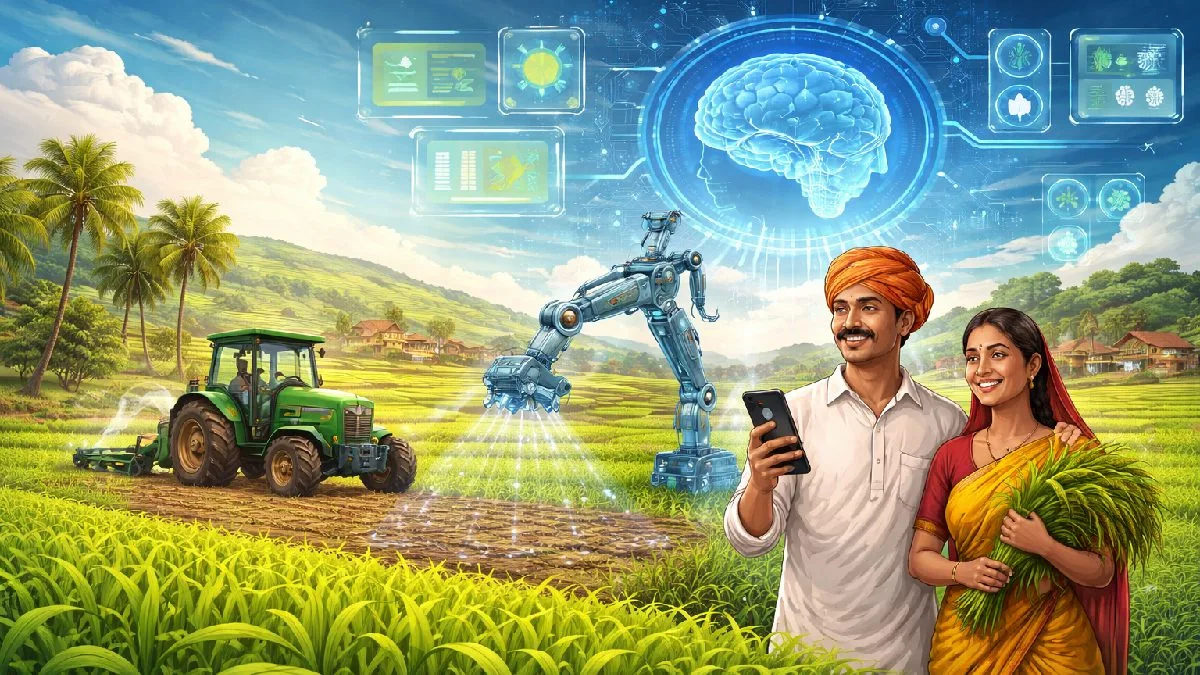
India is emerging as a global leader in Artificial Intelligence, ranking third worldwide in AI competitiveness according to Stanford University’s 2025 Global AI Vibrancy Tool. This rise reflects rapid growth in AI research, talent, startups, data infrastructure and governance frameworks between 2017 and 2024. Within this broader technological transformation, agriculture has become a central focus area. Artificial Intelligence is increasingly being deployed to enhance farm productivity, strengthen climate resilience, improve price realisation and deliver targeted government services to millions of farmers. By combining satellite imagery, sensor data, drones, historical weather patterns and large datasets, AI-enabled systems are helping convert raw data into timely, actionable farm-level decisions.
Artificial Intelligence refers to the ability of machines to perform tasks that typically require human intelligence. These systems learn from large datasets, recognise patterns, adapt to new inputs and generate predictive or advisory outputs. In agriculture, AI translates complex data streams into simple recommendations for farmers, covering decisions such as crop selection, sowing windows, irrigation scheduling, fertiliser application and pest management. Over time, these systems improve their accuracy, enabling more precise and context-specific advisory services.
India’s approach to AI has emphasised inclusive development. The India-AI Impact Summit 2026 highlights the country’s commitment to democratising access to AI technologies, particularly for underserved communities. Anchored in the vision of AI for Humanity, India is positioning AI as a human-centric and ethical tool for improving governance, service delivery and sustainable growth. Agriculture, which supports a large share of India’s population, stands at the centre of this transformation.
One of the most significant developments in this space is the creation of a large-scale digital agricultural foundation under the Digital Agriculture Mission. Launched in 2024 with a total outlay of Rs 2,817 crore and an allocation of Rs 54.972 crore for FY 2025–26, the Mission seeks to build a comprehensive Digital Public Infrastructure for agriculture. This includes verified farmer databases, digitised land records, crop surveys, soil data systems and AI-enabled decision support tools.
As of 27 November 2025, more than 7.63 crore Farmer IDs have been generated against a target of 11 crore by 2026-27. Notably, 1.93 crore of these IDs belong to women farmers. In parallel, over 23.5 crore crop plots were surveyed during Rabi 2024–25 using a mobile-based Digital Crop Survey across 492 districts. This verified database forms the backbone of targeted scheme delivery, insurance assessment, market linkage and advisory systems.
AgriStack serves as the core identity and data integration layer of this ecosystem. Each Farmer ID is linked to land records, livestock ownership, crops cultivated and benefits received. This enables secure authentication and seamless access to government schemes and financial services. To accelerate enrolment, Rs 10 per Farmer ID has been earmarked from PM-KISAN administrative funds. AgriStack is complemented by the Krishi Decision Support System, which integrates satellite imagery, soil data, water resources, weather information and scheme databases to generate digital crop maps, yield estimates and drought or flood assessments. These tools enable both farmers and policymakers to make evidence-based decisions.
The Nationwide Soil Resource Mapping initiative further strengthens scientific planning. Using high-resolution satellite imagery and field surveys, village-level soil maps at a 1:10,000 scale are being created. As of September 2024, approximately 29 million hectares had been mapped against a target of 142 million hectares. Six states, including Uttar Pradesh, Madhya Pradesh, Rajasthan, Maharashtra, Tamil Nadu and Andhra Pradesh, have received Rs 1,076 crore for implementation. These soil maps guide crop selection, fertiliser management and sustainable land use practices.
Artificial Intelligence is also transforming advisory services. The Kisan e-Mitra chatbot, launched in 2023, is a voice-enabled AI platform that assists farmers with information on schemes such as PM-Kisan, Kisan Credit Card and PMFBY. Operating in 11 regional languages, it currently handles more than 8,000 farmer queries daily. As of December 2025, it has responded to over 93 lakh queries, significantly improving access to information in remote areas.
The National Pest Surveillance System, launched in 2024, leverages AI and machine learning to detect pest infestations and crop diseases early. Farmers and extension workers can upload geotagged images of affected crops through a mobile app. The system uses image analytics to identify pests and generate real-time advisories. By December 2025, it supported 66 crops and over 432 pest species and was being used by more than 10,000 extension workers. Early detection helps reduce crop losses and lowers excessive pesticide use.
Climate variability remains a major risk for Indian agriculture, especially in rainfed regions. During Kharif 2025, an AI-based pilot generated location-specific monsoon onset forecasts across 13 states in collaboration with the India Meteorological Department and the Development Innovation Lab-India. The system combined NeuralGCM, the European Centre for Medium-Range Weather Forecasts AI Forecasting System and 125 years of historical rainfall data. Forecasts were disseminated via SMS through the mKisan portal to 3.88 crore farmers in five regional languages. Surveys in Madhya Pradesh and Bihar showed that 31 to 52 percent of farmers adjusted land preparation, sowing timelines and input decisions based on these forecasts, demonstrating measurable behavioural impact.
The Union Budget 2026–27 further proposed Bharat-VISTAAR, a multilingual AI tool designed to integrate AgriStack portals with ICAR’s package of agricultural practices. Bharat-VISTAAR aims to deliver customised, context-aware advisory services, strengthening farm productivity and risk management.
AI is also reshaping crop insurance under the Pradhan Mantri Fasal Bima Yojana. Farmers pay fixed premiums of 2 percent for Kharif crops, 1.5 percent for Rabi crops and 5 percent for commercial crops, with the balance subsidised by government. Since inception, PMFBY and the Restructured Weather-Based Crop Insurance Scheme have covered over 78.51 crore farmer applications and disbursed claims of Rs 1,90,374 crore. Between 2020–21 and 2024–25 alone, over 55.28 crore applications were covered and Rs 93,891 crore in claims paid.
Technology-driven reforms are enhancing transparency and speed. The YES-TECH system uses remote sensing and AI analytics for yield estimation, assigning at least 30 percent weightage to technology-based assessments. It has been adopted by nine states, with Madhya Pradesh fully transitioning to technology-based yield estimation. CROPIC enables geotagged, time-stamped crop photographs for validation and damage assessment, improving claim accuracy. An AI-based PMFBY WhatsApp Chatbot provides instant information access. The Weather Information and Network Data System integrates real-time weather data to strengthen risk assessment.
Beyond insurance and advisory services, AI supports precision farming. By analysing GPS data, soil moisture sensors and satellite imagery, AI enables site-specific input application. This reduces waste, conserves water and improves yields. A notable example is the adoption of an AI-enabled precision system by farmers in Tamil Nadu using solar-powered sensors to monitor irrigation and fertiliser use. Indigenous solutions costing Rs 2.5 lakh have delivered significant productivity gains compared to imported alternatives priced at Rs 25 lakh. Environmental benefits include water savings of over 4,00,000 cubic metres annually and substantial reductions in energy use and emissions.
Agri-tech startups are driving grassroots innovation. Under the Innovation and Agri-Entrepreneurship Development programme, over 6,000 startups have been trained, and 2,282 have received financial and technical support amounting to Rs 186.55 crore between FY 2019–20 and FY 2025–26. These startups operate across AI, IoT-based precision agriculture, mechanisation, post-harvest technologies and supply chain optimisation. Support includes grants up to Rs 5 lakh at the idea stage and Rs 25 lakh at the seed stage.
The Government’s policy direction is further guided by the publication Future Farming in India: AI Playbook for Agriculture, released in October 2025 in collaboration with the World Economic Forum and key national institutions. The playbook outlines the IMPACT AI framework, which focuses on enabling infrastructure and data systems, creating scalable AI solutions through public-private collaboration, and delivering these solutions effectively to farmers through strengthened extension networks.
India’s agricultural transformation is therefore anchored in a comprehensive digital architecture supported by Artificial Intelligence. From generating 7.63 crore Farmer IDs and surveying 23.5 crore plots to deploying AI-based pest surveillance, multilingual advisory chatbots and predictive monsoon forecasting, the scale of implementation is unprecedented. The integration of AI into crop insurance, soil mapping, market intelligence and precision farming reflects a systemic shift toward data-driven governance and farm management.
As India continues to refine and scale these initiatives, Artificial Intelligence is no longer a pilot experiment in agriculture but a foundational pillar of policy and practice. By combining digital public infrastructure with inclusive design and farmer-centric delivery, the country is building a resilient, efficient and sustainable agricultural ecosystem capable of meeting future food security and climate challenges.