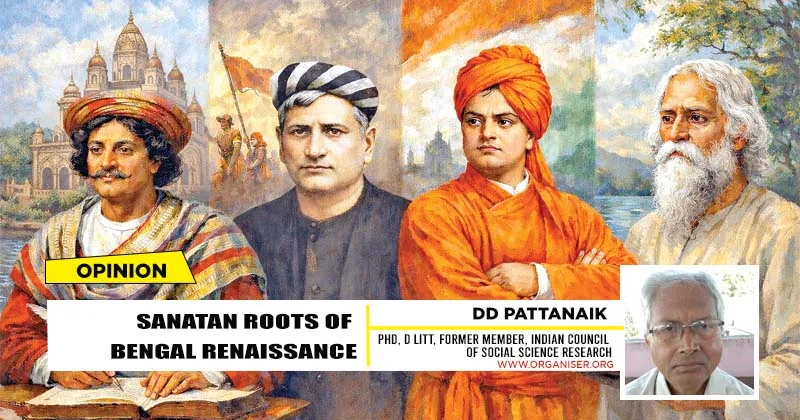
Raja Ram Mohan Roy is obviously torchbearer of Bharatiya renaissance. So much so that he struck the Hindu society that had crept with pernicious practices and rituals. But his reformatory measures exclusively covered the Hindu masses. The Hindus constituted the substratum of Bharatiya society.
However, introspection in 1860’s unfolded that the Brahmo movement was not enough. The nation needed some kind of direct approach to arouse Hindu masses. The outcome was foundation of Mitra Mela by Raj Narain Bose and Nabagopal Mitra in 1867; which was also known as ‘Hindu Mela’ and also ‘Swadeshi Mela’ The annual conclave in the month of ‘chaitra’ (April) continued till 1881.
Binding Sanatanis
In 1880 Tattvabodhini Patrika remorsefully admitted that internal differences of the Hindus were a matter of concern. It noticed, “Now a feeling of disunity among Hindus is predominant. There is a lack of unity among Bengalis, Utkalis, Punjabis and Maharashtrians, though they are all Hindus. They envy each other, and look askance at the different languages, manners; and jealous of another ‘jati’, are more or less the same, and the fact that they are disunited, is a major obstacle to the progress of the Bharatiya ‘jati’…..We must adopt certain ways to achieve ‘jatiya’ unity”.
Yet Prabodh Chandra Sen, another figure of the same time explored, “Bharat was under Muslim rule for five hundred years. But jatiya dharma, language and samajik codes are not eroded”.
Rajani Kanta Gupta’s Arya Kirti (1896) underscored linkages between Bengali and Arya textbooks and in articles in the periodicals Arya Darshan (1873) and Nabhya Bharat he fostered Bharatiya (Hindu) unity.
Vipin Chandra Pal was the most consistent theoretician of Bharatiya nationalism. He founded the English monthly Hindu Review. In a work entitled Sri Krishna, he made a vivid explanation on Bharatiya culture and unity
Bhudev Mukhopadhyay could be quoted, “History reveals that there has been a lot of jatiya disunity aiming the Hindus, which has led to a segregative spirit and political subjugation, and lack of independence……but it must be emphasised that there are some overarching similarities to samajik customs and norms all over Bharat”.
Bankim Chandra Chattopadhya contemplated Bharat Mata as ‘Jagaddhatri’, ‘Kali’ and ‘Durga’ corresponding to the glorious past, devastating present and resurgent future of Bharat. He composed Vande Mataram wherein he sang Twam hi Durga Dasha Praharana Dharini……Bimala Kamala Vidyadayini. He scripted the novel Anand Math (1882) inspired by the ‘Sanyasi’ rebellion of Bengal in 1773 against the atrocities of Nawab of Bengal. Further, Bankim Chandra Chattopadhya in his Krishna Charita sketched Bhagwan Krishna as a nation-builder. He synthesised Rashtra and Dharma in proper perspective. Swami Vivekananda stirred the nation in 1893 in his Chicago address. His sum-total was to arouse the Hindus and reshape the Hindu nation with self-pride. He maintained that the union of the Bharatiya nation was evident from one common ancestral civilisation and common love and hate; and he had a well founded basis to conclude that Hindu is Bharat and Bharat is Hindu. “We are Hindus”, he thundered, and asked to take pride in it. “I do not use the word ‘Hindus’ in any loose sense at all…..if at present the word (Hindu) means anything bad, never mind, that this is the highest word that any language has invented:. He probed that in Bharat the soul was laying in Hinduness. He categorically stated that “our national life is in religion (Hinduism). It is the soul”. Tara Chand comments that Vivekananda not only defended Hindu faith, but carried the battle into the camp of those who held aloft of Western predominance. R. C. Dutt wrote A Brief History of Ancient and Modern Bengal where he mentioned, “….I have considered it necessary to narrate these facts of the Hindu period in five chapters in order that some recollections of them may live in the moods of educated Hindu long after they have ceased to be students.” He translated Rig Veda into Bangla in 1885, Mahabharat in 1889 and Ramayan in 1896 to this end.
Vipin Chandra Pal was the most consistent theoretician of Bharatiya nationalism. He founded the English monthly Hindu Review. In a work entitled Sri Krishna, he made a vivid explanation on Bharatiya culture and unity. In his patriotic writing in English, he frequently employed the expression Hindu Rashtra. He wrote invariably “…..This Mother is the spirit of Bharat”. In his write up The Cult of Patriotism he wrote , “…..this is our organised worship……this is the ‘ism’ of the Hindus”. Aurobindo Ghosh was the intellectual heir of Swami Vivekananda. His Uttarpara speech on May 30, 1909, after one year of his incarceration in Alipore jail, is compared with the Chicago Lecture of Swami Vivekananda. In this speech, he revealed that Sri Krishna gave him an audience (darshan) in jail. He stated, “God can be realised in the nation”. To him, “Nationalism cannot die, because it is no human thing, it is God who is working in Bengal (in the context of the Swadeshi Movement). God cannot be killed, God cannot be sent to jail…..God functioning in the form of a nation”.
Bose was struck by the fact that believers in Christianity and Islam have built empires and converted large numbers of that faith. So he envisaged a plan for spreading Hinduism in Africa as one part of making Bharat a great nation again
In his Uttarpara speech, Aurobindo reaffirmed, “I say no longer that nationalism is a creed, a religion of faith; I say it is Sanatan Dharma which for us is nationalism. This Hindu nation was born with Sanatan Dharma; with it, it moves, with it, it grows. When Sanatan Dharma declines, this nation declines. With Sanatan Dharma it would perish…… The Sanatan Dharma that is nationalism”. As a believer of ‘Shakti’ cult, he adorned ‘Bharat varsh’ from this perspective.
Evoking Nationalism
Rabindra Nath Tagore started Raksha Bandhan during the Swadeshi Movement. He composed Swadeshi songs replete with nationalism of the kind of metaphysical imperative. He evoked, “Devi! Bhubana Mohini!” sketching Bharat Mata as the enchanting Goddess. Along with Aurobindo, he spread Shivaji Mahotsav in Bengal. Apart from following the Ganapati Festival of Lokmanya Tilak, he along with Debendra Nath Tagore started Kali Puja in Bengal to evoke nationalism. He was Rabindra Nath who for the first time sang Vande Mataram in the Annual session of the Congress at Calcutta in 1896 and continued so. He inaugurated Visva Bharati (University ) at Shantiniketan on the day of Saraswati Puja in 1916 reciting Vedic hymns. The Swadeshi Movement was the cumulative effect of cultural nationalism pursued in the nineteenth century renaissance. The anti-Partition Bengal
Movement turned into a nation-wide Swadeshi Movement employing Hindu symbols and idioms. Fifty thousand Satyagrahis, after taking holy bath in river Ganges, stood before the Kali Ghat Mandir holding tulsi plant on hand, took Swadeshi vow witnessing Mahadev. Vande Mataram became a slogan for the first time in the Town Hall meeting of August 7, 1905. The martyrs stepped over the gallows shouting Vande Mataran holding Bhagwat Geeta in hand. The martyrdom of eighteen-year-old Khudiram Bose at Midnapore Jail on August 1, 1908, stirred the entire nation. Subhas Chandra Bose hastened to uphold Advaita Vedanta and subscribed to ‘Shaktism’ – the Mother-cult. In a letter to his mother in early age he regretted: “Mother, How holy and eternal the Hindu religion was and how degraded our religion is now! Think of the Aryans who hallowed this earth by their presence and look at their fallen descendants. Is the eternal faith going to be extinct ? Look how atheism, lack of faith and bigotry have become rampant ……Mother Durga be with us”. (An Indian Pilgrim; Unfinished Autobiography). In another letter to Hemanta Sarkar, Bose regretted that “the Aryan blood no longer flows in our veins. Slavery of ages – much of adulteration …….The Hindu race no longer has that pristine freshness, that youthful vigour and unmatched human qualities……”. He asked the people to uphold inherent Bharatiya culture and not be swayed with the Western paradigm.
Bose was struck by the fact that believers in Christianity and Islam have built empires and converted large numbers of that faith. So he envisaged a plan for spreading Hinduism in Africa as one part of making Bharat a great nation again.
NR Roy summarises, “……the quest for self-identity and self-assertion had led the Hindus from the days of Ram Mohan Roy to the discovery of the Indian cultural tradition since then and the lead in this direction taken by them, their common arena of knowledge was, by and large, confined to India’s ancient and classical point India’s natural tradition and culture of the Hindus all but exclusively. There was identification of Hinduism and the nation……the urge for nationalism was confined at this stage almost exclusively to the Hindus, and the inherent national awareness was limited to the Hindu consciousness”.
The sum-total of the Bengal renaissance categorically unfolded Hindu identity of Bharat, and rightfully it took the lead of the nation in this perspective.