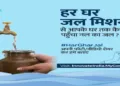
Since August 2019, the Government of India, in partnership with States and Union Territories, has been implementing the Jal Jeevan Mission with the objective of providing potable tap water to every rural household. The mission aims to ensure a service level of 55 litres per capita per day of prescribed quality as per BIS 10500 standards, delivered on a regular and long-term basis.
The mission represents a paradigm shift in rural water governance by moving from habitation-based coverage to household-level tap connectivity. The vision of Har Ghar Nal Se Jal underscores the commitment to ensure that every rural family receives assured drinking water directly at home, thereby reducing drudgery, improving health outcomes and enhancing quality of life.
At the time of the mission’s launch, only 3.23 crore rural households, representing 17 percent of total rural households, had tap water connections. As per data reported by States and Union Territories as on 10 February 2026, around 12.56 crore additional rural households have been provided tap water connections under the mission.
Out of a total of 19.36 crore rural households across approximately 5.86 lakh villages in the country, around 15.69 crore households, accounting for 81.02 percent coverage, now have tap water supply in their homes. These connections are spread across nearly 5.82 lakh villages.
Importantly, more than 2.72 lakh villages have reported 100 percent tap water coverage and have been declared as Har Ghar Jal villages. This milestone reflects saturation-level implementation in a substantial portion of rural India.
State and Union Territory-wise details of coverage are available in the public domain through the JJM Integrated Management Information System portal.
Federal Framework and Shared Responsibility
Drinking water is a State subject under the Constitution. Under the Jal Jeevan Mission, responsibilities related to planning, approval, implementation, operation and maintenance of drinking water supply schemes lie primarily with State and Union Territory governments.
The Government of India plays a supportive role by providing financial and technical assistance, facilitating coordination, offering policy guidance and ensuring monitoring mechanisms are in place. This cooperative federal approach has enabled large-scale expansion of rural water supply infrastructure within a relatively short time span.
The Minister of State for Jal Shakti, Shri V. Somanna, provided these details in a written reply in the Lok Sabha on 12 February 2026.
Financial Progress and Expenditure Trends
The financial commitment under the Jal Jeevan Mission reflects the scale and urgency of the programme. From 2019-20 to 2025-26, the approved central outlay stood at Rs 2,30,705.66 crore, with total utilization restricted to the approved central outlay of Rs 2,08,652 crore.
Between 2019-20 and 2025-26, total fund utilization against allocation reached Rs 2,08,627.76 crore. The combined expenditure by Centre and States during this period amounted to Rs 4,19,470.61 crore.
The yearly trend demonstrates rapid scaling up. In 2019-20, total expenditure stood at Rs 10,074.28 crore. This rose sharply to Rs 20,449.96 crore in 2020-21 and further to Rs 43,551.85 crore in 2021-22. By 2022-23, total expenditure had reached Rs 90,815.55 crore, while 2023-24 saw a substantial rise to Rs 1,51,518.65 crore.
The continued allocation and utilization of funds underscore sustained political and administrative commitment to universal rural drinking water coverage. Financial progress data is publicly accessible through the JJM financial reports portal, enhancing transparency and accountability.
Institutional Strengthening and Monitoring Mechanisms
To ensure effective implementation across diverse geographies, a series of structured interventions have been undertaken. These include joint discussions with States and Union Territories for finalization of saturation plans and annual action plans, regular implementation reviews, capacity-building workshops, webinars and conferences for knowledge sharing.
Field visits by multi-disciplinary technical teams have been conducted to provide on-ground support. Comprehensive operational guidelines have been issued for implementation. A Margdarshika for Gram Panchayats and Village Water and Sanitation Committees has been developed to strengthen grassroots participation and ensure safe drinking water delivery.
Special campaign guidelines have also been shared to ensure piped water supply in Anganwadi centres, Ashramshalas and schools. These steps aim to institutionalise community ownership and promote long-term sustainability of water infrastructure.
Digital monitoring systems have been put in place through the JJM Integrated Management Information System and JJM Dashboard. Transparent online financial management is ensured through the Public Financial Management System. These digital tools allow real-time tracking of physical and financial progress.
Urban Water Supply Reforms: AMRUT and AMRUT 2.0
While the Jal Jeevan Mission focuses on rural households, the urban water supply landscape is being strengthened through the Atal Mission for Rejuvenation and Urban Transformation and AMRUT 2.0.
Launched on 25 June 2015, AMRUT covered 500 cities, including 485 cities and 15 merged cities across States and Union Territories. The mission focused on water supply, sewerage and septage management, storm water drainage, green spaces and non-motorized urban transport.
Under AMRUT, 1,403 water supply projects worth Rs 43,359.6 crore have been grounded. A total water treatment plant capacity of 6,140 million litres per day was approved, of which 5,330 million litres per day has been developed. Additionally, 73,520 kilometres of water supply pipeline network has been laid or replaced.
AMRUT 2.0, launched on 1 October 2021, extends coverage to all Urban Local Bodies and cities, aiming to make them self-reliant and water secure. Universal coverage of sewerage and septage management in 500 AMRUT cities is a key focus area. Rejuvenation of water bodies and development of green spaces and parks are also central components.
So far, 3,528 water supply projects worth Rs 1,19,636.49 crore have been approved under AMRUT 2.0. These projects cover 11,393 million litres per day of water treatment plant capacity and approximately 1.26 lakh kilometres of water supply network.
States and Union Territories are empowered to select, appraise, propose and implement projects under AMRUT and AMRUT 2.0. Funds are allocated and released to States and Union Territories rather than sector-wise. Under AMRUT and AMRUT 2.0, and in convergence with States, 238 lakh household tap connections have been provided so far.
Towards Universal Water Security
The scale of implementation under the Jal Jeevan Mission reflects one of the most ambitious rural infrastructure programmes undertaken in recent years. The transition from 17 percent coverage in 2019 to over 81 percent in early 2026 signifies a transformative shift in rural living standards.
Beyond infrastructure creation, the mission emphasises quality standards, sustainability of sources, community participation and institutional accountability. The integration of digital monitoring tools and financial transparency mechanisms further strengthens governance architecture.
With more than 2.72 lakh villages achieving full tap water coverage and millions of households newly connected, the vision of Har Ghar Nal Se Jal is steadily becoming a reality. The combined push across rural and urban missions signals a comprehensive national strategy aimed at ensuring safe, reliable and equitable access to drinking water for all citizens.