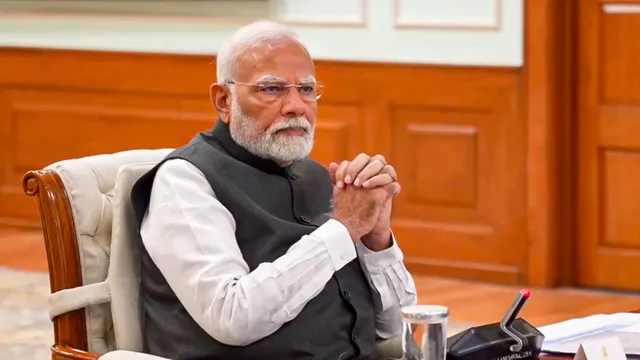
Prime Minister Narendra Modi will formally shift the Prime Minister’s Office (PMO) from the South Block on Raisina Hill to a newly constructed complex named ‘Seva Teerth’ on February 13, 2026, marking the first relocation of the PMO since Independence in 1947. The move brings to a close nearly 80 years of the Prime Minister’s Secretariat functioning from the British-era Secretariat building designed by architects Edwin Lutyens and Herbert Baker, constructed as part of New Delhi’s imperial capital project and inaugurated in 1931. With this transition, the government signals what it describes as both a structural modernisation of India’s administrative infrastructure and a symbolic step toward shedding colonial-era representations embedded in governance architecture.
The name ‘Seva Teerth’, meaning “a sacred place of service,” reflects the government’s stated philosophy of citizen-centric governance. Officials describe the new complex as an embodiment of “Kartavya” (duty) and “Seva” (service), aligning administrative functioning with contemporary aspirations of efficiency, technology integration, and national self-confidence. The Prime Minister is scheduled to unveil the name at around 1:30 pm and later inaugurate the building complex along with Kartavya Bhavan-1 and Kartavya Bhavan-2, before addressing a public gathering at the site in the evening.
For decades, the Prime Minister’s Office operated from South Block, a sandstone structure that became synonymous with executive authority in independent India. When India attained freedom on August 15, 1947, the Prime Minister’s Secretariat began functioning from South Block. The country’s first Prime Minister, Jawaharlal Nehru, worked from these chambers, followed by successive Prime Ministers including Lal Bahadur Shastri, Indira Gandhi, Atal Bihari Vajpayee, Manmohan Singh, and Narendra Modi. In 1977, during the Janata Party government, the Prime Minister’s Secretariat was officially renamed the Prime Minister’s Office (PMO). Despite expansion in administrative responsibilities and growth in bureaucratic machinery over the decades, the physical address remained unchanged.
Before Independence, the building formed part of the British colonial administrative apparatus. The Viceroy and Governor-General operated from what is now Rashtrapati Bhavan, while the Secretariat buildings housed key imperial departments. The very design of Raisina Hill symbolised imperial authority and administrative centralisation under British rule. Although these buildings became institutions of sovereign India after 1947, their architecture and layout continued to reflect colonial-era planning principles, characterised by long corridors, compartmentalised offices, and hierarchical spatial arrangements.
The shift to Seva Teerth is being positioned as part of the broader Central Vista Redevelopment Project, an ambitious overhaul of India’s central administrative district. The project has already seen the construction of the new Parliament building and the redesign of Rajpath into Kartavya Path. It also includes the development of the Common Central Secretariat (Kartavya Bhavan) complexes to consolidate ministries previously scattered across ageing structures, and the proposed conversion of North and South Block into museums.
Seva Teerth itself is conceived as a modern, integrated executive enclave designed to streamline governance. The complex comprises three main buildings. Seva Teerth-1 will house the Prime Minister’s Office, featuring open-plan workspaces, advanced meeting rooms, secure communication facilities, and ceremonial halls. Seva Teerth-2 accommodates the Cabinet Secretariat and is already operational. Seva Teerth-3 will house the National Security Council Secretariat and the Office of the National Security Advisor, centralising strategic decision-making units within close proximity.
One of the notable additions to the complex is ‘India House’, a state-of-the-art conference facility intended to host international delegations, high-level diplomatic engagements, and strategic discussions. Previously, the PMO’s location in South Block did not offer a dedicated modern facility of this scale for global engagements. The inclusion of India House is seen as aligning the executive workspace with India’s expanding diplomatic and geopolitical footprint.
Officials have emphasised that Seva Teerth addresses longstanding administrative inefficiencies. For years, ministries and key offices functioned from fragmented and ageing infrastructure spread across the Central Vista area. This dispersion reportedly created coordination challenges, higher maintenance costs, and logistical constraints. By consolidating executive functions within a technologically advanced, purpose-built environment, the government argues that decision-making processes will become faster and more collaborative.
Unlike the closed cabins and segmented corridors of South Block, Seva Teerth features open interiors aimed at promoting teamwork and real-time coordination. It incorporates encrypted communication systems, advanced surveillance mechanisms, smart access controls, and integrated digital infrastructure to enhance both efficiency and security. The building has been designed according to 4-Star GRIHA sustainability standards, incorporating renewable energy systems, water conservation technologies, waste management solutions, and high-performance building envelopes to reduce environmental impact.
Strategically located near Raisina Hill, Seva Teerth remains within the symbolic heart of India’s administrative capital while representing a physical and conceptual redesign. The government has framed the move as part of an effort to align physical infrastructure with the aspirations of a “New India,” distancing itself from colonial symbolism and reinforcing indigenous narratives of governance.
The transition also carries symbolic weight. South Block has long been considered the nerve centre of India’s executive power. Its red sandstone facade and imposing colonial geometry represented authority for generations. Many have often argued that such spaces were originally designed to reflect imperial dominance rather than democratic participation. By relocating the PMO, the government seeks to mark a psychological shift, from governance structures inherited from colonial rule to facilities conceptualised and built in independent India.
At the same time, the move shows the broader political messaging around decolonisation of public spaces. Over recent years, several landmarks and avenues in Delhi have been renamed to shed colonial-era references. Rajpath was renamed Kartavya Path, and statues and symbols associated with British imperial rule have been replaced or recontextualised. The relocation of the PMO extends this symbolic repositioning into the core of executive administration.
While supporters describe Seva Teerth as a modern, efficient and secure administrative hub befitting India’s global stature, the Central Vista project has also attracted debate and criticism from sections of the opposition and civil society. Concerns have ranged from financial costs to heritage preservation. However, the government maintains that the long-term benefits in terms of operational efficiency, sustainability, and national symbolism outweigh the criticisms.
As PM Modi prepares to move into Seva Teerth, the transition marks a defining administrative moment. After nearly 80 years in South Block, India’s Prime Minister will now operate from a facility designed in post-independence India, underlining what the government calls a shift from colonial-era governance infrastructure to a service-oriented, technologically advanced executive ecosystem.
The move is both practical and symbolic: practical in consolidating administrative functions and modernising workspaces; symbolic in signalling a departure from the architectural imprint of empire toward what is projected as a self-confident, sovereign and service-driven republic. Whether viewed as infrastructural reform, ideological repositioning, or both, Seva Teerth is poised to become the new nerve centre of India’s executive authority.