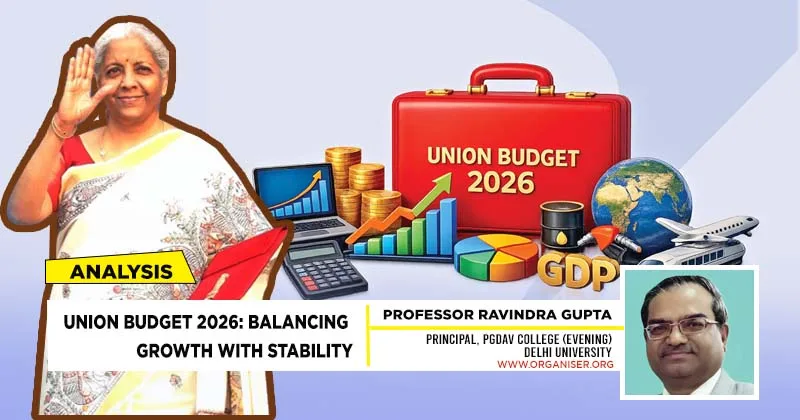
The much anticipated Union Budget presented by Union Finance Minister Nirmala Sitharaman on February 1, 2026, is not merely an annual ritual but carries underlying messages. By no means, it is a routine or ordinary Budget, though some might take it to be so if looked at superficially in a flimsy manner. In fact, it is one of the many sincere steps taken by the Government from time to time towards achieving a long-term goal: to make Bharat a developed country by 2047.
What is a developed country? How do we define it? According to current international standards, per capita income, standard of living of the average citizen, infrastructure development, unemployment rate, foreign trade balance, level of education, research orientation and facilities, self-reliance in most of the sectors etc are some of the parameters that define a country’s state of development.
Realistic Goal
We have to meet these global standards. It’s not that we are far behind. Concretised attempts in planned, systematic and structured manner in this direction are already in shape and reflections thereof have also started to be visible. This is why the goal of a Viksit Bharat, which seemed to be almost impossible to achieve before 2014, is now being perceived as realistic and achievable. This change in perception in itself is a significant achievement.
Budget is a quantum stride through an ideal conglomeration of provisions towards the mission of Viksit Bharat 2047. comprehensiveness, foresightedness and balanced approach. It stands for
We must view the current Budget against this backdrop. Only then will even critics understand that the path to a Viksit Bharat route is not via popular Budgets but through concrete, effective fiscal discipline, financial management and the implementation of fiscal measures with integrity.
Measures Envisaged in Budget
The most important among these is the reduction in fiscal deficit. It has been reduced to 4.3 per cent of Gross Domestic Product (GDP), down from 4.4 per cent in 2025-26. In the previous year 2024-25, the deficit was 4.8 per cent. The intent to consistently reduce the fiscal deficit over the years indicates the Government’s resolve to cut down Government expenditure and narrow the gap between Government revenue and Government expenditure. It paves the way to the sustainable development of the country.
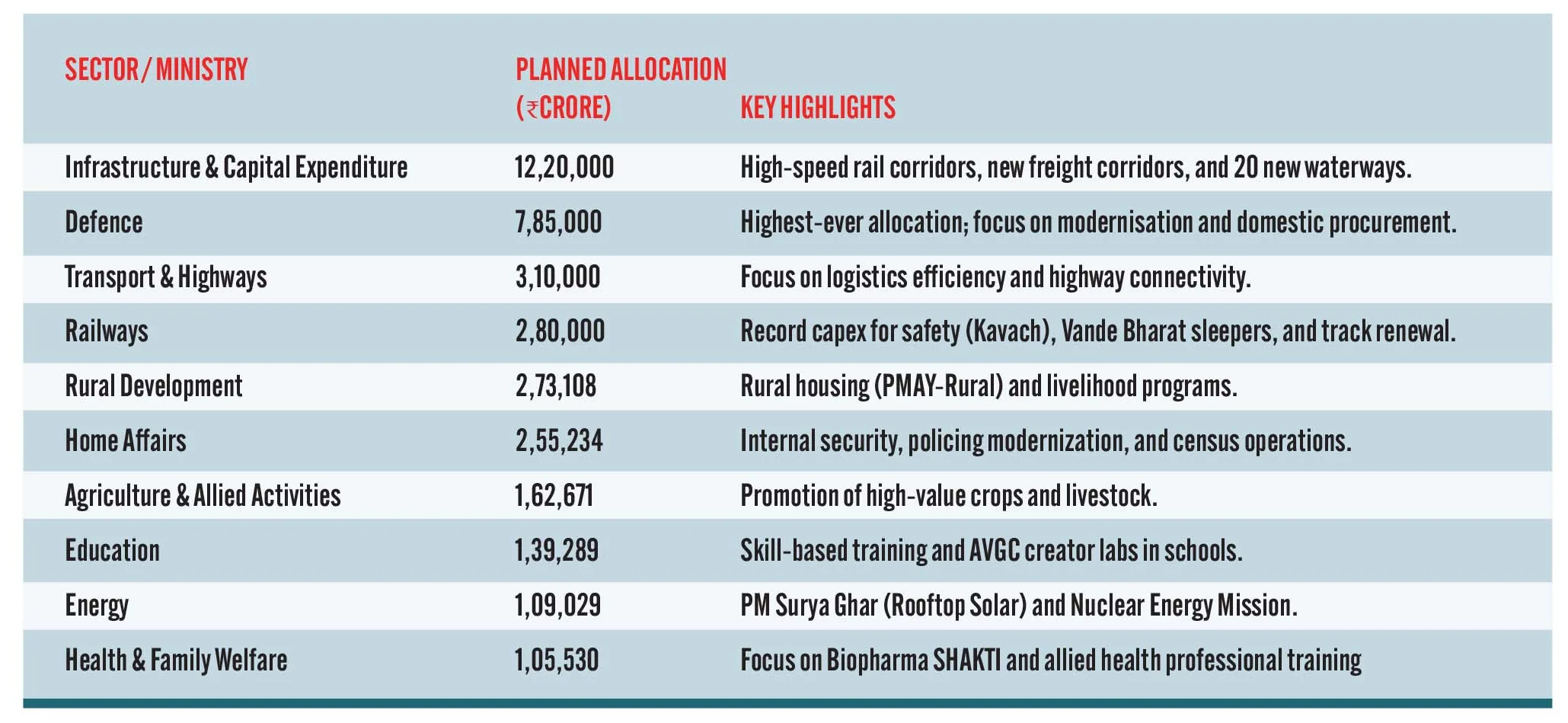
Another significant measure is the proposed Capital Expenditure (Capex) target of Rs 12.2 lakh crore for 2026-27. This is not only 11 per cent higher than last year but also the highest allocation in the last 10 years. It represents 4.4 per cent of India’s GDP – the highest percentage in any of the previous years. What does it mean? It means increased Government spending on infrastructure, including roads, railways, defence, ports, urban development, etc. This boosts all sectors and consequently all economic activities. Numerous new employment opportunities are created. Acting as a catalyst, it will trigger a chain reaction in the economy. To this end, the Budget has announced several schemes, such as 7 high-speed rail corridors, dedicated freight corridors etc. Considering the financial risks involved in infrastructure investments by private developers, there is also a provision for an Infrastructure Risk Guarantee Fund. In total, effective measures have been taken to attract adequate investments required for infrastructure development. This will yield positive results in the long run. Yet another significant measure is towards acquiring self-reliance in technology. Semiconductors are the heart of new technology. Currently, we largely rely on foreign countries for their supply. ThisBudget has effective provisions so that Bharat may leap upwards to be ranked among one of the top four countries in the world in this field. Semiconductor Mission 2.0 has been announced, with an allocation of Rs 40,000 crore. The related Electronic Manufacturing Scheme has also been proposed with additional financial support.
Building Rare Earth Corridors
The importance of rare earths is often overlooked in the ever-changing dynamics of the world economies. They are widely used in sectors such as electronics and renewable energy. However, our dependence on foreign supplies for these is still high. Budget allocations have been made to build rare earth corridors in four mineral rich States – Odisha, Kerala, Andhra Pradesh, and Tamil Nadu.
Artificial Intelligence (AI) is being discussed in every field. It is bound to play a crucial role in the future governance of the entire economy. To promote this, the Budget announced the AI Mission and the National Quantum Mission. A multilingual AI tool called Bharat Vistar aims to make AI accessible to the general public. The access of benefits of AI technology to farmers and specially-abled individuals has been ensured through the AI-based Agri Stock Portal and 3D technologies.
An effective implementation of all these schemes requires skilled and trained youth. The Budget proposes the formation of a high-level committee, “Education to Employment and Enterprise” for skill and capacity building. The education sector’s Budget has also been significantly increased after prolonged years of waiting. It represents 2.6 per cent of the total Budget. The Ministry of Education ranks sixth among all ministries in budget allocation, which is a positive and welcome sign.
Another crucial aspect of this Budget, which has rarely been discussed in Budget analyses, is its diplomatic aspect. The international relations with foreign countries are broadly governed by the foreign policy of the country. The Budget is the least used tool when it comes to diplomacy. However, addressing the current political relations with some of the countries, economic relations have also been redefined and reestablished through this budget. It has been used as an economic policy or weapon, a welcome and diplomatically correct step to safeguard national interests in the international arena.
Bangladesh’s anti-Bharat and anti-minority stance remains unabated despite Bharat’s numerous warnings and strong statements. In this Budget, its aid has been reduced by 50 per cent to ₹600 million. Maldives, which has been at loggerheads with Bharat over military deployments, has also faced an 8 per cent reduction in aid to Rs 500 million. Similarly, Myanmar’s aid has been reduced by 14 per cent compared to last year, to Rs 300 million. Support for Iran’s Chabahar Port, a crucial global political hub, has been completely eliminated. This can also be viewed and analysed in the context of India’s current economic and political relations with Iran and the United States.
Among friendly countries, Nepal’s allocation has been increased by 14 per cent to Rs 800 million, while Sri Lanka has received Rs 400 million, a one-third increase from last year. Bhutan is the largest recipient of Indian economic aid, receiving Rs 2,289 million. Nepal and Bhutan share borders with China and hence have tactical and strategic importance for India. Granting grants to them is to be understood in this context. Assessing Afghanistan’s geopolitical situation, only Rs 150 crore has been allocated, leaving no change in its grant.
Thus, the current Budget is a striking example of how a Budget, which generally is assumed to be a financial statement, can be utilised effectively to gain national interests while dealing with neighbouring and other countries in the international scenario.
Finally, one who glances at this Budget in terms of tax rates, tax slabs, direct taxes, standard deductions, etc only is grossly mistaken. It is more than that. Budget is a quantum stride through an ideal conglomeration of provisions towards the mission of Viksit Bharat 2047. Anybody who can sense it will definitely be full of appreciation for its comprehensiveness, foresightedness and balanced approach.