When Bharat’s most eminent writers, thinkers, orators and literary figures walked into the Raipur Sahitya Utsav for their sessions, most of them paused not to adjust their notes, but to take in the space around. What unfolded before them was perhaps very different from what one instinctively associates with a government-supported literary event, an enclosed auditorium, regimented rows, crowds ferried in buses to fill seats. Instead, they encountered colour, openness, and a quiet confidence rooted in the soil of Chhattisgarh itself.
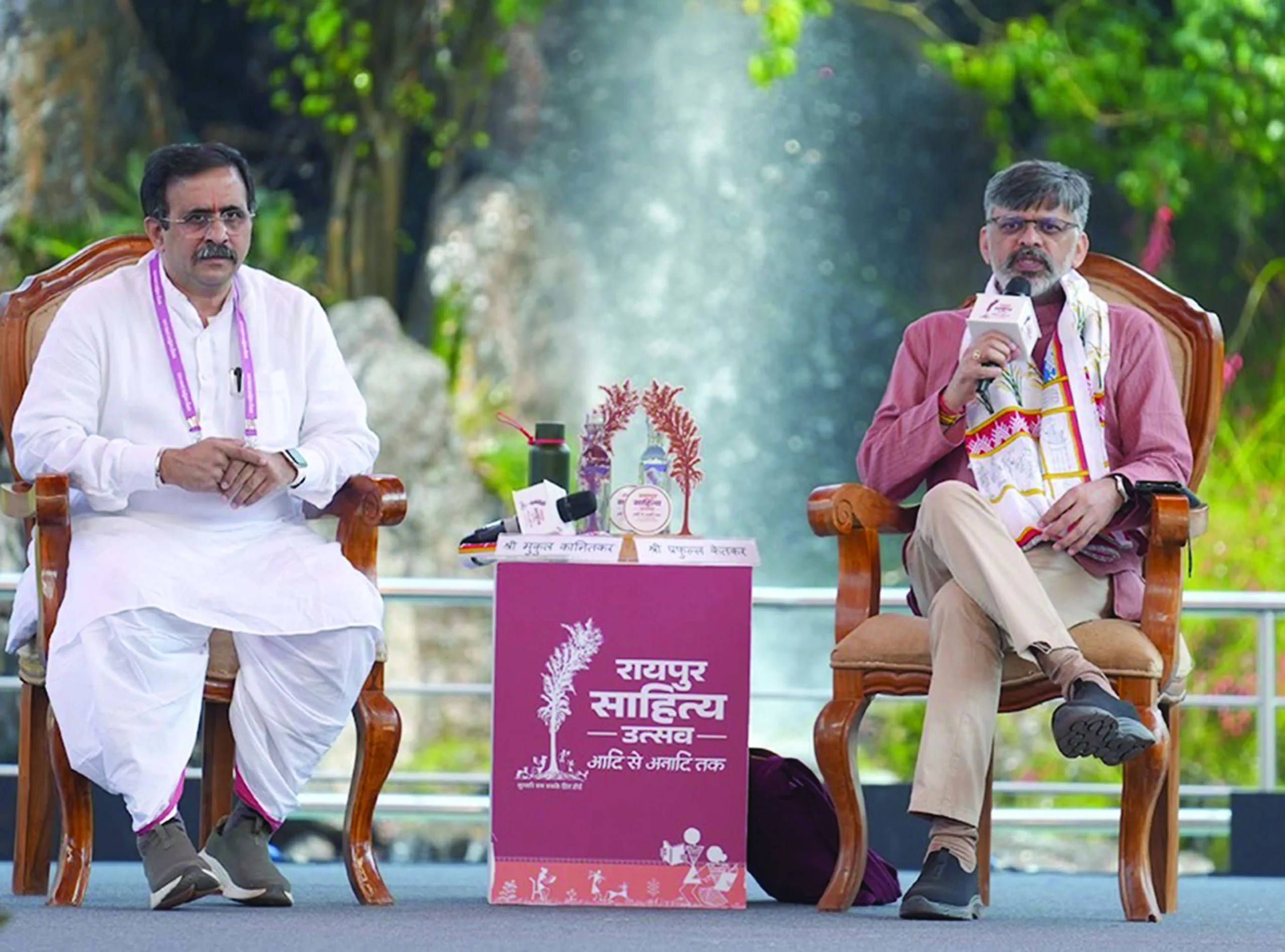
The moment became almost disarming as soon as they had an encounter with the central Mandap. Behind the stage flowed a real, living waterfall, not an LED illusion, not a looping video graphic, but water in motion, indifferent to applause or cameras. Even now, those who did not witness it firsthand struggle to believe that the backdrop was real. Without exaggeration, despite attending numerous national and international events, they had rarely seen a stage so quietly radical. In an age obsessed with digital spectacle and programmable backdrops, the organisers chose nature over novelty. It was almost anti modern in its confidence much like Chhattisgarh itself, a land rich not only in natural resources but in the instinct to let authenticity speak for itself.
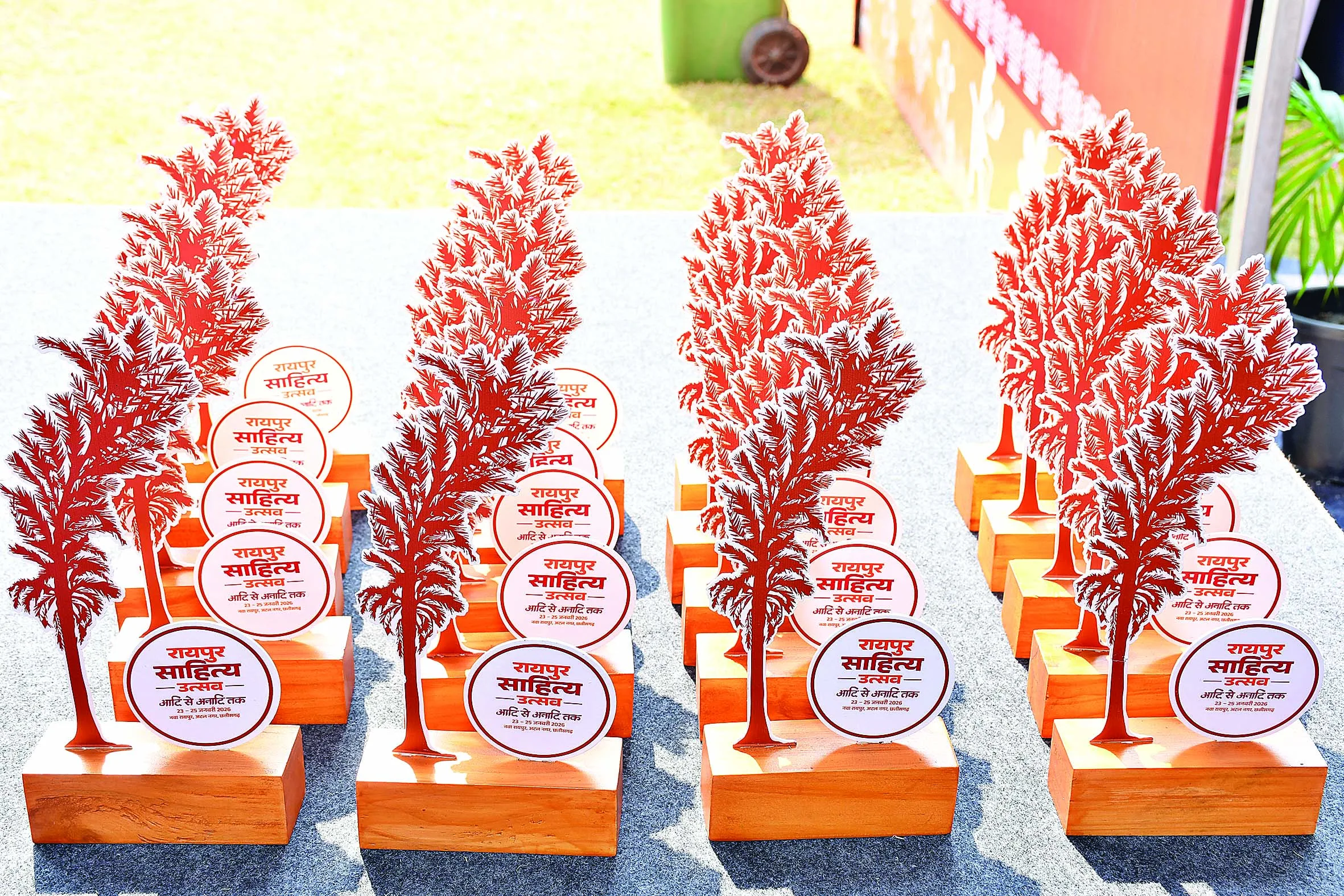
Each and every space was like a “Selfie Point” for the visitors. Spread across thoughtfully curated mandaps named after Chhattisgarh’s literary icons. These were not ornamental add-ons but carefully imagined cultural spaces. The entryways were picturesque, almost conversational, and the decor crafted largely by local artisans carried the warmth of tradition rather than the sterility of event management templates.
The venue had to be colourful, almost as an act of quiet resistance. For far too long, Chhattisgarh has been reduced to a single colour in the national imagination — Red. A “Red State,” weighed down by phrases like “Affected with Left Wing Extremism” or “Red Terror.” Chhattisgarh has carried that burden for long. People here have been asked difficult questions by well-meaning but uninformed people who had never set foot here, some genuinely surprised to learn that the state had more than one airport, others casually wondering how the residents of the state manage to live amidst “insurgency.” Each such question chipped away at something deeper. Not because they were hostile, but because they erased lived realities. They diminished an entire state, and, in the process, those who were born, raised, educated, and rooted here.
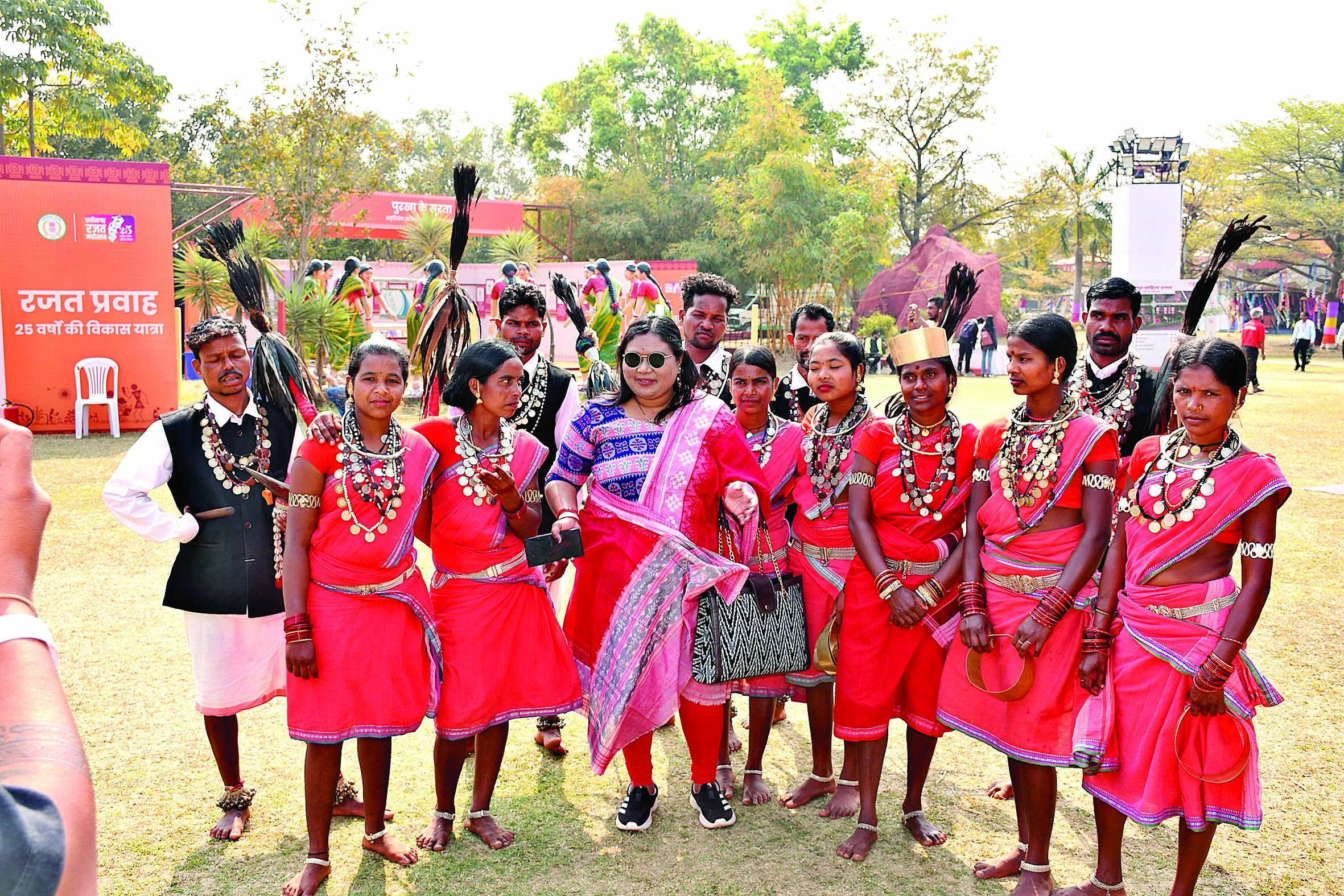
The state often felt the need to explain itself. That is why this festival mattered. Chhattisgarh exists today because of the political vision of Shri Atal Bihari Vajpayee, but it thrives because of its people, its forests, rivers, artisans, writers, and quiet ambitions. It is a land of possibilities that defies labels, a state that continues to surprise those willing to look beyond headlines. Perhaps that is why, the tourism department’s line rings truer than most slogans, “Chhattisgarh, Full of Surprises.” The colours of the Raipur Sahitya Utsav were not decorative, they were declarative. For decades, Chhattisgarh’s national image remained trapped in a narrow frame, conflict headlines, ideological rigidity, and a sense of cultural invisibility. But between January 23 and 25, 2026, at Purkhouti Muktangan, Nava Raipur, something quietly yet decisively shifted and the venue transformed into an intellectual and cultural crossroads. The Raipur Sahitya Utsav 2026 did not merely host discussions, readings, and exhibitions, it rebranded the state of Chhattisgarh from a land perceived in monochrome red to a canvas of vibrant intellectual, artistic, and cultural diversity.
The festival’s stature was reinforced by the presence of eminent personalities including Rajya Sabha Deputy Chairman Harivansh, Chief Minister Vishnu Deo Sai, Deputy Chief Minister Arun Sao, thinker Ram Madhav, scholar Kumud Sharma, actor Manoj Joshi, thinker Mukul Kanitkar, editor Prafulla Ketkar, journalist Dilip Mandal, and numerous scholars, artists, and writers from across Bharat. Their participation ensured that Chhattisgarh was not merely hosting an event, it was entering national intellectual conversations as a contributor.
The Rewriting of Narratives
Raipur Sahitya Utsav emerged as a festival that rewrote the narrative. Chhattisgarh is no longer just a subject of debate, it is a generator of ideas. With over 120 writers, thinkers, journalists, artists, filmmakers, and scholars participating in 42 sessions, the festival emerged as one of Bharat’s most comprehensive cultural congregations. What made the event stand apart was not scale alone, but its ideological openness. From discussions on digital-age readership, AI and creativity, Indian knowledge systems, and media ethics, to conversations on cinema, women’s voices, and grassroots narratives, the festival refused to be boxed into a single worldview. This plurality itself marked a departure from the state’s long-standing association with uniform political narratives.
The festival extended beyond literature. Art exhibitions dedicated to Chhattisgarh’s silver jubilee year showcased paintings like Chhattisgarhi Mahatari and Bastar Bazaar, while workshops in painting and cartooning encouraged young participation. Open-mic events drew youth crowds. Theatre performances, poetry recitals, and cultural presentations balanced national and regional expressions. Book stalls saw unexpected crowds, revealing a thriving reading culture often overlooked in discussions about smaller states. At one mandap, folk literature was being discussed; at another, tribal narratives inspired by works like Kala Padri, elsewhere, journalism and democracy were under scrutiny. This plurality itself marked the transition from uniformity to diversity. There was literature beyond awards and culture beyond slogans. One of the defining threads across sessions was a rejection of elitism. Speakers emphasised that the success of Bharatiya literature must be measured not by awards alone, but by readership, reach, and social impact. The idea that e-libraries, blogs, podcasts, and social media can democratise literature resonated strongly with young participants, students, and first time festival goers. Equally significant was the recognition that technology is no longer optional. Artificial Intelligence, digital publishing, OTT platforms, and new storytelling formats were discussed not as threats, but as tools that can amplify regional voices like Chhattisgarh’s rather than silence them.
Enlightening Candid Sessions
While the open discussions around media, democracy, and the courage to self-reflect added fuel to the ongoing debates and discussions other than the on-stage panel discussions, the sessions on national media debates were among the most candid. Senior journalists acknowledged uncomfortable truths, commercial pressures, advertiser influence, and shrinking editorial independence while simultaneously asserting that media’s moral centre must remain with the last person in society. Such introspection, hosted openly on a state-supported cultural platform, sent a powerful message. Chhattisgarh is confident enough to host critique, not just celebration.
Thinker and RSS functionary Mukul Kanitkar traced the journey of the Rashtriya Swayamsevak Sangh as a social and cultural movement rooted in nation-building rather than politics. Reflecting on themes ranging from the Kumbh tradition and the idea of Hindutva to constitutional values, he emphasised that the spirit of service and social cohesion has been central to the organisation’s ethos for a century.
Ram Madhav emphasised that literature reflects society’s creative consciousness and argued for reclaiming civilisational confidence. Discussions ranged from colonial education policies to Bharat’s global intellectual role, linking ancient traditions with modern technological aspirations. Parallel sessions examined themes from the Upanishads to Artificial Intelligence, highlighting how traditional wisdom and contemporary technology can coexist rather than conflict.
Sessions featuring Organiser Editor Prafulla Ketkar explored Bharatiya knowledge traditions. Instead of viewing Bharat through Western intellectual lenses.Speakers argued for evaluating education, economy, and health through indigenous frameworks. This synthesis of ancient wisdom and modern innovation echoed repeatedly as Bharat’s true soft power and Chhattisgarh emerged as a credible laboratory for that synthesis.
Sessions on new-age cinema highlighted another shift, storytelling is no longer hostage to big studios or metropolitan approval. With OTT platforms, digital tools, and social media, regional stories from Chhattisgarh now have national and global pathways. The insistence that sensitivity and strong storytelling remain cinema’s soul grounded technological optimism in cultural responsibility. Actor-writer Satyajeet Dubey stressed that strong storytelling remains cinema’s soul despite changing trends. Chhattisgarhi film actor and legislator Anuj Sharma described how digital technologies and social media have democratised opportunities for new talent. Actor TJ Bhanu spoke about OTT platforms enabling diverse storytelling.
A state once called as a “Red Corridor” laid “Red Carpet” for creative and literary minds across the country. The button for a brand reset for Chhattisgarh state was pressed during the event. Perhaps the most important outcome of Raipur Sahitya Utsav 2026 lies beyond its stages. Chhattisgarh is discovering its voice and inviting the country to listen. The festival repositioned Chhattisgarh as a thought leader, not just a policy subject. A cultural contributor, not a peripheral state and a plural, confident society, not an ideologically frozen one. This is a quiet but decisive brand reset from red uniformity to colourful diversity. As the festival concluded, the state has established that Chhattisgarh is no longer waiting to be defined by others. Through literature, art, debate, and dialogue, it has begun defining itself in its own many colours and one realisation remained: the colours seen at Purkhouti Muktangan were not temporary decorations. They symbolised a larger transition, from conflict narratives to creative confidence.